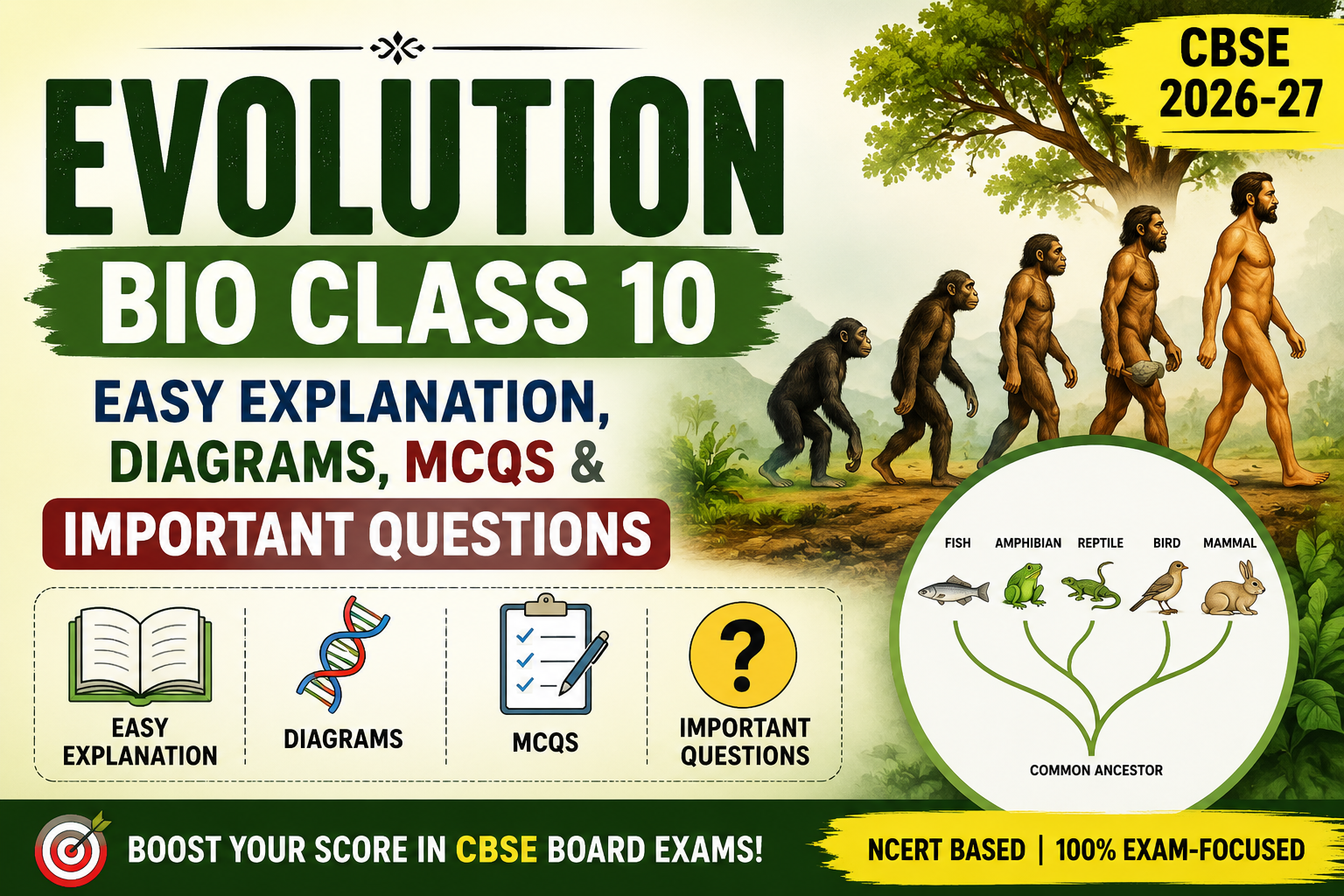
Evolution Bio Class 10 notes are designed to help CBSE students master every important concept, including Darwin’s theory, fossils, variation, speciation, and evolution through easy explanations, diagrams, and NCERT-based questions.
efore understanding heredity, it is important to know how living organisms are grouped. Read our detailed guide on Classification of Living Organisms Class 10 Biology.

The CBSE Syllabus 2023-24 now calls this chapter Chapter 8. This highlights evolution‘s role in 10th-grade biology.
Learning about evolution is vital. It helps us see how life has adapted and evolved over time. This shapes the diverse life we see today.
Key Takeaways of Evolution Bio Class 10
- Understanding evolution is key to grasping biological diversity.
- The CBSE syllabus now numbers this chapter as Chapter 8.
- Evolution explains the gradual development of complex life forms.
- It’s a vital part of the 10th-grade biology curriculum.
- Studying evolution provides insights into the adaptation of living organisms.
Definition and Scope of Evolutionary Biology: Evolution Bio Class 10
Evolutionary biology looks at how life on Earth has changed. It covers the origins of life, how species evolve, and what drives these changes. Genetics is key in understanding evolution, showing us how variations in populations happen.
The laws of inheritance by Gregor Johann Mendel are vital. They explain genetic variation. These laws, like the law of dominance and segregation, are the foundation of genetics and help us understand evolution.
Historical Development of Evolutionary Thought
The idea of evolution has been around for a long time. Scientists like Charles Darwin and Jean-Baptiste Lamarck made early contributions. Darwin’s theory of natural selection, in “On the Origin of Species,” changed evolutionary biology forever.
- Key milestones in the historical development of evolutionary thought include:
- The publication of Darwin’s “On the Origin of Species” in 1859
- The discovery of genetic principles by Gregor Mendel
- The modern synthesis of evolutionary theory, which integrated genetics, evolution, and other biological disciplines
Understanding Evolution Bio Class 10 helps students learn the scientific evidence behind the origin and gradual development of life on Earth.
Many scientists have shaped the history of evolutionary thought. Knowing this history helps us appreciate the complexity and depth of evolutionary biology.
Major Evolutionary Theories in Evolution Bio Class 10
The 10th-grade biology curriculum introduces students to several key evolutionary theories. These theories are fundamental to understanding the processes that drive evolutionary change.
The evidence discussed in Evolution Bio Class 10 includes fossils, homologous organs, analogous organs, embryological evidence, and molecular evidence.
Darwin’s Theory of Natural Selection
Charles Darwin’s theory is a major topic in Evolution Bio Class 10 and is frequently asked in CBSE board examinations.
Charles Darwin’s Theory of Natural Selection is a cornerstone of evolutionary biology. It proposes that species evolve over time through a process. Individuals with favorable traits are more likely to survive and reproduce, passing those traits to their offspring.
Natural selection is one of the most important concepts covered in Evolution Bio Class 10 because it explains how beneficial traits become more common over generations.
Key components of Darwin’s Theory include:
- Variation in populations
- Heritability of traits
- Adaptation to the environment
- Survival of the fittest

Lamarck’s Theory of Acquired Characteristics
Jean-Baptiste Lamarck proposed the Theory of Acquired Characteristics. It suggests that organisms can pass on characteristics they acquire during their lifetimes to their offspring. Though this theory has been largely discredited, it represents an early attempt to explain evolutionary processes.
Modern Synthetic Theory : Evolution Bio Class 10
The Modern Synthetic Theory of Evolution integrates genetics, evolution, and other fields. It provides a complete understanding of how evolution occurs. It emphasizes the role of genetic variation, mutation, and gene flow in the evolutionary process.
The main features of the Modern Synthetic Theory are:
- Genetic variation as the raw material for evolution
- The importance of mutation and gene flow
- Natural selection as a key driver of evolutionary change
Understanding these major evolutionary theories is key for students studying high school biology evolution units. These theories form the foundation of evolutionary biology resources for students. They provide insights into the complex processes that have shaped life on Earth.
Evolution Bio Class10: Evidence and Support
The theory of evolution is backed by many types of evidence from biology. This wide range of evidence helps us see how species have changed over time.
Paleontological Evidence: Fossils and Their Significance
Fossils are the remains or traces of ancient life, key to understanding evolution. Paleontology, the study of fossils, reveals the history of life on Earth.
- Fossils show a pattern of gradual changes in life forms over time.
- Transitional fossils, like Archaeopteryx, link different groups of organisms.
- The location of fossils supports the theory of continental drift and evolution.
Comparative Anatomy and Homologous Structures
Comparative anatomy looks at the similarities and differences in various organisms’ structures. Homologous structures share a common origin but may not have the same function.
Examples of homologous structures include:
- The forelimbs of vertebrates (e.g., human arm, bird wing, whale flipper).
- The bone structure similarity among different mammals.
Embryological Evidence of Common Ancestry
Embryology, the study of embryo development, offers strong evidence for evolution. Many organisms have similar embryonic stages, showing a common ancestry.
- Embryos of different species often have similar structures not seen in adults.
- Embryonic development stages of various animals, including humans, show features common to aquatic animals.
Molecular and Biochemical Evidence
Molecular biology and biochemistry have shown the relatedness of different organisms at the molecular level. This evidence supports evolution.
Key molecular evidence includes:
- DNA and protein sequence similarities among different species.
- The presence of homologous genes across different organisms.
- Biochemical pathways that are conserved across different species.
Mechanisms of Evolutionary Change
To fully understand evolution, we must look at the key changes it brings. These changes help populations adapt and evolve over time.
Natural Selection and Adaptation
Natural selection is a major force in evolution. It makes certain traits more common in a population. This helps the population survive and reproduce better.
- Variation in population traits
- Heritability of traits
- Differential reproduction based on trait advantages
The peppered moth in England is a great example. The moths changed from light to dark as pollution increased. This made dark moths less visible on dark tree trunks.
Genetic Drift and Gene Flow
Genetic drift is when allele frequencies change randomly in a population. This can lead to the loss or fixation of traits. Gene flow, on the other hand, brings genetic variation from one population to another. It increases genetic diversity.
- Genetic drift affects small populations a lot.
- Gene flow introduces new alleles into a population.
Mutation as the Source of Genetic Variation
Mutations are the main source of genetic variation. They provide the material for natural selection and other mechanisms to work on. Mutations can cause many different types of changes, from small to large.
Learning about these mechanisms is key for any evolution lesson plan. They are the core of evolutionary biology. Resources that explain these concepts well are very helpful for students studying evolutionary biology resources for students.
Important Evolutionary Concepts for CBSE Class10
The CBSE Class 10 biology curriculum focuses on evolutionary concepts. It helps students understand how life on Earth has changed over time. Evolutionary biology covers many theories and processes that explain the variety of life.
Speciation: Formation of New Species
Speciation is another scoring topic in Evolution Bio Class 10, explaining how new species arise over time.
Speciation is key in evolutionary biology. It’s when a new species forms from an existing one. This happens when a group of organisms can’t breed with others, leading to genetic changes over time.
Key factors influencing speciation include:
- Geographical barriers
- Genetic drift
- Selection pressures
Adaptive Radiation and Divergent Evolution
Adaptive radiation happens when a species moves into a new area and splits into different species. Each species adapts to its own environment. Divergent evolution is when groups of organisms become more different, eventually forming new species.

Convergent Evolution and Analogous Structures
Convergent evolution is when different species develop similar traits in similar environments. Analogous structures are the result of this, showing how different species can look alike despite not being related.
| Evolutionary Concept | Description | Example |
|---|---|---|
| Speciation | Formation of new species | Darwin’s Finches |
| Adaptive Radiation | Divergence into multiple species | Hawaiian Honeycreepers |
| Convergent Evolution | Similar traits in different species | Wings of birds and insects |
Industrial Melanism in Peppered Moths
The peppered moth is a famous example of industrial melanism. Before the industrial revolution, these moths had light-colored wings with black spots. This helped them blend in with lichen-covered tree bark.
With more air pollution, trees got darker. A genetic variation in the moth population led to dark-colored wings. This adaptation helped dark-colored moths survive better on dark tree trunks, showing natural selection at work.

Antibiotic Resistance in Bacteria
Antibiotic resistance in bacteria is a big issue in public health. It shows how microorganisms can evolve quickly. When exposed to antibiotics, susceptible bacteria die, leaving behind resistant ones.
These resistant bacteria then reproduce, passing on their resistance to their offspring. This is an example of adaptation through natural selection. It shows how bacteria adapt to the pressure of antibiotic use.
Evolution of Darwin’s Finches
Darwin’s finches on the Galapagos Islands are a classic example of adaptive radiation. The finches have evolved different beak shapes and sizes to match the food available on the islands.
This variety in beak morphology shows how one species can evolve into many. Each species is adapted to a different ecological niche.
Human Evolution: From Australopithecus to Homo sapiens
The chapter Evolution Bio Class 10 also introduces students to the basic stages of human evolution.
Human evolution is a complex and fascinating topic. It shows how humans evolved from Australopithecus, an early human ancestor that lived around 4 million years ago.
Over time, humans evolved through stages like Homo habilis and Homo erectus. Eventually, we became Homo sapiens. This journey is supported by fossil evidence, comparative anatomy, and genetic studies.
NCERT and CBSE Curriculum Coverage
The Class 10 science curriculum by NCERT and CBSE has a whole chapter on heredity and evolution. It talks about evolution theories, evidence, and how evolution changes. NCERT Solutions for Class 10 Science Chapter 9 give detailed answers to questions, helping students get these ideas.
The curriculum aims to teach students the basics of evolution. It prepares them for deeper biology studies. It focuses on key ideas and theories to help students understand evolution’s role in nature.
Connecting Evolution to Other Biology Topics
Evolution isn’t just a single topic in biology; it’s connected to many others. For example, genetics and evolution are closely related because genetic changes drive evolution. Knowing how genetics and evolution link helps students see how life’s diversity is shaped.
Ecology also ties into evolutionary biology. Learning about ecosystems and how living things interact with their environment is better with evolutionary knowledge. This way, students can see how everything in nature is connected.

By linking evolution with other biology subjects, Indian education gives students a broad view of biology. This approach not only boosts their knowledge but also helps them appreciate the complexity and connections of life.
Effective Study Strategies for Mastering Evolution
Mastering evolution needs a smart study plan. Students must pick strategies that fit their learning style. This helps them grasp complex ideas better.
Recommended Resources
Choosing the right books and materials is key. NCERT textbooks are top picks for Class 10 students. They cover evolution in depth.
- NCERT Biology Textbook for Class 10
- CBSE Evolution Chapter Notes
- Online resources like educational sites and video lectures
Memory Techniques for Better Retention
Memory tricks can help remember evolution concepts. Mnemonics are great for recalling tough terms and processes.
- Make mnemonics to remember evolutionary steps.
- Use flashcards for key terms and definitions.
- Practice concept maps to see how concepts relate.
By using these study tips and memory aids, students can improve their grasp of evolution.
Evolution Bio Class 10 MCQs (CBSE Board Exam 2026–27)
1. Evolution is the process of:
A) Instant creation of new species
B) Gradual change in organisms over generations
C) Extinction of all species
D) Only increase in body size
✅ Answer: B
2. Who proposed the theory of Natural Selection?
A) Gregor Mendel
B) Charles Darwin
C) Robert Hooke
D) Louis Pasteur
✅ Answer: B
3. The book “On the Origin of Species” was written by:
A) Lamarck
B) Darwin
C) Mendel
D) Aristotle
✅ Answer: B
4. The remains of ancient organisms preserved in rocks are called:
A) Embryos
B) Fossils
C) Mutations
D) Genes
✅ Answer: B
5. Which evidence provides information about extinct organisms?
A) DNA analysis
B) Fossils
C) Cell theory
D) Ecology
✅ Answer: B
6. Homologous organs are evidence of:
A) Convergent evolution
B) Divergent evolution
C) Artificial selection
D) Mutation
✅ Answer: B
7. The wings of a bat and the forelimbs of a human are:
A) Analogous organs
B) Homologous organs
C) Vestigial organs
D) Useless organs
✅ Answer: B
8. The wings of birds and insects are examples of:
A) Homologous organs
B) Analogous organs
C) Vestigial organs
D) Rudimentary organs
✅ Answer: B
9. Analogous organs indicate:
A) Common ancestry
B) Similar function but different origin
C) Same structure and function
D) Identical genes
✅ Answer: B
10. Which organ is vestigial in humans?
A) Heart
B) Brain
C) Appendix
D) Liver
✅ Answer: C
11. Variations are important because they:
A) Prevent reproduction
B) Help organisms survive changing environments
C) Cause extinction immediately
D) Stop evolution
✅ Answer: B
12. Evolution mainly occurs due to:
A) Variation and natural selection
B) Digestion
C) Respiration
D) Photosynthesis
✅ Answer: A
13. The basic unit responsible for heredity is:
A) Cell
B) Tissue
C) Gene
D) Organ
✅ Answer: C
14. Which scientist explained inheritance using pea plants?
A) Darwin
B) Mendel
C) Hooke
D) Pasteur
✅ Answer: B
15. Evolution does NOT necessarily mean:
A) Becoming more complex
B) Change over generations
C) Adaptation
D) Natural selection
✅ Answer: A
16. Human evolution is believed to have started in:
A) Europe
B) Asia
C) Africa
D) Australia
✅ Answer: C
17. The study of fossils is called:
A) Ecology
B) Paleontology
C) Cytology
D) Anatomy
✅ Answer: B
18. Which of the following is NOT evidence of evolution?
A) Fossils
B) Homologous organs
C) Analogous organs
D) Blood circulation
✅ Answer: D
19. The giraffe’s long neck is best explained by:
A) Natural selection
B) Photosynthesis
C) Digestion
D) Respiration
✅ Answer: A
20. Which statement is correct?
A) Evolution happens in a single generation.
B) Evolution is a gradual process over many generations.
C) Evolution stops after one species forms.
D) Evolution occurs without variation.
✅ Answer: B
21. Fossils are mainly found in:
A) Igneous rocks
B) Sedimentary rocks
C) Metamorphic rocks
D) Volcanic lava
✅ Answer: B
22. Which of the following is a homologous organ pair?
A) Wings of butterfly and bird
B) Human arm and whale flipper
C) Bird wing and insect wing
D) Fish fin and insect wing
✅ Answer: B
23. Which process increases the chances of survival of better-adapted organisms?
A) Natural selection
B) Diffusion
C) Osmosis
D) Fermentation
✅ Answer: A
24. Darwin observed finches during his visit to:
A) Madagascar
B) Galápagos Islands
C) Sri Lanka
D) Antarctica
✅ Answer: B
25. Which factor provides the raw material for evolution?
A) Respiration
B) Variation
C) Digestion
D) Excretion
✅ Answer: B
26. Which of the following best describes speciation?
A) Formation of new species
B) Death of organisms
C) Cell division
D) Digestion of food
✅ Answer: A
27. The appendix in humans is considered a:
A) Functional organ
B) Vestigial organ
C) Analogous organ
D) Homologous organ
✅ Answer: B
28. Evolution explains:
A) Only the origin of humans
B) The gradual development of all living organisms over time
C) Only plant reproduction
D) Only animal classification
✅ Answer: B
29. Which evidence compares embryos of different animals?
A) Fossil evidence
B) Embryological evidence
C) Geological evidence
D) Ecological evidence
✅ Answer: B
30. Which chapter is closely related to Evolution in Class 10 Biology?
A) Heredity
B) Acids, Bases and Salts
C) Light
D) Electricity
✅ Answer: A
These 30 MCQs are aligned with the latest CBSE Class 10 Science syllabus (2026–27) and cover all major topics of the Evolution Bio Class 10 chapter, including Darwin’s theory, natural selection, fossils, homologous and analogous organs, vestigial organs, variation, speciation, embryological evidence, and human evolution. They are suitable for board exam practice and revision.
Recommended Reading
Master Classification of Organisms Class 10 Biology: Latest Notes, MCQs & FAQs (2026–27)
Our Environment Bio Class 10 Smart Study Guide 2026: Easy Explanation
Science Class 10 Life Processes: Chapter 5 (Easy Guide 2026)
Reproductive System in Humans Bio Class 10: Amazing Easy Notes with Diagrams
Human Digestive System Bio Class 10 : Important Points + Labeled Diagram
Ozone Depletion Environmental Issues 10th Bio Notes: A Complete Guide
Management of Natural Resources Bio Class 10 Key Points
Science Class 10 Control and Coordination: Complete Chapter 6 Guide 2026-27
Chemistry 10: All Important Study Material (2026-27)
Physics 10: All Important Study Material (2026-27)
Conclusion: Applying Evolutionary Knowledge Beyond Class10
We hope these Evolution Bio Class 10 notes help you understand natural selection, fossils, speciation, and the evidence of evolution with confidence. Revise Evolution Bio Class 10 regularly, practice NCERT questions and MCQs, and you’ll be well prepared for the CBSE Board Examination.
For a detailed overview of genetics and heredity, you can also read the Encyclopaedia Britannica article on genetics.
Frequently Asked Questions (FAQs) – Heredity Class 10 (CBSE 2026–27)
1. What is heredity?
Answer:
Heredity is the process by which genetic traits are passed from parents to their offspring through genes. It explains why children resemble their parents in characteristics such as eye colour, hair type, and blood group.
2. What is variation?
Answer:
Variation refers to the differences in physical characteristics and genetic makeup among individuals of the same species. These differences help organisms adapt to changing environments and play a key role in evolution.
3. Who discovered the laws of inheritance?
Answer:
The laws of inheritance were discovered by Gregor Johann Mendel, who is known as the Father of Genetics. His experiments on pea plants explained how traits are inherited from one generation to the next.
4. What is a gene?
Answer:
A gene is the basic unit of heredity. It is a segment of DNA that carries instructions for specific traits, such as eye colour, height, or blood group, and is passed from parents to offspring.
5. What is DNA?
Answer:
DNA (Deoxyribonucleic Acid) is the hereditary material present in almost all living organisms. It contains the genetic information that controls the structure, function, growth, and reproduction of cells.
6. Why are variations important?
Answer:
Variations are important because they increase the chances of survival of a species in changing environmental conditions. They provide the raw material for natural selection and evolution, helping species adapt over time.
7. What is the difference between genotype and phenotype?
| Genotype | Phenotype |
|---|---|
| Genetic makeup of an organism | Observable physical characteristics |
| Determined by genes | Influenced by genes and environment |
| Cannot be seen directly | Can be observed easily |
| Example: TT, Tt, tt | Example: Tall or Dwarf plant |
8. What are dominant and recessive traits?
Answer:
A dominant trait is expressed even when only one copy of the dominant allele is present (for example, Tall (T) in pea plants). A recessive trait is expressed only when both alleles are recessive (for example, Dwarf (t)). In a Tt plant, the dominant trait (Tall) appears, while the recessive trait (Dwarf) remains hidden.
These FAQs are CBSE Class 10 Board Exam-oriented, based on the latest NCERT syllabus (2026–27), and are ideal for quick revision before exams.
The concepts explained in this article are based on the latest NCERT syllabus. For the official Class 10 Science textbook and chapter-wise content, students can also refer to the NCERT Science Textbook.