Nationalism in India Class 10 is an important chapter for CBSE Class 10 History preparation. To help students revise this chapter effectively, this practice paper includes 25 CBSE-style questions covering important concepts, events, movements, personalities, dates and analytical themes from Nationalism in India.
The paper contains 10 MCQs, 10 short-answer questions and 5 long-answer questions, carrying a total of 65 marks. The questions are designed for conceptual, analytical, source/competency-style and exam-oriented practice.
This Nationalism in India Class 10 practice paper is designed to help students strengthen their understanding of the chapter through exam-oriented questions and detailed solutions.
Students should first attempt the complete question section without looking at the solutions. After completing each section, they can check their answers using the detailed, exam-ready solutions provided below.
Nationalism in India Class 10 Practice Paper – Overview
Subject: Social Science – History
Class: 10
Chapter: Chapter 2 – Nationalism in India
Session: 2026–27
Time Suggested: 2 Hours
Maximum Marks: 65
Total Questions: 25
Paper Pattern
- Section A: 10 MCQs × 1 mark = 10 marks
- Section B: 10 Short Answer Questions × 3 marks = 30 marks
- Section C: 5 Long Answer Questions × 5 marks = 25 marks
All questions are compulsory. Short answers should be approximately 60 words, while long answers should be approximately 120 words.
Students can use this Nationalism in India Class 10 practice paper for chapter-wise revision, self-assessment and answer-writing practice.
Looking for structured support for your Class 10 preparation? Explore our Class 10 Tuition Classes for concept-based learning, regular practice and exam-oriented preparation.
Section A – Multiple Choice Questions
10 × 1 = 10 Marks
The Nationalism in India Class 10 MCQ section covers important events, movements, personalities and concepts from the chapter.
1. Which statement best explains why the growth of nationalism in India was closely linked with the anti-colonial movement?
A. All Indians had identical economic interests.
B. The experience of colonial oppression created a shared bond among diverse groups, although their experiences and ideas of freedom differed.
C. The Congress represented only one social class.
D. Nationalism developed independently of the struggle against British rule.
2. Consider the following statements about the First World War and its impact on India:
I. Defence expenditure increased and taxes were raised.
II. Prices rose sharply during the war years.
III. Forced recruitment in rural areas created resentment.
Which of the statements is/are correct?
A. I only
B. I and II only
C. II and III only
D. I, II and III
3. Assertion (A): Gandhiji’s idea of satyagraha emphasised the power of truth and non-violence.
Reason (R): A satyagrahi could win a struggle by appealing to the conscience of the oppressor rather than using physical force.
Choose the correct option:
A. Both A and R are true, and R is the correct explanation of A.
B. Both A and R are true, but R is not the correct explanation of A.
C. A is true, but R is false.
D. A is false, but R is true.
4. Why did Indians strongly oppose the Rowlatt Act of 1919?
A. It introduced elected provincial governments.
B. It allowed the government to repress political activities and detain political prisoners without trial.
C. It abolished the salt tax.
D. It granted complete independence to India.
5. Which sequence is chronologically correct?
A. Rowlatt Act → Non-Cooperation Movement → Lahore Congress → Salt March
B. Jallianwala Bagh → Lahore Congress → Rowlatt Act → Salt March
C. Non-Cooperation Movement → Rowlatt Act → Salt March → Lahore Congress
D. Lahore Congress → Rowlatt Act → Non-Cooperation Movement → Salt March
6. Match the following:
- Baba Ramchandra
- Alluri Sitarama Raju
- Abdul Ghaffar Khan
- Vallabhbhai Patel
A. Bardoli
B. Awadh
C. Gudem Hills
D. North-West Frontier Province
A. 1-B, 2-C, 3-D, 4-A
B. 1-C, 2-B, 3-A, 4-D
C. 1-D, 2-A, 3-C, 4-B
D. 1-A, 2-D, 3-B, 4-C
7. What was the main reason for Gandhiji’s withdrawal of the Non-Cooperation Movement in February 1922?
A. The Simon Commission had arrived in India.
B. The Congress had accepted dominion status.
C. The movement had turned violent at Chauri Chaura, and Gandhiji believed satyagrahis needed further training in non-violence.
D. The Salt March had already begun.
8. Why was salt chosen by Gandhiji as a powerful symbol for the Civil Disobedience Movement?
A. Salt was used only by peasants.
B. Salt was a luxury consumed mainly by rich people.
C. Salt was an essential item consumed by rich and poor alike, and the salt tax represented colonial oppression.
D. Salt production was controlled by Indian industrialists.
9. Which statement correctly distinguishes the Non-Cooperation Movement from the Civil Disobedience Movement?
A. Non-Cooperation involved only armed resistance, while Civil Disobedience was purely constitutional.
B. Non-Cooperation focused on refusing cooperation and boycotting institutions and goods; Civil Disobedience also involved openly breaking colonial laws.
C. Both movements had exactly the same programme.
D. Civil Disobedience began before the Non-Cooperation Movement.
10. Which of the following best explains the role of Bharat Mata, the Swaraj flag, folklore and reinterpretation of history?
A. They were used only for religious purposes.
B. They helped create a shared sense of identity and pride, though some cultural symbols could also exclude certain communities.
C. They replaced all political movements.
D. They were introduced by the British government to promote nationalism.
The questions above are reproduced from the supplied Chapter 2 practice-paper PDF.
Section A – Answers and Explanations
1. Answer: B — The experience of colonial oppression created a shared bond among diverse groups, although their experiences and ideas of freedom differed.
Explanation: Nationalism in India developed alongside the anti-colonial struggle. Different social groups had different aspirations, but colonial rule created a common experience of oppression and provided a basis for collective resistance.
2. Answer: D — I, II and III.
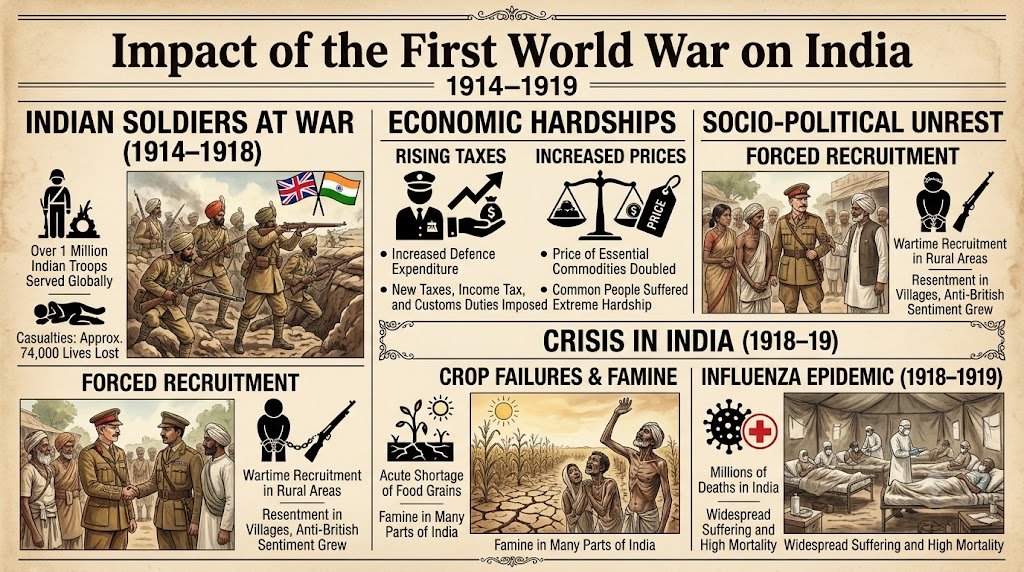
Explanation: The First World War increased defence expenditure and taxation. Prices nearly doubled between 1913 and 1918, while forced recruitment in rural areas created resentment. Crop failures, food shortages and the influenza epidemic further increased people’s suffering.
3. Answer: A — Both A and R are true, and R is the correct explanation of A.
Explanation: Satyagraha was based on truth and non-violence. A satyagrahi did not seek revenge or physical destruction of the opponent but tried to appeal to the opponent’s conscience and persuade them to recognise the truth.
4. Answer: B — It allowed the government to repress political activities and detain political prisoners without trial.
Explanation: The Rowlatt Act of 1919 gave the colonial government extensive powers of repression and allowed detention without trial. Gandhiji called for non-violent civil disobedience against this unjust law.
5. Answer: A — Rowlatt Act → Non-Cooperation Movement → Lahore Congress → Salt March.
Explanation: The Rowlatt Act was passed in 1919. The Non-Cooperation-Khilafat Movement was launched in 1921. The Lahore Congress in December 1929 adopted the demand for Purna Swaraj, and Gandhiji began the Salt March in March 1930.
6. Answer: A — 1-B, 2-C, 3-D, 4-A.
Explanation: Baba Ramchandra was associated with the Awadh peasant struggle, Alluri Sitarama Raju with the Gudem Hills tribal struggle, Abdul Ghaffar Khan with the North-West Frontier Province, and Vallabhbhai Patel with the Bardoli Satyagraha.
7. Answer: C — The movement had turned violent at Chauri Chaura, and Gandhiji believed satyagrahis needed further training in non-violence.
Explanation: In February 1922, a demonstration at Chauri Chaura became violent. Gandhiji believed that the participants were not sufficiently prepared for a large-scale non-violent struggle and therefore withdrew the movement.
8. Answer: C — Salt was an essential item consumed by rich and poor alike, and the salt tax represented colonial oppression.
Explanation: Salt was used by everyone, irrespective of social or economic status. Gandhiji therefore considered the salt tax and government monopoly over salt production a powerful symbol of colonial oppression.
9. Answer: B — Non-Cooperation focused on refusing cooperation and boycotting institutions and goods; Civil Disobedience also involved openly breaking colonial laws.
Explanation: Non-Cooperation included surrendering titles and boycotting government institutions, courts, schools, councils and foreign goods. Civil Disobedience went further by encouraging people to openly break specific colonial laws, beginning with the salt law.
10. Answer: B — They helped create a shared sense of identity and pride, though some cultural symbols could also exclude certain communities.
Explanation: Bharat Mata, folklore, the Swaraj flag and reinterpretations of history helped Indians imagine a common national identity. However, cultural nationalism based heavily on Hindu imagery could make some communities feel excluded.
These Nationalism in India Class 10 MCQs are followed by answers and explanations so that students can understand the reasoning behind each correct option.
Section B – Short Answer Type Questions
10 × 3 = 30 Marks
The following Nationalism in India Class 10 short-answer questions are designed to practise important three-mark topics.
11. Explain any three effects of the First World War that created conditions for the growth of the national movement in India.
12. What is meant by satyagraha? Explain any two features of Gandhiji’s method of satyagraha.
13. Why did the Rowlatt Satyagraha become an important event in the growth of nationalism? Mention the role of the Rowlatt Act and the Jallianwala Bagh massacre.
14. Explain the role of the Khilafat issue in bringing Hindus and Muslims together in the Non-Cooperation Movement.
15. Describe the programme of the Non-Cooperation Movement. Mention any three forms of boycott proposed by Gandhiji.
16. Why did different social groups participate in the Non-Cooperation Movement? Explain with reference to peasants of Awadh and plantation workers in Assam.
17. Why did Gandhiji withdraw the Non-Cooperation Movement? Explain the significance of the Chauri Chaura incident.
18. Explain any three important developments between 1928 and 1930 that led to the Civil Disobedience Movement.
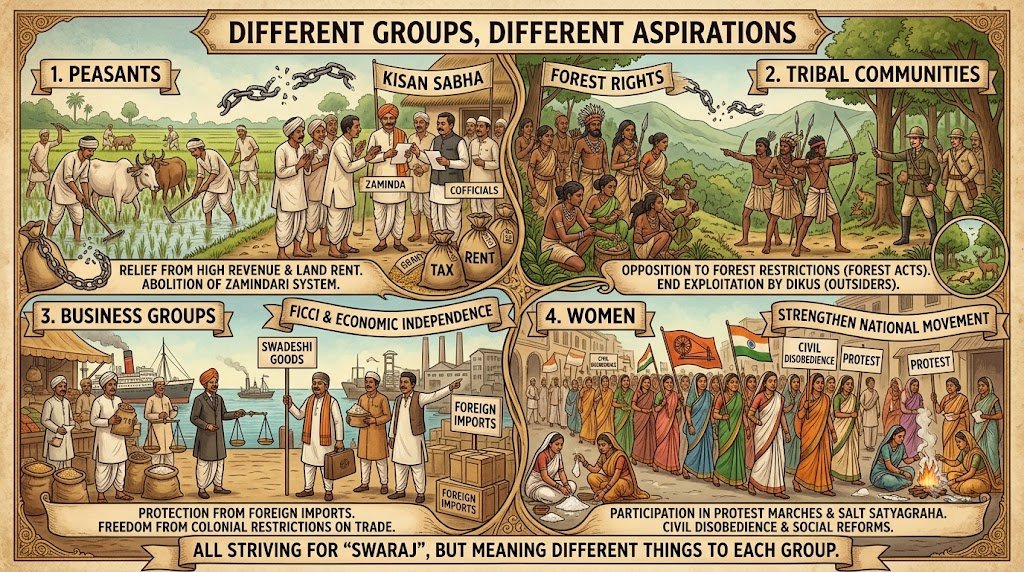
19. Why did different social groups interpret the idea of swaraj differently during the Civil Disobedience Movement? Explain with reference to rich peasants, poor peasants and business groups.
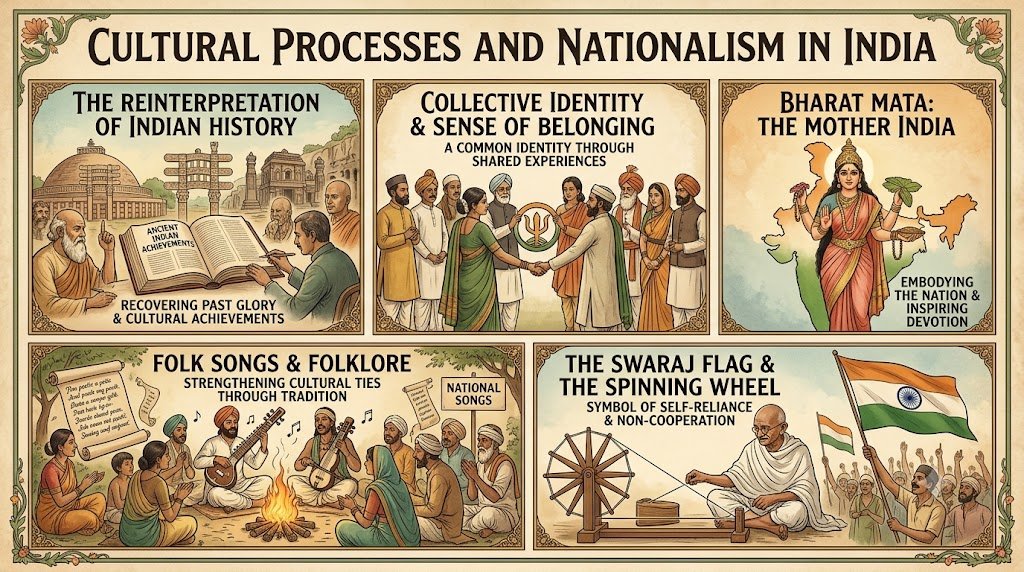
20. How did cultural processes help create a sense of collective belonging among Indians? Explain with reference to Bharat Mata, folklore, the Swaraj flag and reinterpretation of history.
These questions are taken from the supplied Chapter 2 question paper.
Section B – Short Answer Solutions
The Nationalism in India Class 10 short-answer solutions are written in a clear, point-wise and exam-ready format.
11. Answer:
The First World War created several conditions that encouraged the growth of the national movement in India:
- Defence expenditure increased sharply, leading to higher taxes and additional financial pressure.
- Prices nearly doubled between 1913 and 1918, creating severe hardship for ordinary people.
- Forced recruitment in rural areas created resentment among villagers.
- Crop failures, food shortages and the influenza epidemic further increased people’s suffering.
12. Answer:
Satyagraha was a method of struggle based on the power of truth and non-violence.
- It rejected physical force and violence.
- A satyagrahi did not seek revenge or physical destruction of the opponent.
- The method aimed to appeal to the conscience of the oppressor and persuade the opponent to recognise the truth.
- Gandhiji believed that non-violence could unite people in a common struggle against injustice.
13. Answer:
The Rowlatt Satyagraha became important because it brought widespread opposition to colonial repression.
- The Rowlatt Act of 1919 gave the government extensive powers to repress political activities and detain political prisoners without trial.
- Gandhiji called for a nationwide non-violent protest, including hartals, rallies and strikes.
- On 13 April 1919, General Dyer ordered firing on a large crowd at Jallianwala Bagh.
- The massacre and subsequent repression shocked Indians and intensified opposition to British rule.
14. Answer:
The Khilafat issue helped bring Hindus and Muslims together during the Non-Cooperation Movement.
- After the First World War, Muslims feared that a harsh peace treaty would be imposed on the Ottoman emperor, the Khalifa.
- The Khilafat Committee was formed in Bombay in March 1919.
- Muslim leaders Muhammad Ali and Shaukat Ali discussed united mass action with Gandhiji.
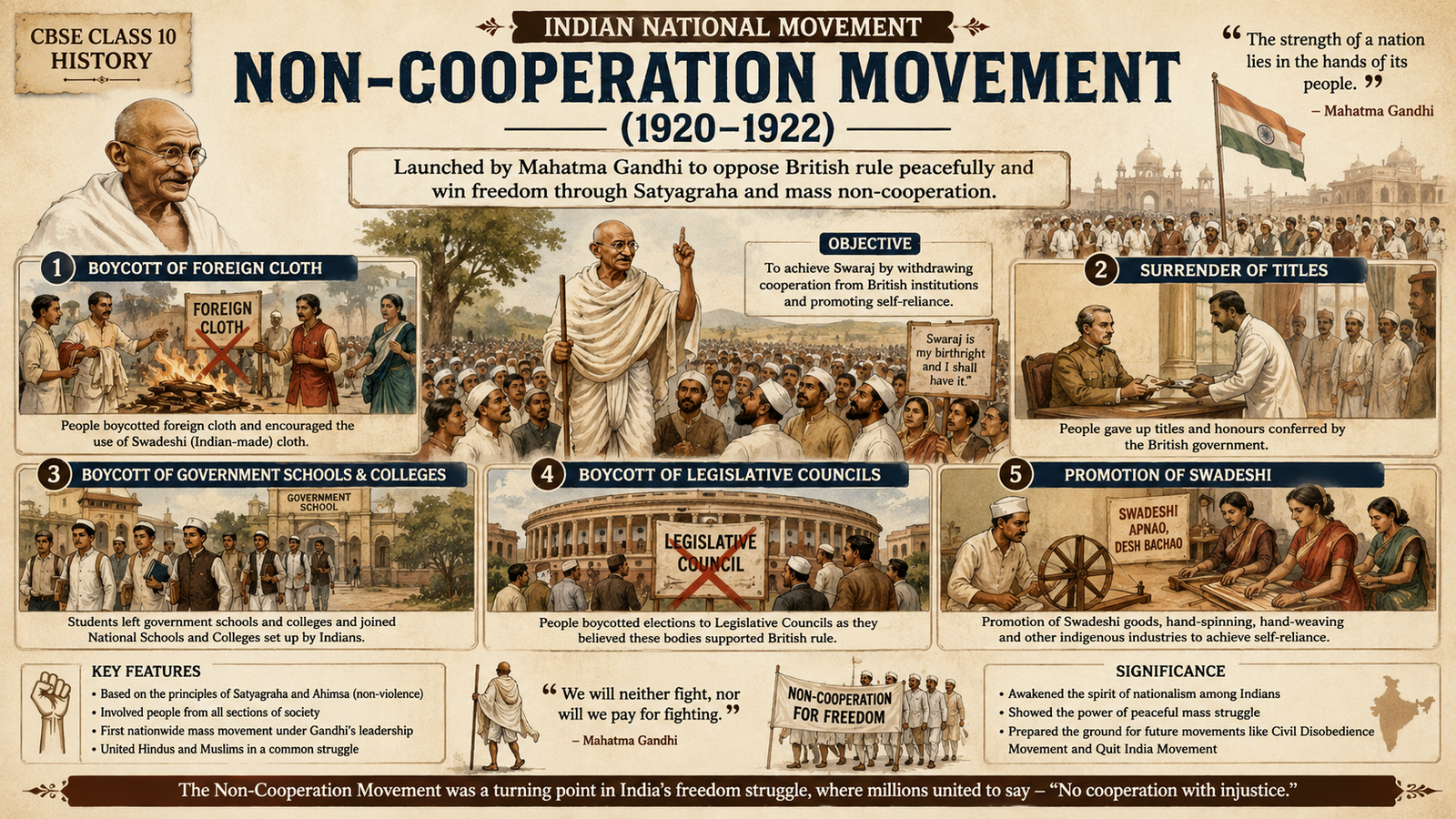
- Gandhiji viewed the issue as an opportunity to unite Muslims with the national movement.
- At the Calcutta Congress in September 1920, Congress leaders supported Non-Cooperation for both Khilafat and Swaraj.
15. Answer:
The Non-Cooperation Movement proposed several forms of cooperation withdrawal and boycott.
- People were asked to surrender government-awarded titles.
- Civil services, army, police, courts and legislative councils were to be boycotted.
- Government-controlled schools and colleges were to be boycotted.
- Foreign goods, especially foreign cloth, were to be boycotted.
- If the government used repression, a wider civil disobedience campaign was proposed.
16. Answer:
Different social groups participated because they connected the national movement with their own local problems.
- In Awadh, peasants led by Baba Ramchandra opposed high rents, revenue demands, cesses and forced labour or begar.
- Many peasants understood Swaraj as freedom from oppressive landlords and excessive revenue demands.
- Plantation workers in Assam were restricted by the Inland Emigration Act and could not freely leave tea gardens.
- For them, Swaraj meant freedom to leave plantations and return to their villages.
17. Answer:
Gandhiji withdrew the Non-Cooperation Movement because the movement was becoming violent.
- In February 1922, a demonstration at Chauri Chaura in Gorakhpur turned into a violent clash with the police.
- Gandhiji believed that the participants were not properly trained for a mass non-violent struggle.
- He therefore called off the movement.
- The incident demonstrated the difficulty of maintaining strict non-violence during a large mass movement.
18. Answer:
Three important developments between 1928 and 1930 were:
- The Simon Commission arrived in India in 1928 without any Indian member and was opposed with the slogan “Go back Simon”.
- In December 1929, the Lahore Congress adopted the demand for Purna Swaraj or complete independence.
- 26 January 1930 was declared Independence Day.
- Gandhiji selected salt as a concrete issue and sent eleven demands to Viceroy Irwin before launching the Civil Disobedience Movement.
19. Answer:
Different groups interpreted Swaraj according to their own economic interests.
- Rich peasants such as Patidars of Gujarat and Jats of Uttar Pradesh faced economic difficulties and wanted reduction or suspension of land revenue.
- Poor peasants wanted unpaid rent to landlords to be remitted.
- Business groups wanted protection against foreign imports and freedom from colonial restrictions.
- Thus, although different groups participated in nationalism, Swaraj had different meanings for them.
20. Answer:
Cultural processes helped Indians develop a sense of collective belonging.
- Bharat Mata became a visual symbol of the nation.
- Nationalists collected folk songs, tales and legends to preserve traditional culture and create pride in the national past.
- The Swaraj flag, with the spinning wheel at its centre, became a symbol of defiance and self-help.
- Nationalists reinterpreted Indian history by highlighting achievements in art, science, mathematics, culture, crafts and trade.
- However, symbols heavily based on Hindu imagery could make people from other communities feel excluded.
Section C – Long Answer Type Questions
5 × 5 = 25 Marks
These Nationalism in India Class 10 long-answer questions cover major themes and analytical aspects of the chapter.
21. Trace the development of the national movement in India from the First World War to the launch of the Non-Cooperation Movement in 1920–21. Include the effects of the war, the Rowlatt Act, Jallianwala Bagh and the Khilafat issue.
22. Explain the Non-Cooperation Movement in detail. Discuss its programme, participation of different social groups, and the reasons for its withdrawal in 1922.
23. Describe the Civil Disobedience Movement from the Lahore Congress of 1929 to its relaunch in 1932. Explain why salt became a powerful symbol and discuss the participation of different social groups.
24. “The national movement in India was a process of bringing together many different social groups, but their participation was not always based on identical aspirations.” Explain the statement with suitable examples from peasants, tribals, business groups and women.
25. Explain how a sense of collective belonging developed among Indians during the national movement. Discuss the contribution of folklore, symbols and images, the reinterpretation of history, and the limitations of these attempts.
The five long-answer questions are from the supplied Chapter 2 practice paper.
Section C – Long Answer Solutions
21. Answer:
The development of the national movement after the First World War can be traced through several important events:
- The First World War increased defence expenditure, taxation and prices. Forced recruitment, crop failures, food shortages and the influenza epidemic increased public suffering.
- Gandhiji returned to India in 1915 and introduced satyagraha based on truth and non-violence. He successfully organised struggles at Champaran, Ahmedabad and Kheda.
- In 1919, Gandhiji launched a nationwide satyagraha against the Rowlatt Act, which permitted repression and detention without trial.
- The Jallianwala Bagh massacre of 13 April 1919 and the repression that followed intensified anti-British feelings.
- Gandhiji then supported the Khilafat issue to promote Hindu-Muslim unity.
- At the Calcutta Congress in September 1920 and subsequently at Nagpur in December 1920, the Non-Cooperation programme was adopted.
- The movement began in January 1921 with the objectives of Swaraj and support for the Khilafat cause.
22. Answer:
The Non-Cooperation Movement was based on Gandhiji’s belief that British rule survived because Indians cooperated with it.
- The programme included surrendering government titles and boycotting civil services, army, police, courts, legislative councils, schools and foreign goods.
- In towns, students left government institutions, while teachers and lawyers resigned. Foreign cloth was boycotted and liquor shops were picketed.
- Peasants and tribals also participated with their own demands. In Awadh, peasants opposed high rents, revenue demands and begar. Plantation workers in Assam wanted freedom to leave plantations.
- Traders, merchants and other groups also participated, although different communities understood Swaraj differently.
- In February 1922, violence at Chauri Chaura convinced Gandhiji that the movement was becoming violent.
- He believed that satyagrahis needed further training in non-violence and therefore withdrew the movement.
23. Answer:
The Civil Disobedience Movement developed through several important stages:
- In December 1929, the Lahore Congress under Jawaharlal Nehru adopted the demand for Purna Swaraj.
- 26 January 1930 was observed as Independence Day.
- Gandhiji chose salt because it was an essential item used by both rich and poor.
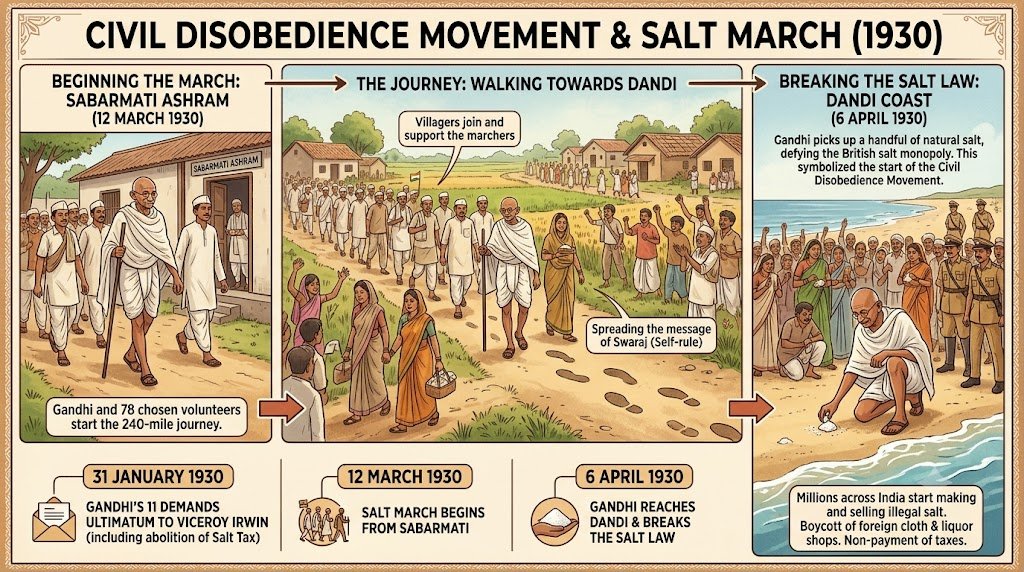
- On 31 January 1930, Gandhiji sent eleven demands to Viceroy Irwin. When they were not accepted, he began the Salt March from Sabarmati to Dandi with 78 volunteers.
- On 6 April 1930, Gandhiji broke the salt law by making salt from seawater.
- Rich peasants, business groups, workers and women participated in different ways. Women joined marches, made salt and picketed shops.
- The Gandhi-Irwin Pact was signed in March 1931, followed by the Second Round Table Conference. After negotiations broke down, the Civil Disobedience Movement was relaunched in 1932.
24. Answer:
The national movement brought many different social groups into a wider anti-colonial struggle, but their specific aspirations were often different.
- Peasants: In Awadh, peasants opposed high rents, revenue demands and begar. During the Civil Disobedience period, rich peasants wanted reduction of land revenue, while poor peasants wanted remission of unpaid rent.
- Tribals: In the Gudem Hills, tribal communities opposed forest restrictions and forced labour. Alluri Sitarama Raju led their militant struggle.
- Business groups: Industrialists and merchants wanted protection against foreign imports and freedom from colonial economic restrictions. They initially supported the Civil Disobedience Movement and provided financial assistance.
- Women: Thousands of women participated in marches, made salt and picketed foreign cloth and liquor shops.
- However, Congress did not always accept every group’s economic demands. Therefore, different groups understood Swaraj differently.
25. Answer:
A sense of collective belonging developed through various cultural processes during the national movement.
- Nationalists used cultural symbols to create a common identity among people divided by region, language, caste and community.
- The image of Bharat Mata became a visual representation of the nation. Bankim Chandra Chattopadhyay wrote Vande Mataram, while Abanindranath Tagore painted Bharat Mata.
- Nationalists collected folk tales, songs and legends to recover traditional culture and develop national pride.
- The Swaraj flag became a symbol of resistance and self-help. Gandhiji’s 1921 flag carried the spinning wheel.
- Nationalists also reinterpreted Indian history by highlighting achievements in art, architecture, science, mathematics, culture, law, crafts and trade.
- However, these cultural methods had limitations. Symbols or images heavily influenced by Hindu traditions could make people from other communities feel excluded.
- Thus, cultural nationalism helped create collective belonging, but developing a fully inclusive national identity remained a challenge.
Quick Revision: Important Dates
| Year/Date | Event |
|---|---|
| 1915 | Gandhiji returned to India |
| 1919 | Rowlatt Act and Rowlatt Satyagraha |
| 13 April 1919 | Jallianwala Bagh massacre |
| March 1919 | Khilafat Committee formed in Bombay |
| 1920 | Non-Cooperation programme adopted |
| 1921 | Non-Cooperation Movement began |
| February 1922 | Chauri Chaura incident and withdrawal of Non-Cooperation Movement |
| 1928 | Simon Commission arrived in India |
| December 1929 | Lahore Congress adopted the demand for Purna Swaraj |
| 26 January 1930 | Independence Day observed |
| 31 January 1930 | Gandhiji sent eleven demands to Viceroy Irwin |
| 6 April 1930 | Gandhiji broke the salt law at Dandi |
| March 1931 | Gandhi-Irwin Pact |
| 1932 | Civil Disobedience Movement relaunched |
These dates and developments are drawn from the supplied question and solution PDFs.
Use this Nationalism in India Class 10 quick revision section to revise important dates, movements, leaders and events before the examination.
How to Use This Practice Paper
Step 1: First attempt all 10 questions in Section A without looking at the answers.
Step 2: Check your answers using the answer key and explanations provided at the end of Section A.
Step 3: Attempt all 10 questions in Section B in your own words and then compare your answers with the exam-ready solutions.
Step 4: Practise writing all 5 long-answer questions in approximately 120 words using a clear introduction and well-organised points.
Step 5: Finally, revise the important dates, personalities, movements and events from the Quick Revision section.
Read More
The Rise of Nationalism in Europe Class 10: CBSE Practice Paper 2026-27 with Solutions
Frequently Asked Questions
Students preparing for Nationalism in India Class 10 can use the following FAQs for quick revision of commonly asked concepts.
1. What is Nationalism in India Class 10?
Nationalism in India is Chapter 2 of Class 10 History. It explains the development of Indian nationalism and major events and movements such as the Rowlatt Satyagraha, Non-Cooperation Movement, Civil Disobedience Movement, Khilafat Movement and the development of collective belonging.
2. How many questions are included in this practice paper?
This practice paper contains 25 questions: 10 MCQs, 10 short-answer questions and 5 long-answer questions.
3. How many marks is this practice paper?
The practice paper carries 65 marks: 10 marks for MCQs, 30 marks for short-answer questions and 25 marks for long-answer questions.
4. What was the Rowlatt Act of 1919?
The Rowlatt Act gave the colonial government extensive powers to repress political activities and detain political prisoners without trial.
5. Why did Gandhiji withdraw the Non-Cooperation Movement?
Gandhiji withdrew the movement in February 1922 after the violent Chauri Chaura incident because he believed that the movement was becoming violent and that satyagrahis needed further training in non-violence.
6. Why was salt chosen as a symbol of the Civil Disobedience Movement?
Salt was an essential item used by both rich and poor. The salt tax and government control over salt production therefore provided a powerful and easily understood symbol of colonial oppression.
7. Who led the peasant movement in Awadh?
Baba Ramchandra was associated with the peasant struggle in Awadh.
8. Who led the tribal struggle in the Gudem Hills?
Alluri Sitarama Raju led the tribal struggle in the Gudem Hills.
9. What was Purna Swaraj?
Purna Swaraj means complete independence. The Lahore Congress of December 1929 adopted the demand for Purna Swaraj, and 26 January 1930 was observed as Independence Day.
10. How did cultural processes create collective belonging?
Nationalists used Bharat Mata, folklore, the Swaraj flag and reinterpretation of Indian history to create a common sense of identity and national pride. However, some cultural symbols could also make certain communities feel excluded.
For more CBSE study material, practice papers and concept-based educational resources, visit the PCM ConceptClear Home Page.
For textbook-based preparation, students should also refer to the official NCERT Class 10 History textbook. Reading the prescribed textbook along with this Nationalism in India Class 10 Practice Paper can help students revise important concepts, events and personalities more effectively.
Conclusion
This Nationalism in India Class 10 Practice Paper with Solutions is designed to help students prepare systematically for Class 10 History during the 2026–27 academic session. It combines MCQs, short-answer questions and long-answer questions covering the major themes of Chapter 2.
Students should first attempt the questions independently and then use the section-wise solutions to identify mistakes and improve their answer-writing skills. The MCQs include explanations, while the short and long answers are presented in a clear, exam-ready point-wise format.
Regular practice with important dates, movements, personalities, causes and consequences can help students build stronger conceptual understanding and write more structured answers in the examination. The supplied solution paper specifically recommends clear, relevant points for 3-mark answers and a direct introduction followed by well-organised points for 5-mark answers.
Regular practice with this Nationalism in India Class 10 question paper can help students improve their conceptual understanding and exam-oriented answer writing.
Tip: Try to complete the entire paper without looking at the solutions first. After checking your answers, revise the topics where you made mistakes and attempt the questions again after a few days.
Students preparing for the CBSE Class 10 History examination should also check the latest curriculum and academic resources published by the official CBSE Academic website. This can help students understand the prescribed syllabus and examination-related resources.