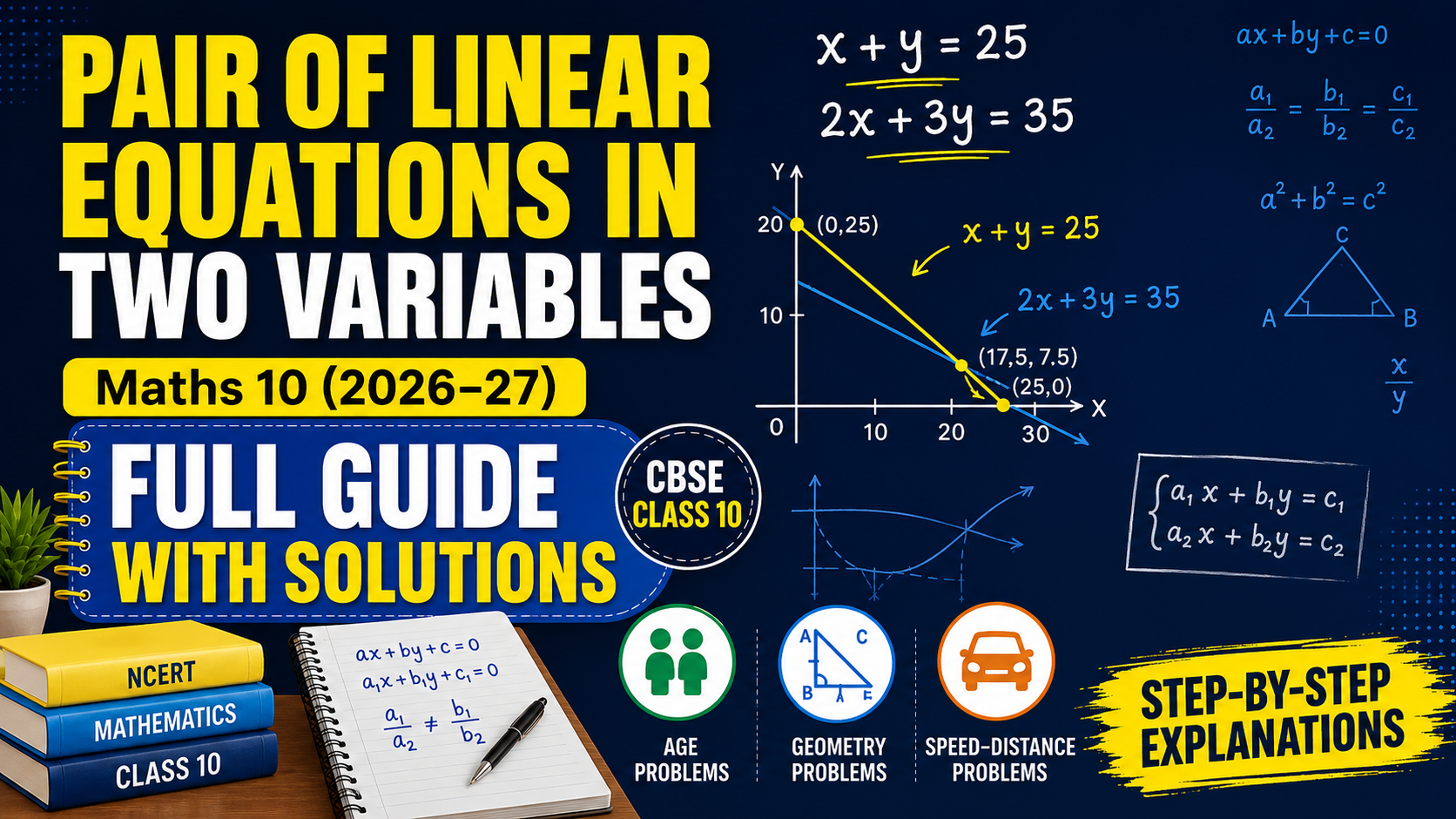
Pair of Linear Equations in Two Variables is one of the most important chapters in Class 10 Maths. This chapter helps students understand how to solve two equations simultaneously using graphical and algebraic methods. It is highly important for CBSE board exams and foundation preparation for higher mathematics.
In this chapter, students learn graphical representation, substitution method, elimination method, and cross multiplication method with important examples and numericals.

What is Pair of Linear Equations in Two Variables?
A pair of linear equations in two variables is written in the form:
a₁x + b₁y + c₁ = 0
a₂x + b₂y + c₂ = 0
Where:
- x and y are variables
- a₁, b₁, c₁, a₂, b₂, c₂ are constants
Important Concepts in Pair of Linear Equations in Two Variables
Consistent Equations
A system having at least one solution.
Inconsistent Equations
A system having no solution.
Dependent Equations
A system having infinitely many solutions.
Graphical Representation of Pair of Linear Equations in Two Variables
When two linear equations are plotted on a graph:
- Intersecting lines → One solution
- Parallel lines → No solution
- Coincident lines → Infinite solutions
Conditions for Nature of Graph/ Lines in Pair of Linear Equations in Two Variables
Intersecting lines
a₁/a₂ ≠ b₁/b₂
Parallel lines
a₁/a₂ = b₁/b₂ ≠ c₁/c₂
Coincident lines
a₁/a₂ = b₁/b₂ = c₁/c₂
Conditions for Solutions in Pair of Linear Equations in Two Variables
Unique Solution
a₁/a₂ ≠ b₁/b₂
No Solution
a₁/a₂ = b₁/b₂ ≠ c₁/c₂
Infinitely Many Solutions
a₁/a₂ = b₁/b₂ = c₁/c₂

Methods to Solve Pair of Linear Equations in Two Variables
Graphical Method
The solution is obtained by finding the point of intersection of two lines.
Substitution Method
One variable is expressed in terms of another and substituted into the second equation.
Elimination Method
One variable is eliminated by adding or subtracting equations.
Cross Multiplication Method
Direct formula method used for faster calculations.
Formula:
x = (b₁c₂ − b₂c₁)/(a₁b₂ − a₂b₁)
y = (c₁a₂ − c₂a₁)/(a₁b₂ − a₂b₁)
Solved Example of Pair of Linear Equations in Two Variables
Solve:
2x + y = 5
x − y = 1
Solution by Elimination Method
Given equations:
2x + y = 5
x − y = 1
Add both equations:
3x = 6
x = 2
Substitute in:
x − y = 1
2 − y = 1
y = 1
Final Answer
x = 2, y = 1

Word Problems Based on Pair of Linear Equations in Two Variables
Pair of linear equations are used in:
- Age problems
- Train problems
- Geometry problems
- Business calculations
- Speed and distance problems
Pair of linear equations are widely used in daily life and practical situations.
Below are important application-based questions with detailed solutions.
Age Problems Based on Pair of Linear Equations in Two Variables
Age Problem 1
Question
The sum of the present ages of a father and his son is 45 years. Five years ago, the father’s age was four times the age of the son. Find their present ages.
Solution
Let:
- Father’s present age = x years
- Son’s present age = y years
Step 1: Form Equations
According to question:
x + y = 45
Five years ago:
Father’s age = x − 5
Son’s age = y − 5
Given:
x − 5 = 4(y − 5)
Simplify:
x − 5 = 4y − 20
x − 4y = −15
Step 2: Solve Equations
Equations are:
x + y = 45
x − 4y = −15
Subtract second equation from first:
x + y − (x − 4y) = 45 − (−15)
5y = 60
y = 12
Substitute in:
x + y = 45
x + 12 = 45
x = 33
Final Answer
- Father’s present age = 33 years
- Son’s present age = 12 years
Age Problem 2
Question
The present age of a mother is three times the age of her daughter. After 10 years, the mother’s age will be twice the age of the daughter. Find their present ages.
Solution
Let:
- Mother’s present age = x years
- Daughter’s present age = y years
Step 1: Form Equations
According to question:
x = 3y
After 10 years:
Mother’s age = x + 10
Daughter’s age = y + 10
Given:
x + 10 = 2(y + 10)
Simplify:
x + 10 = 2y + 20
x − 2y = 10
Step 2: Solve Equations
Equations are:
x = 3y
x − 2y = 10
Substitute x = 3y:
3y − 2y = 10
y = 10
x = 3(10)
x = 30
Final Answer
- Mother’s present age = 30 years
- Daughter’s present age = 10 years
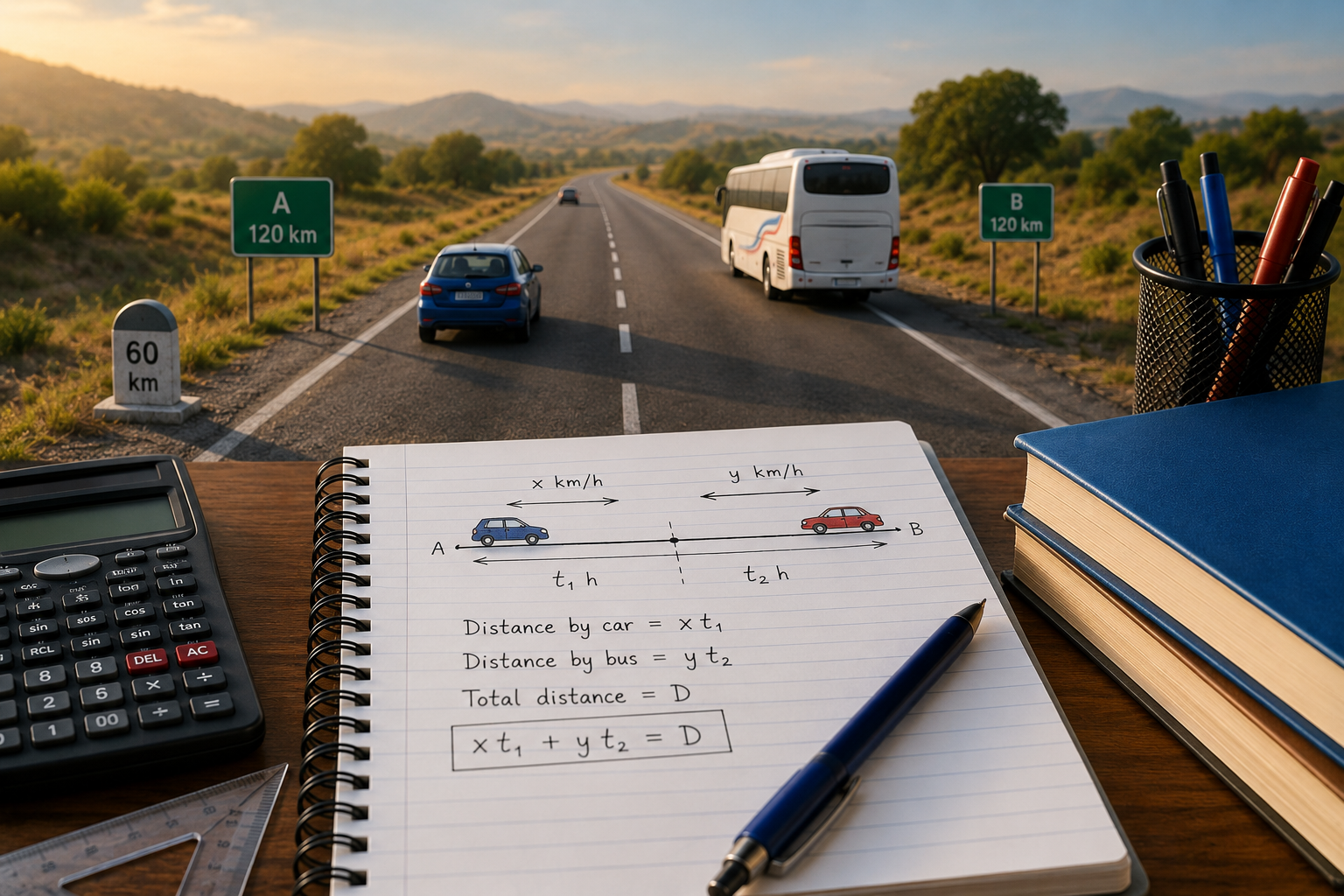
Train Problems Based on Pair of Linear Equations in Two Variables
Question
A train covered a certain distance at a uniform speed. If the train had been 10 km/h faster, it would have taken 2 hours less than the scheduled time. And if the train had been 10 km/h slower, it would have taken 3 hours more than the scheduled time. Find the distance covered by the train.
Solution
Let:
- Speed of train = x km/h
- Time taken = y hours
Then:
Distance = xy
Case 1
If speed becomes 10 km/h faster:
(x + 10) km/h
Time becomes:
(y − 2) hours
Distance remains same:
xy = (x + 10)(y − 2)
Expand:
xy = xy − 2x + 10y − 20
Simplify:
2x − 10y = −20
x − 5y = −10
Case 2
If speed becomes 10 km/h slower:
(x − 10) km/h
Time becomes:
(y + 3) hours
Distance remains same:
xy = (x − 10)(y + 3)
Expand:
xy = xy + 3x − 10y − 30
Simplify:
3x − 10y = 30
Step 3: Solve the Pair of Equations
Equations obtained:
x − 5y = −10
3x − 10y = 30
Multiply first equation by 2:
2x − 10y = −20
Subtract:
(3x − 10y) − (2x − 10y) = 30 − (−20)
x = 50
Substitute in:
x − 5y = −10
50 − 5y = −10
5y = 60
y = 12
Step 4: Find Distance
Distance = xy
= 50 × 12
= 600 km
Final Answer
- Speed of train = 50 km/h
- Time taken = 12 hours
- Distance covered = 600 km

Geometry Problems Based on Pair of Linear Equations in Two Variables
Geometry problems are important applications of Pair of Linear Equations in Two Variables. These questions generally involve dimensions like length, breadth, perimeter, and area.
Geometry Problem 1
Question
The perimeter of a rectangle is 50 cm. Its length is 5 cm more than its breadth. Find the length and breadth of the rectangle.
Solution
Let:
- Length of rectangle = x cm
- Breadth of rectangle = y cm
Step 1: Form Equations
Perimeter of rectangle:
2(l + b) = 50
2(x + y) = 50
x + y = 25
Length is 5 cm more than breadth:
x − y = 5
Step 2: Solve Equations
Equations are:
x + y = 25
x − y = 5
Add both equations:
2x = 30
x = 15
Substitute in:
x + y = 25
15 + y = 25
y = 10
Final Answer
- Length = 15 cm
- Breadth = 10 cm
Geometry Problem 2
Question
The sum of the length and breadth of a rectangle is 35 cm. The length is 7 cm more than the breadth. Find the dimensions of the rectangle.
Solution
Let:
- Length = x cm
- Breadth = y cm
Step 1: Form Equations
According to question:
x + y = 35
Length exceeds breadth by 7 cm:
x − y = 7
Step 2: Solve Equations
Add equations:
x + y + x − y = 35 + 7
2x = 42
x = 21
Substitute in:
x + y = 35
21 + y = 35
y = 14
Final Answer
- Length = 21 cm
- Breadth = 14 cm
Geometry Problem 3
Question
The length of a rectangle is 4 cm more than its breadth. If the perimeter of the rectangle is 36 cm, find its dimensions.
Solution
Let:
- Length = x cm
- Breadth = y cm
Step 1: Form Equations
Perimeter:
2(x + y) = 36
x + y = 18
Length is 4 cm more:
x − y = 4
Step 2: Solve Equations
Add equations:
2x = 22
x = 11
Substitute in:
11 + y = 18
y = 7
Final Answer
- Length = 11 cm
- Breadth = 7 cm
Speed and Distance Problems Based on Pair of Linear Equations in Two Variables
Speed and Distance Problem 1
Question
Two cars start together in opposite directions from the same place. One car travels 5 km/h faster than the other. In 2 hours, they are 150 km apart. Find their speeds.
Solution
Let:
- Speed of slower car = x km/h
- Speed of faster car = y km/h
Step 1: Form Equations
Difference of speeds:
y − x = 5
Since they move in opposite directions:
2x + 2y = 150
Divide by 2:
x + y = 75
Step 2: Solve Equations
Equations are:
x + y = 75
y − x = 5
Add both equations:
2y = 80
y = 40
Substitute in:
x + y = 75
x + 40 = 75
x = 35
Final Answer
- Speed of slower car = 35 km/h
- Speed of faster car = 40 km/h
Speed and Distance Problem 2
Question
Two buses start from the same bus stand at the same time in opposite directions. One bus travels 15 km/h faster than the other. After 3 hours, they are 255 km apart. Find their speeds.
Solution
Let:
- Speed of slower bus = x km/h
- Speed of faster bus = y km/h
Step 1: Form Equations
Difference of speeds:
y − x = 15
Total distance after 3 hours:
3x + 3y = 255
Divide by 3:
x + y = 85
Step 2: Solve Equations
Equations are:
x + y = 85
y − x = 15
Add both equations:
2y = 100
y = 50
Substitute in:
x + y = 85
x + 50 = 85
x = 35
Final Answer
- Speed of slower bus = 35 km/h
- Speed of faster bus = 50 km/h
Important Formulas of Pair of Linear Equations in Two Variables
| Concept | Formula |
|---|---|
| General Form | a₁x + b₁y + c₁ = 0 |
| Unique Solution | a₁/a₂ ≠ b₁/b₂ |
| No Solution | a₁/a₂ = b₁/b₂ ≠ c₁/c₂ |
| Infinite Solutions | a₁/a₂ = b₁/b₂ = c₁/c₂ |
Quick Revision Tips for Pair of Linear Equations in Two Variables
- Learn all conditions carefully.
- Practice graphical questions regularly.
- Use elimination method for faster solving.
- Revise formulas daily.
- Solve previous year board questions.
Conclusion of Pair of Linear Equations in Two Variables
Pair of Linear Equations in Two Variables is a scoring chapter in Class 10 Maths. Understanding the graphical meaning, conditions of solutions, and algebraic methods helps students solve problems quickly and accurately.
Regular practice of derivations, examples, and numericals will help students score excellent marks in CBSE board exams and strengthen their mathematical concepts for higher studies.
Related Posts
Polynomial Class 10 Maths 2026-27: Most Important Questions with Solutions
Science Class 10 Control and Coordination: Complete Chapter 6 Guide 2026-27
Science Class 10 Light Reflection and Refraction: Chapter 9 Complete Study Material 2026-27
Science Class 10 Life Processes: Chapter 5 (Easy Guide 2026)
Science Class 10 Acids, Bases and Salts: Chapter 2 Made Easy
External References
Students can also refer to the official
NCERT Website
for textbooks and the
CBSE Academic Portal
for the latest syllabus and examination updates.
1 thought on “Pair of Linear Equations in Two Variables Maths 10 (2026–27) Full Guide with Solutions”