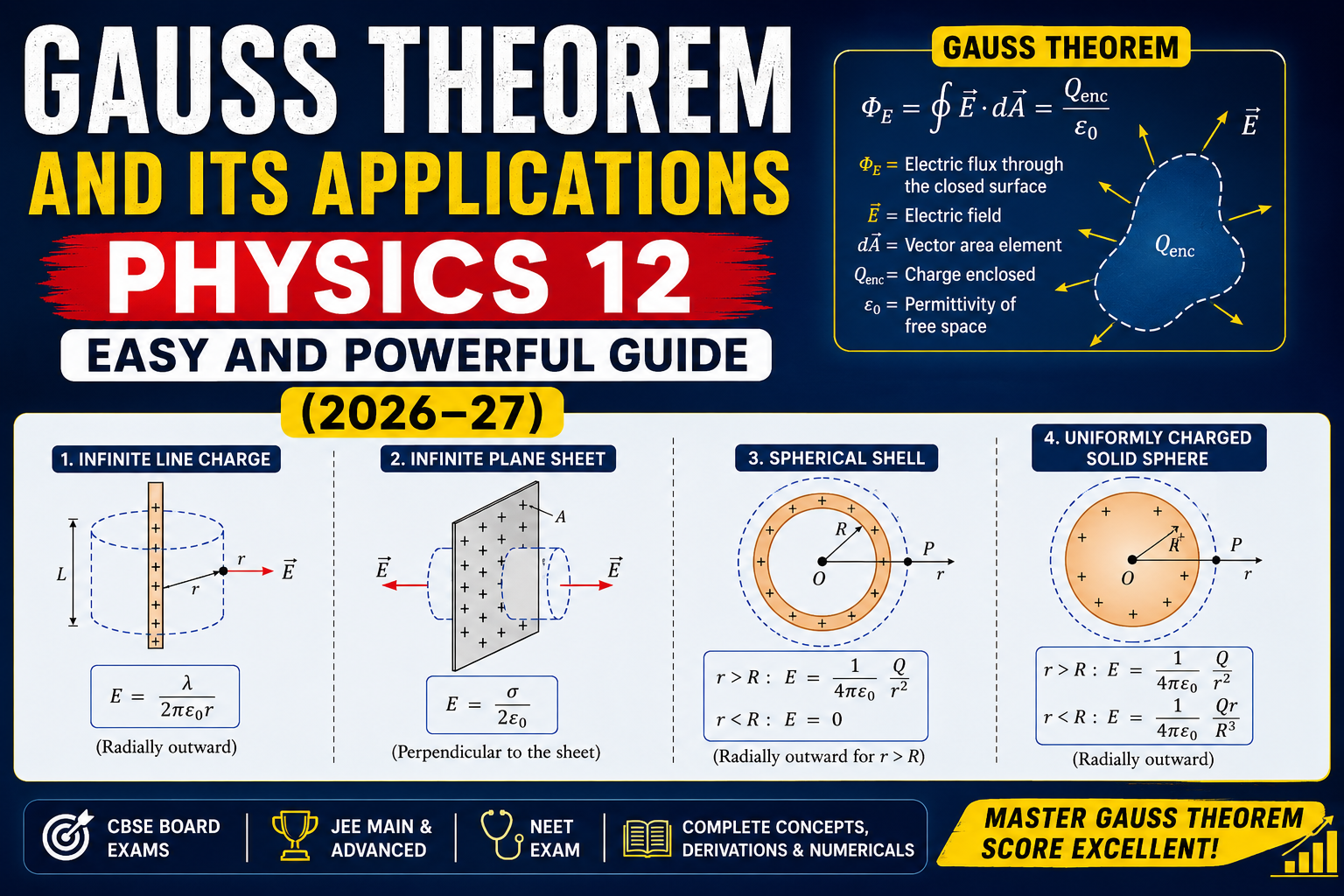
In this chapter on Gauss Theorem and Its Applications Physics 12 , we study electric flux, Gaussian surfaces, and derivations of electric field due to line charge, plane sheet, spherical shell, and solid sphere.
In this chapter Gauss Theorem and Its Applications Physics 12, we will learn the statement of Gauss Theorem, electric flux, derivation, applications, and solved examples in the easiest possible way. This theorem is extremely important for CBSE board exams, JEE Main, JEE Advanced, and NEET.
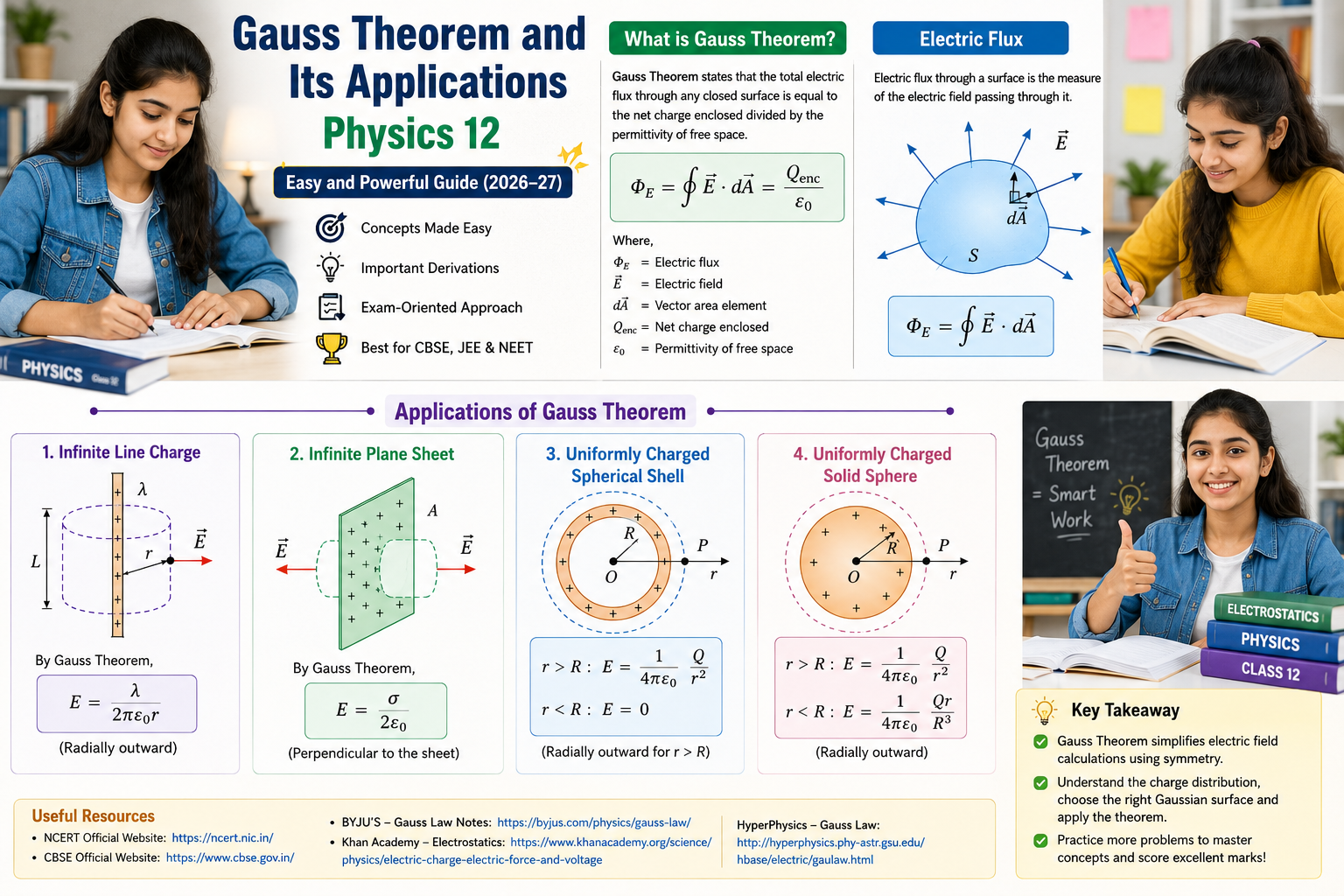
What is Gauss Theorem?
Gauss Theorem states that:
“The total electric flux through any closed surface is equal to 1/ε₀ times the total charge enclosed by the surface.”
Φ = Qenclosed / ε₀
Where:
- Φ = Electric Flux
- Qenclosed = Total charge enclosed
- ε₀ = Permittivity of free space
Electric Flux in Gauss Theorem and Its Applications Physics 12
Electric flux measures the number of electric field lines passing through a surface.
Φ = EA cosθ
Where:
- E = Electric field
- A = Area
- θ = Angle between electric field and area vector
Important Points About Gauss Theorem
- Applicable only for closed surfaces
- Depends only on enclosed charge
- Charges outside the surface do not affect net flux
- Very useful for symmetrical charge distributions
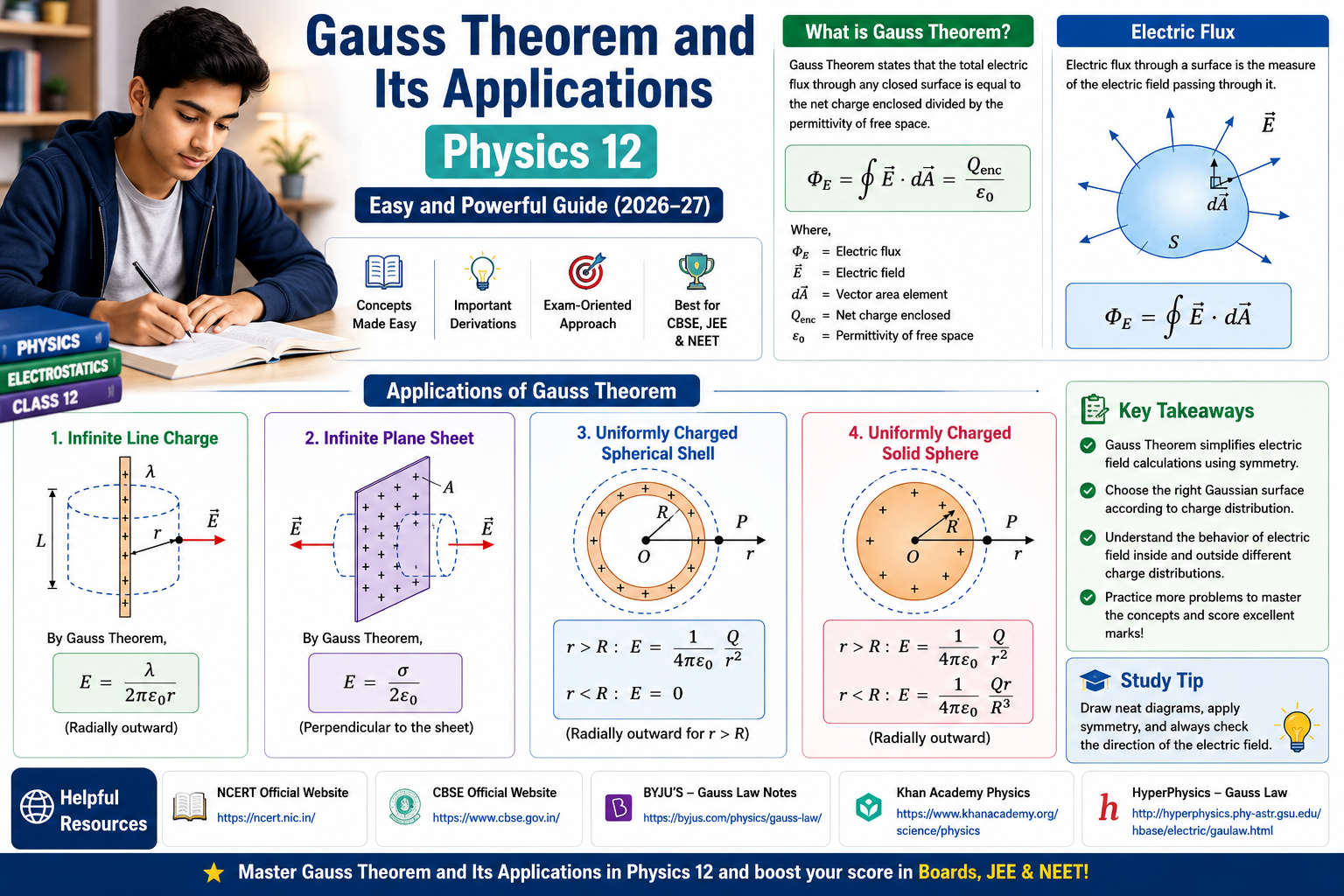
Applications of Gauss Theorem
Gauss Theorem is mainly used to calculate electric field intensity for:
- Infinite Line Charge
- Infinite Plane Sheet
- Uniformly Charged Spherical Shell
- Uniformly Charged Solid Sphere
1. Electric Field due to Infinite Line Charge
Consider a line charge having linear charge density λ.
E = λ / (2π ε₀ r)
Where:
- r = Distance from line charge
The electric field decreases inversely with distance.
The derivations included in Gauss Theorem and Its Applications Class 12 Physics are among the most frequently asked topics in Class 12 Physics examinations.
Electric Field due to Infinite Line Charge — Derivation
- λ = Linear charge density
- r = Distance from line charge
- E = Electric field at point P
Step 1: Choose Gaussian Surface
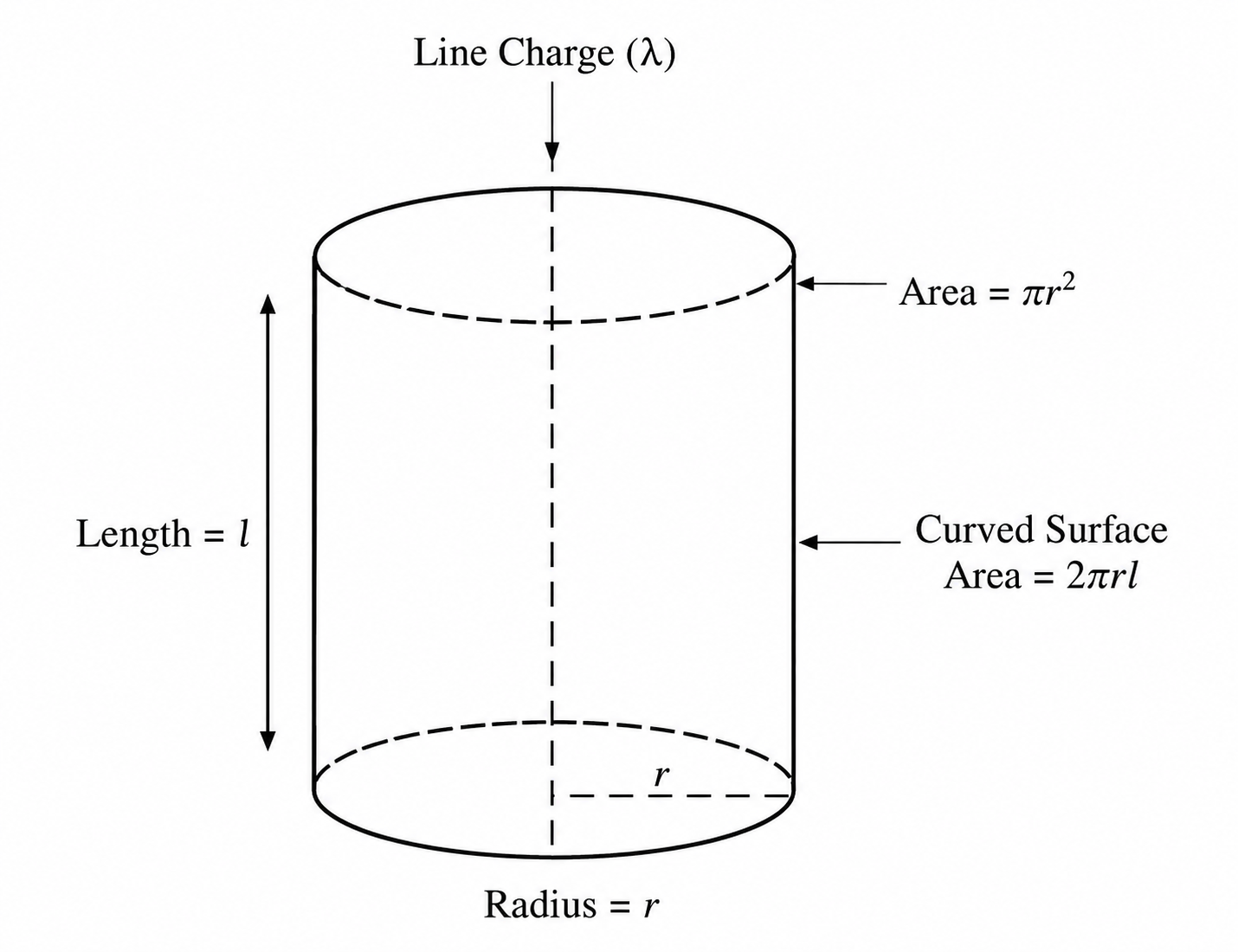
For an infinite line charge, choose a cylindrical Gaussian surface.
Let:
- Radius of cylinder = r
- Length of cylinder = l
Step 2: Apply Gauss Theorem
Φ = Q / ε₀
Electric flux:
Φ = ∮ E·dA
For cylindrical surface:
- Electric field is perpendicular to curved surface
- Electric field is constant everywhere on curved surface
Therefore:
Φ = E × (Curved Surface Area)
Curved surface area of cylinder:
2πrl
Hence:
Φ = E(2πrl)
Step 3: Find Enclosed Charge
Linear charge density:
λ = Q / l
Therefore:
Q = λl
Step 4: Substitute in Gauss Theorem
Using:
Φ = Q / ε₀
We get:
E(2πrl) = λl / ε₀
Cancel l:
E(2πr) = λ / ε₀
Therefore:
E = λ / (2π ε₀ r)
Final Result
E = λ / (2π ε₀ r)
Important Observations
- Electric field decreases inversely with distance.
- Electric field is directed radially outward.
- Formula is valid only for infinite line charge.
Quick Revision Table
| Quantity | Formula |
|---|---|
| Linear Charge Density | λ = Q / l |
| Curved Surface Area | 2πrl |
| Electric Field | λ / (2π ε₀ r) |
“`
2. Electric Field due to Infinite Plane Sheet
For surface charge density σ:
E = σ / (2ε₀)
Important:
- Electric field is constant
- Independent of distance
Electric Field due to Infinite Plane Sheet — Derivation
Diagram of Infinite Plane Sheet
Where:
- σ = Surface charge density
- E = Electric field intensity
The electric field is perpendicular to the plane sheet.
Step 1: Choose Gaussian Surface
Choose a cylindrical Gaussian surface (pillbox) intersecting the plane sheet.
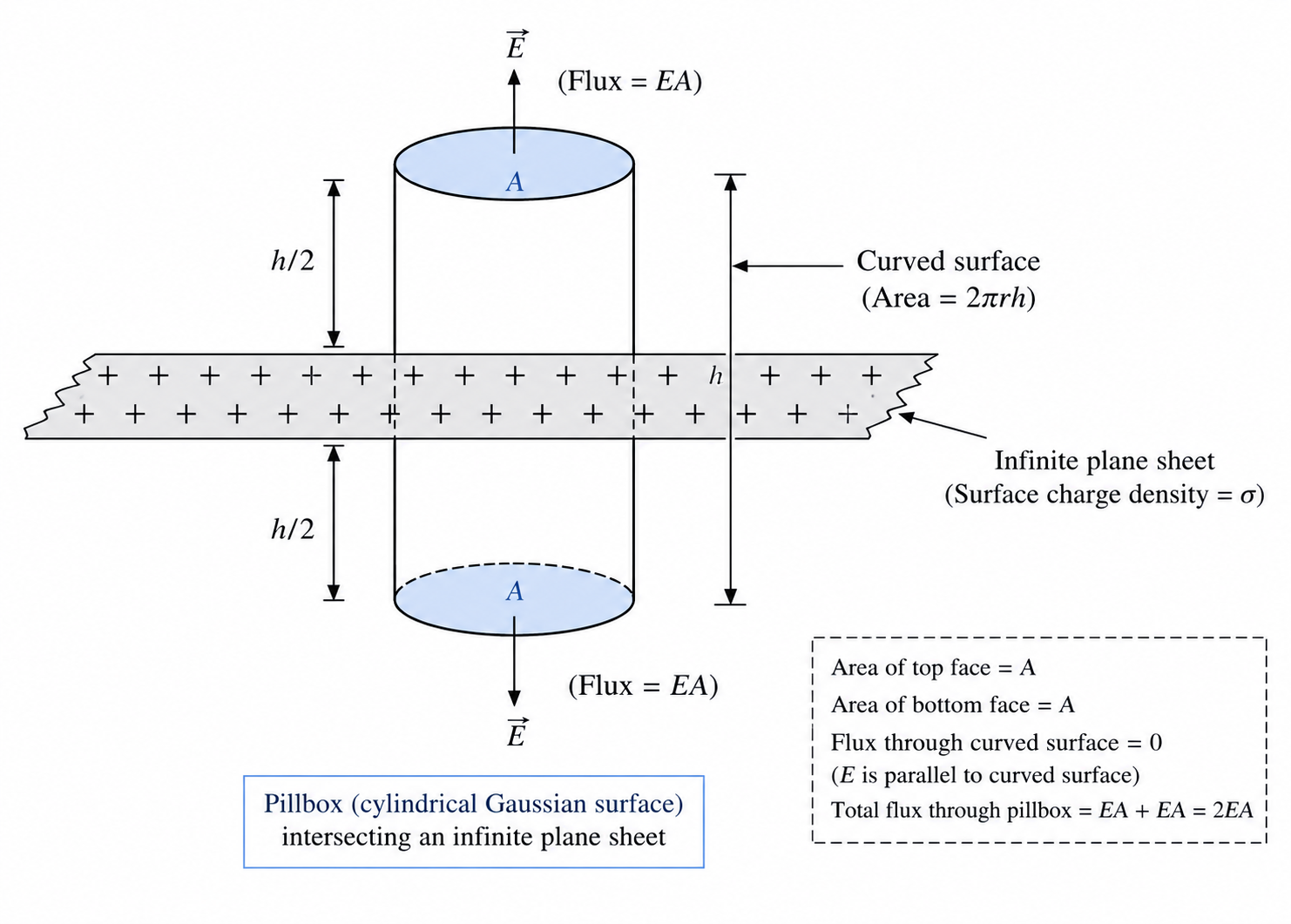
Let:
- Area of each circular face = A
Step 2: Apply Gauss Theorem
Φ = Q / ε₀
Electric flux:
Φ = ∮ E·dA
Step 3: Calculate Total Flux
Flux through curved surface:
= 0
because electric field is parallel to curved surface.
Flux passes only through two flat faces.
Flux through upper face:
EA
Flux through lower face:
EA
Total flux:
Φ = EA + EA
Φ = 2EA
Step 4: Find Enclosed Charge
Surface charge density:
σ = Q / A
Therefore:
Q = σA
Step 5: Substitute in Gauss Theorem
Using:
Φ = Q / ε₀
We get:
2EA = σA / ε₀
Cancel A:
2E = σ / ε₀
Therefore:
E = σ / (2ε₀)
Final Result
E = σ / (2ε₀)
Important Observations
- Electric field is constant everywhere.
- Electric field does not depend on distance.
- Electric field is perpendicular to the sheet.
- Formula is valid only for infinite plane sheet.
Quick Revision Table
| Quantity | Formula |
|---|---|
| Surface Charge Density | σ = Q / A |
| Total Flux | 2EA |
| Electric Field | σ / (2ε₀) |
“`
3. Electric Field due to Uniformly Charged Spherical Shell
Outside the Shell
If r > R:
E = (1 / 4π ε₀) × (Q / r²)
The shell behaves like a point charge.
Inside the Shell
If r < R:
E = 0
Electric field inside a uniformly charged shell is zero.
Electric Field due to Uniformly Charged Spherical Shell — Derivation
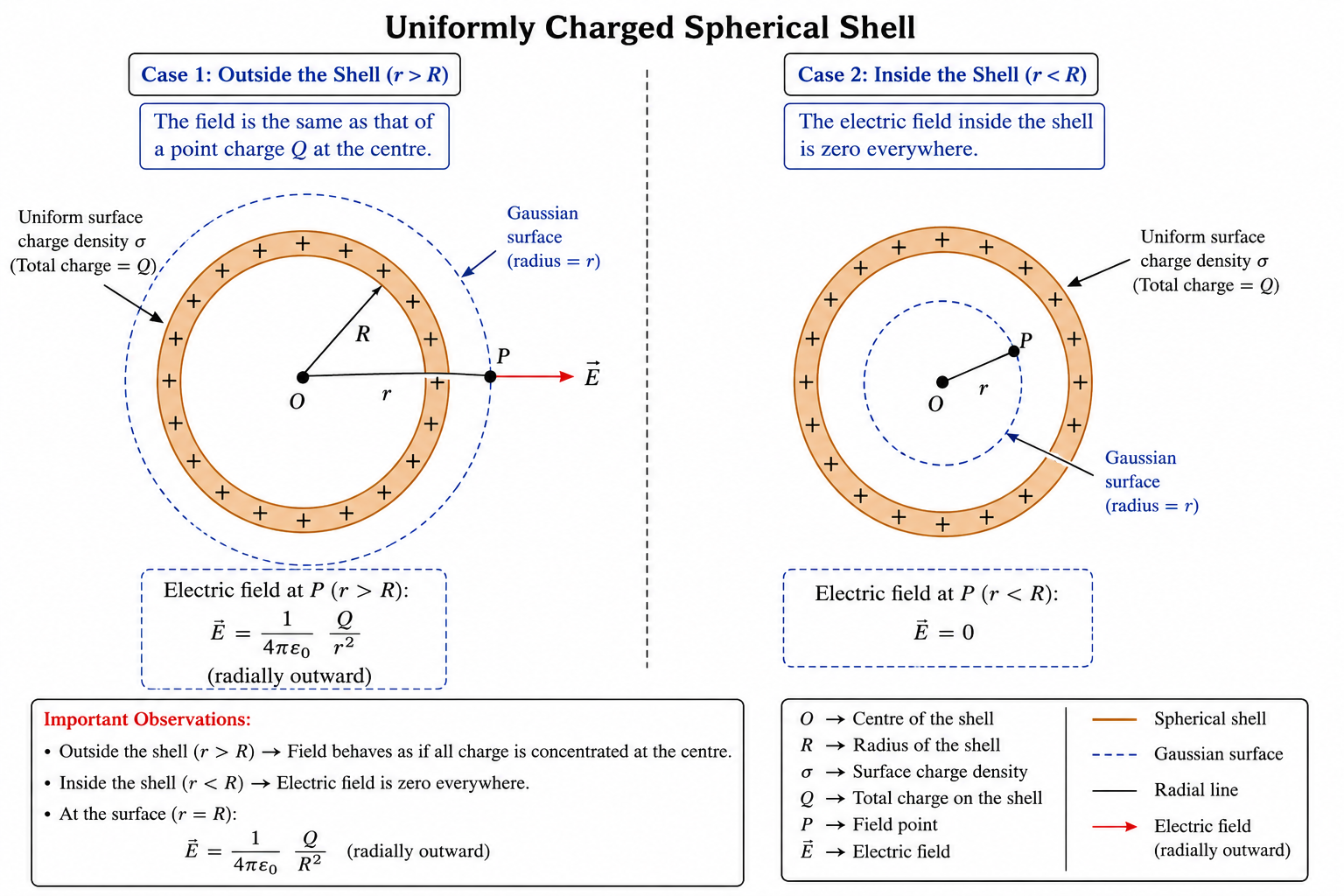
Where:
- R = Radius of shell
- r = Distance of point P from center
- Q = Total charge on shell
Case 1: Electric Field Outside the Shell (r > R)
Step 1: Choose Gaussian Surface
Take a spherical Gaussian surface of radius r outside the shell.
Step 2: Apply Gauss Theorem
Φ = Q / ε₀
Electric flux:
Φ = ∮ E·dA
Since:
- Electric field is radial
- Magnitude of electric field is constant on Gaussian surface
Therefore:
Φ = E ∮ dA
Surface area of sphere:
4πr²
Hence:
Φ = E(4πr²)
Step 3: Substitute in Gauss Theorem
Using:
Φ = Q / ε₀
We get:
E(4πr²) = Q / ε₀
Therefore:
E = (1 / 4π ε₀) × (Q / r²)
Final Result Outside the Shell
r > R
E = (1 / 4π ε₀) × (Q / r²)
The shell behaves like a point charge.
Case 2: Electric Field Inside the Shell (r < R)
Step 1: Choose Gaussian Surface Inside Shell
Take a spherical Gaussian surface inside the shell.
Step 2: Find Enclosed Charge
Inside the shell:
Qenclosed = 0
because all charge lies on the outer surface.
Step 3: Apply Gauss Theorem
Using:
Φ = Qenclosed / ε₀
We get:
Φ = 0
Therefore:
E = 0
Final Result Inside the Shell
r < R
E = 0
Important Observations
- Outside shell → behaves like point charge.
- Inside shell → electric field is zero.
- Electric field is radial.
- Gauss Theorem simplifies derivation greatly.
Quick Revision Table
| Region | Electric Field |
|---|---|
| Outside Shell (r > R) | (1 / 4π ε₀) × (Q / r²) |
| Inside Shell (r < R) | E = 0 |
4. Electric Field due to Uniformly Charged Solid Sphere
Outside the Sphere
r > R
E = (1 / 4π ε₀) × (Q / r²)
Inside the Sphere
r < R
Electric field varies linearly with distance:
E ∝ r
Electric Field due to Uniformly Charged Solid Sphere — Derivation
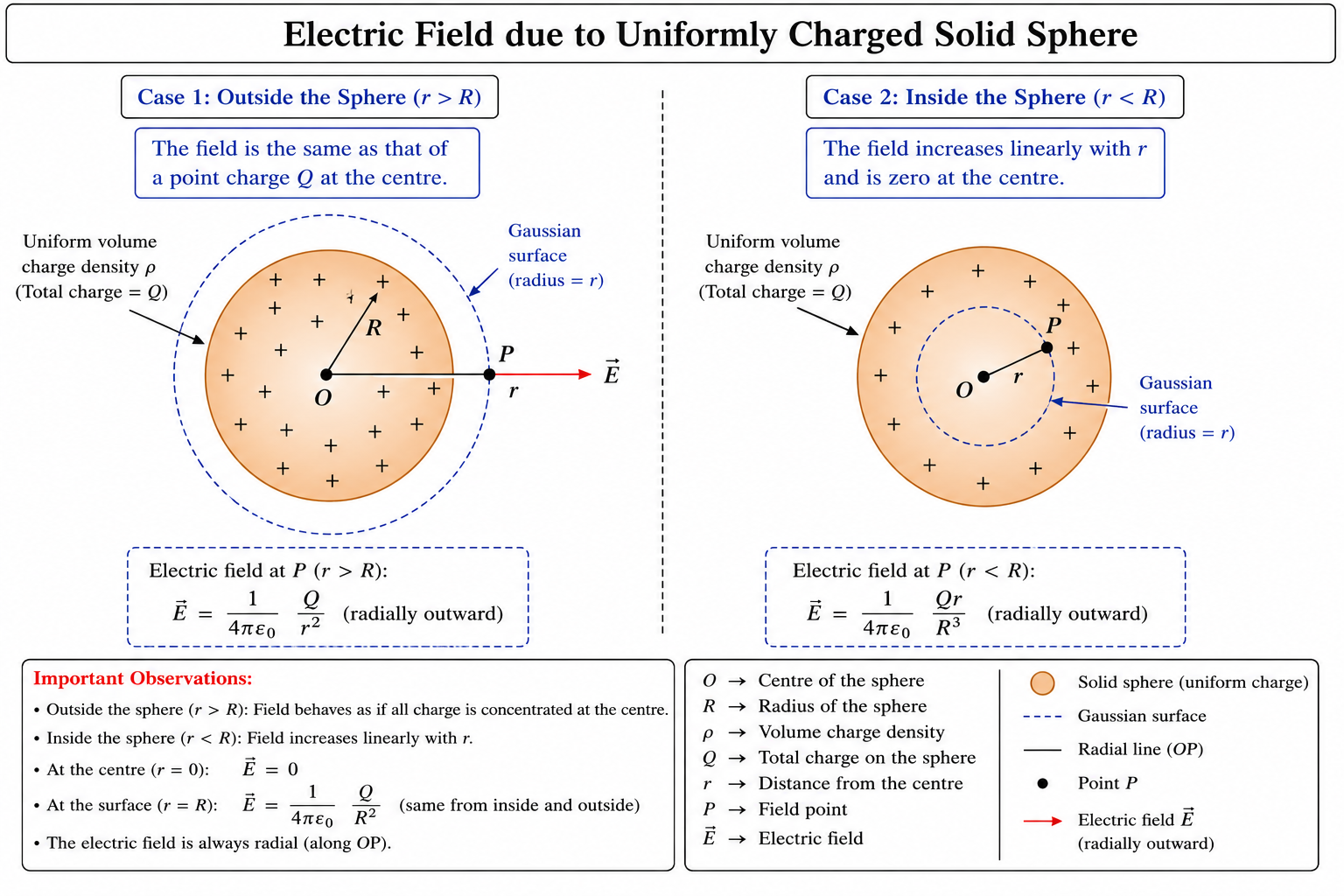
Where:
- R = Radius of sphere
- r = Distance of point P from center
- Q = Total charge on sphere
Case 1: Electric Field Outside the Sphere (r > R)
Step 1: Choose Gaussian Surface
Take a spherical Gaussian surface of radius r outside the sphere.
Step 2: Apply Gauss Theorem
Φ = Q / ε₀
Electric flux:
Φ = ∮ E·dA
Since:
- Electric field is radial.
- Magnitude of electric field is constant on Gaussian surface.
Therefore:
Φ = E ∮ dA
Surface area of sphere:
4πr²
Hence:
Φ = E(4πr²)
Step 3: Substitute in Gauss Theorem
Using:
Φ = Q / ε₀
We get:
E(4πr²) = Q / ε₀
Therefore:
E = (1 / 4π ε₀) × (Q / r²)
Final Result Outside the Sphere
r > R
E = (1 / 4π ε₀) × (Q / r²)
The sphere behaves like a point charge.
Case 2: Electric Field Inside the Sphere (r < R)
Step 1: Choose Gaussian Surface Inside Sphere
Take a spherical Gaussian surface of radius r inside the sphere.
Step 2: Find Charge Enclosed
Volume charge density:
ρ = Q / [(4/3)πR³]
Charge enclosed inside Gaussian surface:
Qenclosed = ρ × (4/3)πr³
Substitute value of ρ:
Qenclosed =
[Q / ((4/3)πR³)] × (4/3)πr³
Therefore:
Qenclosed = Qr³ / R³
Step 3: Apply Gauss Theorem
Using:
Φ = Qenclosed / ε₀
We get:
E(4πr²) = Qr³ / (ε₀R³)
Therefore:
E = Qr / (4π ε₀ R³)
Hence:
E ∝ r
Final Result Inside the Sphere
r < R
E = Qr / (4π ε₀ R³)
Important Observations
- Outside sphere → behaves like point charge.
- Inside sphere → electric field increases linearly with distance.
- Electric field is maximum at surface.
- Electric field at center is zero.
Quick Revision Table
| Region | Electric Field |
|---|---|
| Outside Sphere (r > R) | (1 / 4π ε₀) × (Q / r²) |
| Inside Sphere (r < R) | Qr / (4π ε₀ R³) |
| At Center | E = 0 |
Why Gauss Theorem and Its Applications Physics 12 is Important?
Understanding Gauss Theorem and Its Applications Physics 12 helps students solve electric field problems quickly using symmetry concepts.
The concepts explained in Gauss Theorem and Its Applications Class 12 Physics are extremely useful for CBSE board examinations, JEE Main, JEE Advanced, and NEET preparation.
Gauss Theorem:
- Simplifies electric field calculations
- Reduces lengthy integrations
- Helps solve highly symmetrical problems quickly
It is one of the most scoring topics in Electrostatics.
Regular practice of Gauss Theorem and Its Applications Physics 12 improves conceptual clarity and numerical problem-solving skills for board exams and competitive exams.
Solved Numerical of Gauss Theorem and Its Applications Physics 12
Problem
A spherical shell carries charge 5 × 10⁻⁶ C. Find electric field at a point 2 m away from center.
Take:
1 / 4π ε₀ = 9 × 10⁹
Solution
Using formula:
E = (1 / 4π ε₀) × (Q / r²)
Substitute values:
E = (9 × 10⁹ × 5 × 10⁻⁶) / (2)²
E = (45 × 10³) / 4
E = 11250 N/C
Final Answer
E = 1.125 × 10⁴ N/C
Common Mistakes Students Make
1. Using Wrong Gaussian Surface
Choose surface according to symmetry.
2. Confusing Inside and Outside Shell Field
Remember:
- Inside shell → E = 0
3. Forgetting Enclosed Charge Concept
Only enclosed charge contributes to net flux.
Quick Revision Table
| Quantity | Formula |
|---|---|
| Gauss Theorem | Φ = Q / ε₀ |
| Electric Flux | EA cosθ |
| Infinite Line Charge | λ / (2π ε₀ r) |
| Infinite Plane Sheet | σ / (2ε₀) |
| Spherical Shell Outside | (1 / 4π ε₀) × (Q / r²) |
| Spherical Shell Inside | E = 0 |
Gauss Theorem and Its Applications Class 12 Physics is a highly important chapter in Electrostatics because it helps students calculate electric fields using symmetry and Gaussian surfaces.
By mastering Gauss Theorem and Its Applications Class 12 Physics, students can easily solve difficult electrostatics problems involving electric flux and electric field intensity.
Conclusion: Gauss Theorem and Its Applications Physics 12
Gauss Theorem and Its Applications Physics 12 is one of the most important topics in Electrostatics for CBSE, JEE, and NEET preparation.
A strong understanding of Gauss Theorem and Its Applications Class 12 Physics improves conceptual clarity and helps students solve derivations and numericals faster.
For official NCERT Physics resources, students can visit NCERT Official Website
Students preparing for CBSE board exams should also check updates from CBSE Official Website
Also Read
JoSAA Freeze Float Slide | Seat Allotment Options 2026 Explained