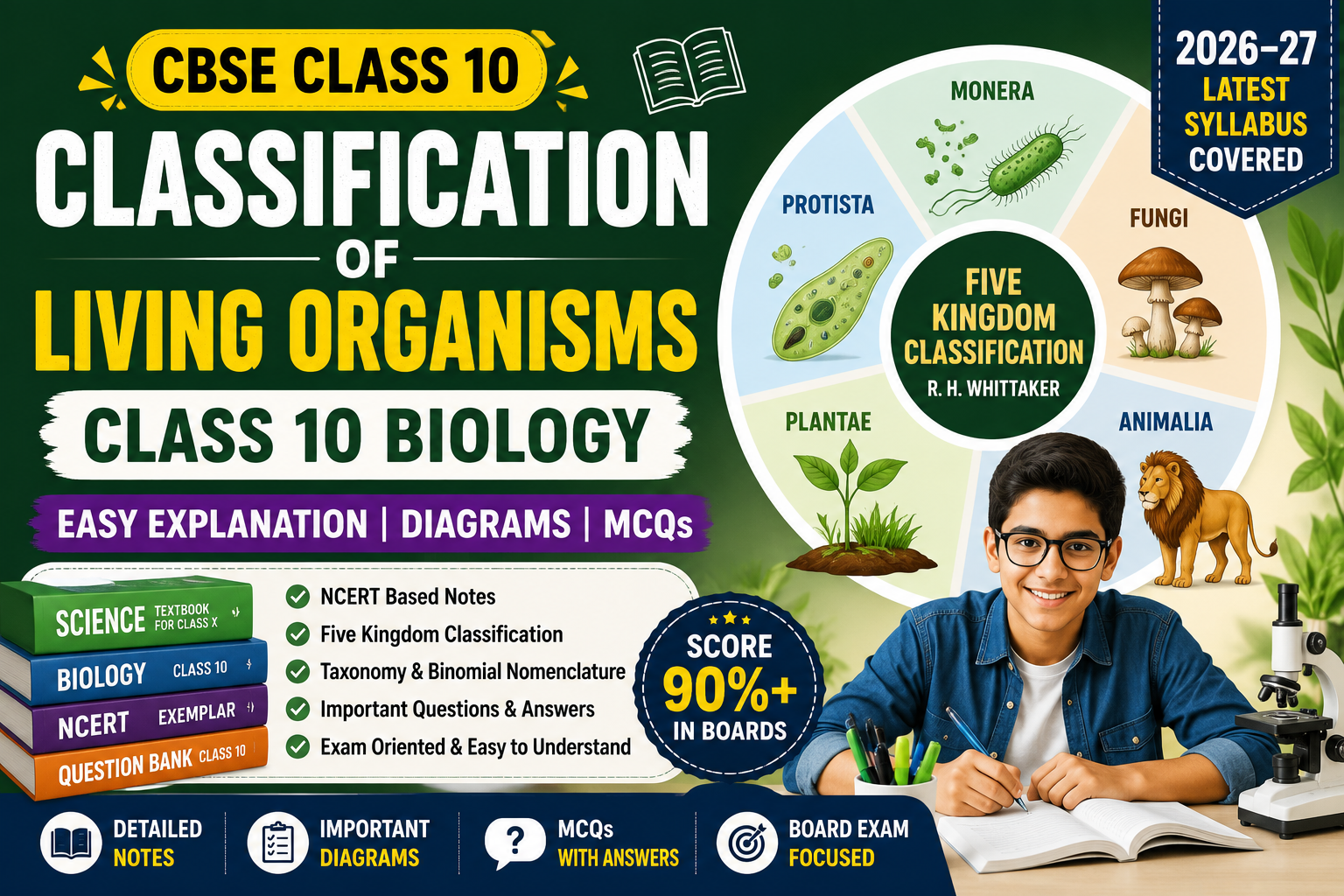
Classification of Organisms Class 10 Biology
Classification of Organisms Class 10 Biology is one of the most important chapters in CBSE Class 10 Science. It explains how scientists group living organisms based on similarities, differences, evolutionary relationships, and shared characteristics. In this complete guide, you’ll learn taxonomy, kingdoms, binomial nomenclature, examples, diagrams, MCQs, and important exam points.
The natural world is home to about 8.7 million species. These range from simple bacteria to complex beings like humans. Understanding the relationships between these diverse organisms is key in biology.
Classification of organisms is a basic idea in biology. It helps us see how different species are connected. By grouping organisms by their traits, we learn how they evolved over time.

This article will explore how organisms are classified. We’ll focus on its role in understanding evolutionary ties, as seen in Class 10 Biology.
Classification of Living Organisms Class 10 Biology is one of the most important chapters in the CBSE Class 10 Science syllabus. It introduces students to taxonomy, scientific naming, and the classification of organisms into different kingdoms.
Key Takeaways of Classification of Organisms Class 10 Biology
- Classification of organisms is vital for grasping evolutionary ties.
- Grouping organisms by traits helps us understand their evolution.
- The classification system is essential in biology.
- Appreciating diversity is important to see the complexity of life.
- Evolutionary relationships are clearer through classification.
Understanding Classification of Living Organisms Class 10 Biology helps students recognize the similarities and differences among organisms, making biological studies more systematic.
The Need for Classifying Living Organisms
Classification of Organisms Class 10 Biology is an essential chapter for CBSE students because it explains how living organisms are grouped based on their characteristics and evolutionary relationships.
Our planet is full of different life forms. With millions of species, from simple bacteria to complex animals, we need a good way to sort them out.
Diversity of Life Forms
The Earth has a wide range of life, from simple cells to complex animals. This variety is seen in the number of species and their looks, functions, and where they live.
Benefits of Systematic Classification
Understanding Classification of Organisms Class 10 Biology helps students identify similarities and differences among living organisms and prepares them for board examinations.
Systematic classification, or taxonomy, has many advantages. It helps us understand and see the connections between different organisms. By sorting them by their traits, it makes studying their evolution and how they adapt easier.
- Simplifies the study of diverse organisms
- Helps in understanding evolutionary relationships
- Facilitates communication among scientists
Classification of Organisms Class 10 Biology As A Tool for Understanding Evolution
Classification is more than just grouping organisms. It’s a key tool for learning about evolution. By looking at the traits of different groups, scientists can figure out how they are related and the history of life on Earth.
| Classification Level | Characteristics | Example |
|---|---|---|
| Kingdom | Cell structure, body organization | Animalia |
| Phylum/Division | Body structure, development | Chordata |
| Class | Morphological features | Mammalia |
Historical Development of Classification Systems
Classification systems have changed a lot over the years. They show how we’ve learned more about the variety of life. The work of classifying organisms has been key in biology. It helps scientists talk about the many different life forms.
Aristotle’s Early Classification
Aristotle was one of the first to group living things. He used simple traits to do this. His ideas helped other scientists later on.
Linnaeus and Binomial Nomenclature
Carl Linnaeus changed the game with binomial nomenclature. He named species with a genus and species name. This made the biology classification system much better.

From Two Kingdoms to Multiple Kingdoms
At first, there were only two kingdoms: plants and animals. But as we learned more about tiny life and others, we added more kingdoms. This shows a deeper understanding of life’s variety.
The way we classify things shows how biology keeps changing. It grows with new discoveries and ideas.
Taxonomy in Classification of Organisms Class 10 Biology
Taxonomy is key to understanding life on Earth. It helps us organize living things based on their traits and how they evolved. This science is vital for grasping the wide variety of life.
Taxonomic Hierarchy and Categories
The taxonomic hierarchy groups organisms into specific categories. It starts with the broadest category, the domain. Then it moves to kingdom, phylum, class, order, family, genus, and ends with species. This system makes classifying life forms detailed and organized.
Taxonomic Categories:
- Domain
- Kingdom
- Phylum/Division
- Class
- Order
- Family
- Genus
- Species
Rules of Nomenclature
Rules of nomenclature ensure each species has a unique name. The binomial nomenclature, created by Carl Linnaeus, is used worldwide. It names each species with a genus followed by a species name.
Taxonomic Aids Used in Classification of Organisms Class 10 Biology
Many tools and methods help in classifying life. These include:
| Taxonomic Aid | Description |
|---|---|
| Herbarium | A collection of preserved plant specimens used for study and reference. |
| Museum | Institutions that house collections of specimens, often including both plants and animals, for taxonomic study. |
| Key | A tool used for identifying organisms based on their characteristics, often presented in a dichotomous format. |
These aids are essential for accurate identification and classification. They help us understand the vast diversity of life.
Classification of Organisms Class10 Biology: The Five-Kingdom System
The Classification of Organisms Class 10 Biology chapter introduces the Five Kingdom Classification proposed by R.H. Whittaker, making it easier to study biodiversity systematically.
The five-kingdom system is key in biology. It shows how diverse life on Earth is. It groups living things into five kingdoms based on their cells, how they eat, and their body structure.
Kingdom Monera: Characteristics and Examples
Kingdom Monera includes prokaryotic organisms. These have no true nucleus or membrane-bound organelles. They have a single circular DNA molecule. Examples are Escherichia coli bacteria and Anabaena cyanobacteria.

Kingdom Protista: Characteristics and Examples
Kingdom Protista is diverse and eukaryotic. They can be single-celled or multicellular. They eat in different ways, like making their own food or eating others. Examples include Amoeba, Paramecium, and algae like Chlamydomonas.
Kingdom Fungi: Characteristics and Examples
Kingdom Fungi are heterotrophic. They get nutrients by breaking down organic matter or by living with other organisms. Their cell walls are made of chitin. Examples are mushrooms like Agaricus and molds like Rhizopus.
Kingdom Plantae: Characteristics and Examples
Kingdom Plantae are photosynthetic eukaryotes, or plants. They make their own food with chlorophyll. Their cell walls are made of cellulose. Examples range from simple liverworts and mosses to complex flowering plants like roses and grasses.
The five-kingdom system helps us understand life’s diversity. It makes studying different organisms easier.
Modern Three-Domain System of Classification
The way we classify living things has changed a lot with the modern three-domain system. It divides life into three main groups: Archaea, Bacteria, and Eukarya. This helps us understand how different organisms are related.
Domain Archaea: Ancient Microbes
Domain Archaea includes ancient microbes that can live in extreme conditions. They have special ways of breaking down food and unique cell walls.
Domain Bacteria: Prokaryotic Organisms
Domain Bacteria covers a wide range of microbes found in many places. They have different ways of making food and are key to ecosystems.
Domain Eukarya: Complex Cellular Organisms
Domain Eukarya includes complex cells like those of plants, animals, fungi, and protists. These cells have a true nucleus and other organelles.
Advantages Over the Five-Kingdom System
The three-domain system has many benefits over the old five-kingdom system. It shows evolutionary links more clearly and highlights the big differences between Archaea and Bacteria.
Key advantages of the three-domain system include:
- More accurate representation of evolutionary relationships
- Recognition of the distinct characteristics of Archaea and Bacteria
- Improved understanding of the diversity of life on Earth
| Domain | Characteristics | Examples |
|---|---|---|
| Archaea | Prokaryotic, extremophilic | Methanogens, Halophiles |
| Bacteria | Prokaryotic, diverse metabolic capabilities | E. coli, Cyanobacteria |
| Eukarya | Eukaryotic, complex cellular structure | Plants, Animals, Fungi |

Evolutionary Basis of Biological Classification
Understanding the evolutionary basis of biological classification is key to grasping the diversity of life. The way we classify organisms reflects their evolutionary history. This shows the changes and adaptations they’ve gone through over time.
Darwin’s Theory and Its Impact on Classification
Charles Darwin’s theory of evolution by natural selection changed biological classification. It gave us a way to see similarities and differences among organisms based on their evolutionary ties. Darwin’s work laid the foundation for modern taxonomy, showing how important evolutionary history is in classifying life.

Homologous and Analogous Organs as Evolutionary Evidence
Homologous and analogous organs are key evidence for evolution. Homologous organs share a common origin but may not have the same function today. Analogous organs have similar functions but different origins, showing convergent evolution. Both types of organs are vital in understanding evolutionary relationships.
Vestigial Structures and Their Significance
Vestigial structures are features that have lost their original function but are present in a species. They show evidence of evolutionary history, as they are remnants of traits important to an organism’s ancestors. The presence of vestigial structures supports the theory of evolution, showing the changes that have happened over time.
Connecting Classification with Evolutionary History
Modern biological classification systems aim to reflect the evolutionary history of organisms. By grouping organisms based on their evolutionary relationships, these systems help us understand the diversity of life. This approach not only helps in identifying and categorizing organisms but also in understanding their evolutionary paths.
Plant Kingdom: Classification and Evolutionary Trends
It’s important to understand the Plant Kingdom’s classification and evolution. This kingdom includes everything from simple plants to complex ones with seeds. Each type has its own special features and ways to survive.
Non-vascular Plants: Thallophytes and Bryophytes
Non-vascular plants are the simplest. They don’t have a system to move water and nutrients. Thallophytes are simple and often live in water. Bryophytes are more complex and include mosses and liverworts.
Vascular Cryptogams: Pteridophytes
Pteridophytes are a big step up. They have vascular tissues, which help move water and nutrients. This group includes ferns and their relatives.
Seed Plants: Gymnosperms and Angiosperms
Seed plants are the most advanced. They are split into Gymnosperms and Angiosperms. Gymnosperms have seeds without flowers. Angiosperms have seeds in fruits, showing a more complex way of making seeds.
Evolutionary Progression in Plant Kingdom
The Plant Kingdom has grown more complex over time. It started with simple plants and moved to ones with vascular tissues and seeds. These changes have helped plants live in many different places.
| Plant Group | Characteristics | Examples |
|---|---|---|
| Non-vascular Plants | Lack vascular tissues, simple structure | Thallophytes, Bryophytes |
| Vascular Cryptogams | Vascular tissues present, no seeds | Pteridophytes (Ferns) |
| Seed Plants | Produce seeds, advanced reproductive strategies | Gymnosperms, Angiosperms |
Animal Kingdom: Classification and Evolutionary Relationships
The Animal Kingdom is home to a wide range of life forms. From simple invertebrates to complex vertebrates, each has its own unique features and evolutionary history. This diversity comes from millions of years of evolution, adapting to different environments and ecological niches.
Major Invertebrate Phyla and Their Characteristics
Invertebrates, lacking a backbone, make up most of the Animal Kingdom. They are grouped into several phyla based on their body structure and developmental traits.
- Porifera: Simple multicellular animals, commonly known as sponges.
- Cnidaria: Includes jellyfish, corals, and sea anemones, known for their stinging cells.
- Platyhelminthes: Flatworms, such as tapeworms and liver flukes, often parasitic.
- Mollusca: A wide range, including snails, slugs, clams, and octopuses.
- Arthropoda: The largest phylum, including insects, arachnids, and crustaceans.
Vertebrate Classes and Their Distinguishing Features
Vertebrates have a backbone or spinal column. They are divided into several classes, each with unique features.
- Pisces: Fish, which are mainly aquatic and breathe through gills.
- Amphibia: Includes frogs and salamanders, undergoing metamorphosis from aquatic to terrestrial environments.
- Reptilia: Reptiles, such as snakes, lizards, and turtles, often laying eggs and having scales.
- Aves: Birds, characterized by feathers, beaks, and laying eggs.
- Mammalia: Mammals, which are warm-blooded, have hair, and produce milk for their young.
Evolutionary Trends from Simple to Complex Animals
The evolutionary history of the Animal Kingdom shows a trend from simplicity to complexity. Early animals were simple and often unicellular. Over time, they evolved into more complex multicellular forms.
Connecting Classification with Habitat and Adaptations
The classification of animals is closely linked to their habitats and adaptations. Different environments have led to the development of unique adaptations. These adaptations enable animals to survive and thrive in various ecological niches.
Understanding these evolutionary relationships and adaptations is key to a complete classification of the Animal Kingdom. It reflects the complex diversity of life on Earth.
Modern Approaches to Classification of Organisms Class 10 Biology
The field of taxonomy has seen big changes with new classification methods. These new ways have greatly helped us understand how different life forms are related.
Phylogenetic Classification and Cladistics
Phylogenetic classification looks at how organisms evolved together. It groups them based on their shared history. Cladistics is a part of this, focusing on the traits they share.
- Cladistics puts a big focus on groups that come from a common ancestor.
- It helps us see how different life forms are connected.
- Cladograms show these connections in a clear way.
Molecular Taxonomy and DNA Barcoding
Molecular taxonomy uses genetics to sort out organisms. DNA barcoding is a special part of this, using a short genetic code to spot species.
Key benefits of DNA barcoding include:
- It lets us quickly identify species.
- It makes classifying more accurate.
- It helps find hidden species.
Bioinformatics in Taxonomic Studies
Bioinformatics is key in modern taxonomy. It gives tools to work with big data. It helps compare genetic sequences and find patterns.
- Bioinformatics helps manage and find taxonomic data.
- It makes it easier to analyze complex genetic info.
Integrating Traditional and Modern Classification Methods
Mixing old and new methods has changed taxonomy a lot. Old methods use shape and structure, while new ones look at genetics and evolution.
Benefits of integration include:
- It makes classifying more accurate.
- It gives a deeper look into evolutionary history.
- It helps solve taxonomic debates.
By using both, scientists get a clearer picture of how life is classified.
📚 Recommended Articles
• Life Processes Class 10 Notes
• Our Environment Bio Class 10 Smart Study Guide
• Reproductive System in Humans Bio Class 10
• Management of Natural Resources Class 10
• Human Digestive System Bio Class 10
Conclusion: Significance of Classification of Organisms Class 10 Biology
Understanding how organisms are classified is key in biology. It helps us see how different life forms are connected. The biology curriculum for class 10 highlights how taxonomy organizes life on Earth.
Classification is more than just grouping living things. It’s a tool for understanding life’s complex web and its history. Scientists use taxonomy to study organisms’ traits. This helps us understand their biology and roles in nature.
Classification’s impact goes beyond school. It affects conservation, medicine, and agriculture. Knowing how organisms relate helps tackle issues like biodiversity loss and finding new disease treatments.
In summary, studying how organisms are classified is vital. It helps us understand the world and our place in it. As we find new species, the role of classification in biology will keep growing.
The concepts discussed in this article follow the latest NCERT syllabus. For the official Class 10 Science textbook and chapter-wise content, students can also refer to the NCERT Science Textbook.
To learn more about biodiversity, species classification, and conservation around the world, you can also visit the World Wildlife Fund (WWF) website.
FAQ: Classification of Organisms Class 10 Biology
The following FAQs cover the most frequently asked questions from Classification of Organisms Class 10 Biology in CBSE board examinations.
What is the importance of classification in biology?
Classification is key in biology. It helps us understand the variety of life and how they are related. It also makes it easier to identify and name living things.
Who is credited with developing the binomial nomenclature system?
Carolus Linnaeus created the binomial nomenclature system. It uses a two-part name for each organism, including genus and species.
What are the main categories used in the taxonomic hierarchy?
The main categories are Domain, Kingdom, Phylum, Class, Order, Family, Genus, and Species. These help organize living things.
What is the difference between homologous and analogous organs?
Homologous organs share a common ancestor. They look similar but have different functions. Analogous organs, on the other hand, look similar but have different origins.
What is the significance of vestigial structures in understanding evolution?
Vestigial structures are old parts of an organism that have lost their original function. They show how an organism has evolved over time.
How does the three-domain system differ from the five-kingdom system?
The three-domain system divides life into Archaea, Bacteria, and Eukarya. The five-kingdom system divides life into Monera, Protista, Fungi, Plantae, and Animalia.
What is molecular taxonomy, and how is it used in classification?
Molecular taxonomy uses DNA and protein sequences to classify organisms. It’s a precise and objective way to group living things.
What is cladistics, and how is it used in phylogenetic classification?
Cladistics groups organisms based on their evolutionary history. It uses shared traits to build phylogenetic trees.
How does bioinformatics contribute to taxonomic studies?
Bioinformatics uses computers to analyze biological data, like DNA sequences. It helps in understanding and classifying living things.
What are the benefits of integrating traditional and modern classification methods?
Combining old and new methods gives a deeper understanding of life’s diversity. It uses the best of both worlds to improve how we classify organisms.
The concepts covered in Classification of Living Organisms Class 10 Biology form the foundation for advanced Biology topics studied in higher classes.
To stay updated with the latest syllabus, sample papers, and academic resources, students should regularly visit the CBSE Academic website.
Reviewed by Vijay Kumar Sinha
Academic Educator | PCM Concept Clear
Specialized in creating CBSE Class 9–12 study resources based on the latest NCERT and CBSE syllabus.
1 thought on “Master Classification of Organisms Class 10 Biology: Latest Notes, MCQs & FAQs (2026–27)”