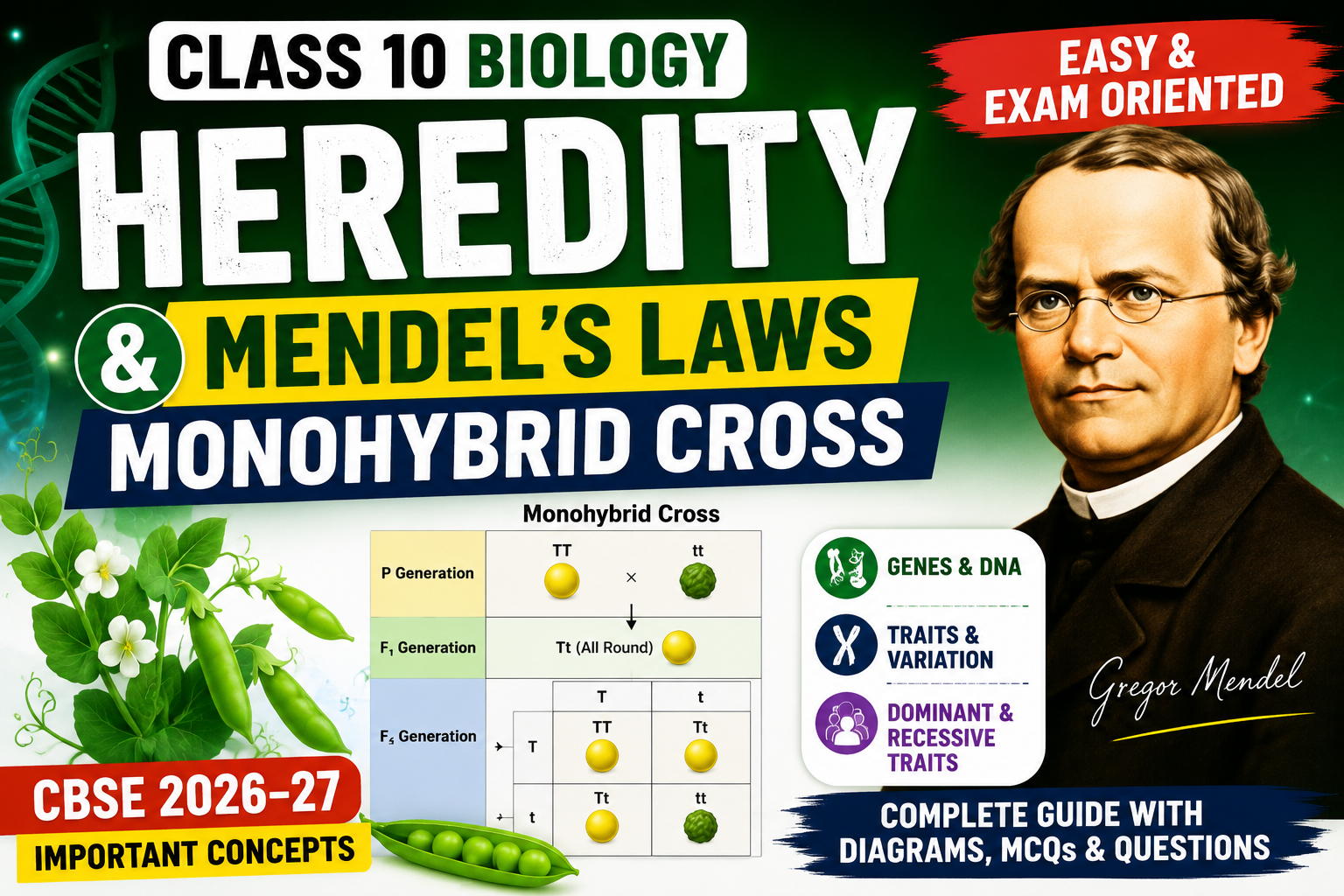
Heredity Bio Class 10 is an important topic in the CBSE Class 10 Science syllabus that explains how traits are transferred from parents to their offspring. It helps students understand genes, DNA, inherited traits, variation, dominant and recessive characters, genotype, and phenotype. The study of heredity also introduces the important experiments of Gregor Mendel and his Laws of Inheritance.
In this easy and exam-oriented guide, you will learn Mendel’s Laws, monohybrid cross, genes and DNA, dominant and recessive traits, genotype and phenotype, and the importance of variation with simple explanations and examples. These Heredity Bio Class 10 notes are useful for NCERT preparation, CBSE Board Exam 2026–27, MCQs, and important questions.
If you are revising the Class 10 Biology syllabus, you can also study our detailed guide on Evolution Bio Class 10, which explains variation, natural selection, fossils, and other important concepts.

The study of genetics is key to understanding life’s complexity. Mendel’s laws, like the law of dominance and segregation, are the base of modern genetics. The CBSE Syllabus 2023-24, Chapter 8, teaches students about heredity and genetics basics.
Heredity Bio Class 10 explains how genetic information is transferred from parents to offspring and how inherited characteristics appear in successive generations.
The concepts covered in this Heredity Bio Class 10 guide are based on the NCERT Science curriculum. Students can also refer to the official NCERT textbooks for detailed chapter content and textbook-based preparation.
Key Takeaways from Heredity Bio Class 10
- Understanding Mendel’s laws is essential for grasping the principles of genetics.
- The law of dominance explains how different traits are expressed.
- The study of genetics helps in understanding the complexity of life.
- Mendel’s work on pea plants laid the foundation for modern genetics.
- The CBSE Syllabus 2023-24 covers Mendel’s laws in Chapter 8.
Understanding the Basics of Heredity and Genetics
The study of heredity and genetics uncovers how traits are passed down. Heredity is about the transfer of characteristics from parents to their kids through genes.
What is Heredity?
Heredity is the core of genetics, dealing with the passing of traits from one generation to the next. It follows the rules of inheritance, showing how genes are shared and shown.
Understanding heredity helps us see why family members often share traits like eye color and height. It’s key in genetics and affects medicine and farming.
The Role of Genes in Inheritance
Genes are the basic units of heredity, carrying information from one generation to the next. They are parts of DNA that code for proteins, affecting traits and characteristics.
Genes are vital in shaping an organism’s traits, from simple things like eye color to complex conditions like disease risk. Studying genes helps us grasp genetic inheritance.
Chromosomes and DNA: The Carriers of Genetic Information
Chromosomes are long, thin structures in cells’ nuclei, carrying genes and playing a key role in passing genetic info. DNA, or deoxyribonucleic acid, makes up chromosomes and holds the genetic instructions for life.
The DNA structure and chromosome organization are key to understanding genetic info storage, replication, and passing on to future generations.
Gregor Mendel: The Father of Modern Genetics
Gregor Mendel’s work on pea plants changed how we understand inheritance.
Gregor Johann Mendel is called the ‘Father of Genetics’ for his groundbreaking work. He was born on July 20, 1822, in Heinzendorf, Austria (now Hynčice, Czech Republic). Mendel was a monk who loved botany and mathematics.
Mendel’s Life and Background
Mendel’s work was shaped by his love for botany and genetics. He joined the Augustinian monastery in Brno. There, he had the resources and support to do his experiments.
Why Mendel Chose Pea Plants for His Experiments
Mendel picked pea plants (Pisum sativum) for his research. They were perfect because:
- Pea plants breed quickly, letting Mendel study many generations fast.
- They can be easily crossed and self-pollinated, giving Mendel control.
- Pea plants show clear traits, making it simple to track inheritance.
Seven Traits of Pea Plants Studied by Mendel
Mendel looked at seven traits in pea plants, including:
- Flower color (purple or white)
- Seed shape (smooth or wrinkled)
- Seed color (green or yellow)
- Pod shape (inflated or constricted)
- Pod color (green or yellow)
- Plant height (tall or short)
- Position of flowers (axial or terminal)
By studying these traits, Mendel created the laws of inheritance. These laws are the basis of modern genetics.
Heredity Bio Class10: Core Concepts and Terminology
Understanding heredity is key to learning genetics. Heredity is how traits are passed from parents to kids through genes.
Key terms in heredity include alleles, genes, and loci. Alleles are different forms of a gene that occupy the same position on a chromosome. For example, pea plants have different alleles for flower color.
Alleles, Genes, and Loci
Genes are the basic units of heredity. They are parts of DNA that code for traits. A locus is where a gene is found on a chromosome. Knowing these terms helps us understand how traits are inherited.
- Alleles: Different forms of a gene.
- Genes: Basic units of heredity.
- Loci: Specific locations of genes on chromosomes.
For more Class 10 Biology revision, students can also revise Our Environment Bio Class 10, covering ecosystems, food chains, food webs, and ecological pyramids.

Dominant and Recessive Traits: Heredity Bio Class 10
In Heredity Bio Class 10, dominant and recessive traits are important concepts for understanding the results of Mendelian crosses.
Traits can be dominant or recessive. Dominant traits show up when an individual has one or two copies of the dominant allele. Recessive traits need two copies of the recessive allele to show. This is important for understanding trait inheritance.
Genotype vs. Phenotype
Students preparing Heredity Bio Class 10 should clearly understand the difference between genotype and phenotype.
The genotype is an individual’s genetic makeup. The phenotype is their physical traits. Knowing the difference helps predict offspring traits.
| Genotype | Phenotype |
|---|---|
| BB or Bb | Dominant trait expressed |
| bb | Recessive trait expressed |
Homozygous and Heterozygous Conditions
An individual can be homozygous or heterozygous for a gene. Homozygous individuals have two identical alleles (e.g., BB or bb). Heterozygous individuals have two different alleles (e.g., Bb). This is important for predicting trait inheritance.
Mendel’s Laws of Inheritance in Heredity Bio Class 10
Understanding Heredity Bio Class 10 becomes easier when Mendel’s experiments and the basic principles of inheritance are studied step by step.
Mendel’s laws are key to understanding how traits are passed down through generations. These laws include dominance, segregation, and independent assortment. They are the basis of genetics today.
Law of Dominance
The law of dominance says one allele can be more powerful than another. This means the dominant allele is seen in the phenotype. If an individual has two different alleles, the dominant one will show, hiding the recessive one.
Example: In a cross between a tall pea plant (T) and a short one (t), T is dominant. So, Tt will show as tall because T is dominant.
Law of Segregation (First Law)
The law of segregation says alleles separate during gamete formation. This law keeps genetic variation alive and explains how traits are passed on.
- Each pair of alleles separates during meiosis.
- Gametes get only one allele for each gene.
Law of Independent Assortment (Second Law)
The law of independent assortment says genes are sorted separately during gamete formation. This means one gene’s inheritance doesn’t affect another’s.
Example: In a dihybrid cross, alleles for two genes are sorted separately. This leads to many genotypic combinations in offspring.
Exceptions to Mendel’s Laws in Heredity Bio Class 10
While Mendel’s laws are fundamental, there are exceptions. These include incomplete dominance, codominance, and polygenic inheritance.
| Exception | Description | Example |
|---|---|---|
| Incomplete Dominance | Neither allele is completely dominant, resulting in a blended phenotype. | Red and white flowers producing pink offspring. |
| Codominance | Both alleles are equally expressed, resulting in a combined phenotype. | AB blood type in humans. |
| Polygenic Inheritance | Multiple genes influence a single trait, resulting in a range of phenotypes. | Human skin color. |
Understanding Monohybrid Cross in Detail
The Heredity Bio Class 10 syllabus gives special importance to the monohybrid cross because it demonstrates how a single pair of contrasting traits is inherited.
In genetics, a monohybrid cross is when two different organisms are crossed on a single trait. This method is key to learning about heredity. It’s a big part of what students learn in heredity bio class10.
What is a Monohybrid Cross?
A monohybrid cross studies a single trait, like flower color or seed shape, in offspring. It’s done by crossing two parents that are different in that trait.
This method helps predict the chances of different traits in the offspring.
Heredity Bio Class 10: Procedure and Steps in a Monohybrid Cross
To do a monohybrid cross, follow these steps:
- Choose parent organisms with different traits.
- Cross the parents to get the F1 generation.
- Self-pollinate or cross-pollinate the F1 to get the F2 generation.
- Look at the genotypes and phenotypes of the F1 and F2.

Punnett Square Method for Monohybrid Cross
The Punnett square is a tool to predict offspring genotypes. It’s very useful for monohybrid crosses. It shows the chances of different traits in the F1 and F2 generations.
The Punnett square makes predicting genetic traits easier by showing possible genotypes.
Analyzing F1 and F2 Generations
The F1 generation is the first offspring from the parents. The F2 generation comes from self-pollination or cross-pollination of the F1.
Looking at the F1 and F2 helps us see how alleles segregate and traits are expressed. The ratios of genotypes and phenotypes in these generations reveal genetic principles.
Practical Applications and Examples of Monohybrid Cross
Monohybrid cross is key in genetics for predicting trait inheritance. It helps us understand how traits are passed down. This is vital for genetic counseling and managing hereditary disorders.
Solving Monohybrid Cross Problems
To solve monohybrid cross problems, we look at the parents’ genotypes. We use the Punnett square to predict offspring genotypes and phenotypes. This tool is essential for geneticists to forecast trait inheritance.
For example, let’s say we have two pea plants. One has tall stems (T) and the other has short stems (t). We can use the Punnett square to see what the offspring might look like.

Predicting Offspring Traits
Predicting traits in offspring involves analyzing the parents’ genotypes. This is critical in genetic counseling. It helps us understand the risk of certain traits or disorders being passed on.
The key steps include:
- Determining the parents’ genotypes
- Using the Punnett square to predict offspring traits
- Calculating the probability of trait expression
Real-life Examples of Monohybrid Inheritance in Humans
Monohybrid inheritance isn’t just for plants; it happens in humans too. A well-known example is sickle cell anemia. It’s caused by a mutation in the HBB gene and follows an autosomal recessive pattern.
| Genotype | Phenotype |
|---|---|
| HH or Hh | Normal |
| hh | Sickle Cell Anemia |
Understanding monohybrid inheritance is vital for predicting genetic traits and disorders. This knowledge is essential for genetic counseling and managing hereditary disorders.
Beyond Monohybrid: Dihybrid and Complex Inheritance Patterns
Dihybrid crosses help us understand how multiple traits are inherited. This is key to grasping the full picture of genetic inheritance.
Introduction to Dihybrid Crosses
A dihybrid cross involves two organisms with different traits. Scientists use this to study how traits are inherited together. It gives a deeper look into genetic interactions.
Dihybrid crosses are important in genetics. They help predict the traits passed to offspring. By studying these crosses, researchers learn about complex genetic mechanisms.

Comparing Monohybrid and Dihybrid Crosses
Monohybrid crosses focus on one trait. Dihybrid crosses look at two traits. This lets dihybrid crosses show how genes work together during inheritance.
- Monohybrid crosses involve one trait and are used to understand basic principles of inheritance.
- Dihybrid crosses involve two traits and provide insights into how genes interact.
Incomplete Dominance and Codominance
Incomplete dominance means one allele doesn’t fully dominate another. This results in a blended phenotype. Codominance occurs when both alleles equally affect the phenotype, showing both.
Many organisms, like plants and animals, show incomplete dominance and codominance. Knowing these concepts helps predict genetic cross outcomes.
Multiple Alleles and Blood Groups
The ABO blood group system is a prime example of multiple alleles. It has three alleles (A, B, and O) that determine blood type. This shows how different alleles can lead to various phenotypes.
Understanding multiple alleles is critical for genetic counseling. It helps predict the likelihood of certain traits being passed on.
Genetic Variations and Hereditary Disorders in Humans
Another important part of Heredity Bio Class 10 is variation, which explains why offspring are not always identical to their parents.
It’s important to know about genetic variations to understand hereditary disorders. These variations are differences in DNA among people. They can affect how genes work and are shown. This can cause hereditary disorders, passed down from parents to kids.
Causes of Genetic Variations
Genetic variations come from many sources, including:
- Mutations: Spontaneous or environmental changes in DNA.
- Genetic recombination: Gene shuffling during reproduction.
- Gene expression: How genes guide protein creation.
These variations can cause different traits, some harmful, leading to disorders.
Common Hereditary Disorders in the Indian Population
In India, many hereditary disorders exist, such as:
- Sickle Cell Anemia: Affects hemoglobin, causing abnormal red blood cells.
- Thalassemia: Affects hemoglobin, causing anemia.
- Hemophilia: Impairs clotting, needed to stop bleeding.
These disorders have big health impacts and need proper care.
Role of Genetic Counseling and Modern Diagnostic Techniques
Genetic counseling helps people understand genetic risks. Modern tools, like:
- Genetic testing: Finds genetic disorders and mutations.
- Prenatal diagnosis: Detects disorders in the fetus during pregnancy.
These tools help diagnose and manage disorders. They give people the info to make reproductive choices.
Knowing about genetic variations and disorders helps people understand risks. Genetic counseling and modern tools are key in this journey.
You can continue your Class 10 Science preparation with our Classification of Living Organisms Class 10 Biology guide for easy explanations and important questions.
To explore genetics, genes, DNA, and inheritance in greater detail, students can also consult the educational resources provided by the National Human Genome Research Institute.
Conclusion: Heredity Bio Class 10
The study of heredity and genetics is key to understanding life and the natural world. Mendel’s laws are at the heart of genetics, giving us insights into how traits are passed down. This knowledge helps us understand the patterns of inheritance.
Learning about mendelian laws and monohybrid crosses helps students see how genes and the environment interact. This knowledge is important for many areas, like medicine, agriculture, and biotechnology. It helps us make new discoveries and improve our understanding of life.
Genetics and heredity are vital for seeing the diversity of life on Earth. As we learn more about genetics, we appreciate the complex ways life works. It shows us the amazing mechanisms that govern our world.
Overall, Heredity Bio Class 10 becomes much easier when Mendel’s laws, monohybrid cross, genes, DNA, dominant and recessive traits, genotype, phenotype, and variation are studied together.
For the latest curriculum, examination-related information, and official academic resources, students preparing for the CBSE Class 10 Board Exam should also check the official CBSE Academic website.
FAQ: Heredity Bio Class 10
The following Heredity Bio Class 10 FAQs cover common questions students encounter during revision.
What is heredity?
Heredity is the passing of traits from parents to their offspring. It happens through genetic information.
Who is the father of modern genetics?
Gregor Mendel is known as the father of modern genetics. He worked on heredity and found the basic laws of inheritance.
What are Mendel’s laws of inheritance?
Mendel’s laws explain how traits are passed down. They include the law of dominance, segregation, and independent assortment.
What is a monohybrid cross?
A monohybrid cross studies a single trait. It helps understand how that trait is inherited.
What is the difference between genotype and phenotype?
Genotype is an organism’s genetic makeup. Phenotype is the physical traits that result from the genotype.
What is genetic counseling?
Genetic counseling helps people understand genetic risks. It guides them in planning their family.
What are some common hereditary disorders in humans?
Common disorders include sickle cell anemia, cystic fibrosis, and thalassemia. They are caused by genetic mutations.
How do genetic variations occur?
Variations can happen through mutations, genetic recombination, or environmental factors. These affect gene expression.
What is the role of chromosomes and DNA in heredity?
Chromosomes carry genes, which are the basic units of heredity. DNA contains the genetic instructions for all living organisms.
What is the significance of Mendel’s work in modern genetics?
Mendel’s work is key to modern genetics. It provides a solid understanding of inheritance laws. This knowledge impacts genetics, biotechnology, and medicine.