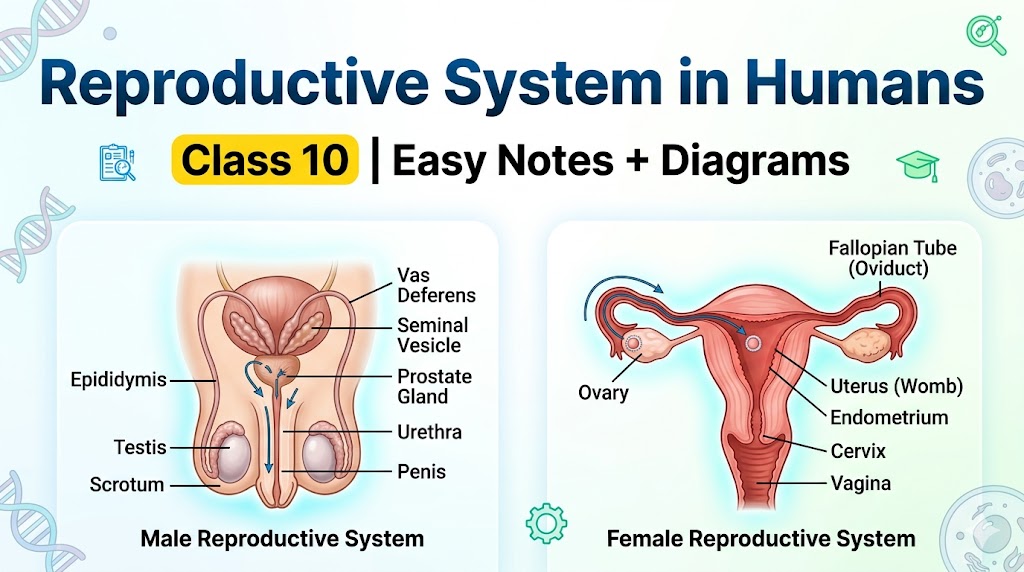
Reproductive System in Humans Bio Class 10 is an important chapter in CBSE Biology. In this topic, students learn about male and female reproductive systems with diagrams and functions.
The human reproductive system is complex and fascinating. It’s key for the human species to continue. Millions of people worldwide learn about and explore human reproductive anatomy every day.
To understand human reproduction better, you should also read Human Digestive System Bio Class 10.

Knowing about reproductive anatomy helps us understand human biology. The male and female systems have unique parts. These parts work together to create a new life.
Key Takeaways: Reproductive System in Humans Bio Class 10
- The human reproductive system is vital for the continuation of the human species.
- Understanding reproductive anatomy is essential for appreciating human biology.
- The male and female reproductive systems have distinct components.
- Knowledge of the reproductive system is key for reproductive health.
- The reproductive system is a complex process involving multiple organs.
The Fundamentals of Human Reproduction
Understanding human reproduction is key to grasping its biological and evolutionary aspects. It’s a complex process that needs the teamwork of many body systems.
Biological Purpose and Evolutionary Significance
The main goal of the human reproductive system is to create offspring. This ensures the survival of our species. It’s shaped by genetics and the environment.
Reproduction’s role in evolution is huge. It allows for genetic diversity. This diversity is vital for our species to adapt and evolve.
Key aspects of the biological purpose and evolutionary significance include:
- Production of gametes (sperm and eggs) through gametogenesis
- Fertilization and the formation of a zygote
- Development of the embryo and fetus
The concept of Reproductive System in Humans Bio Class 10 helps students understand human reproduction clearly.
Reproduction is also a part of life processes, so check Life Processes Class 10 Notes.
Sexual Dimorphism in Human Reproduction
Sexual dimorphism shows the differences between males and females. In human reproduction, this is seen in the unique reproductive systems of each sex.
The male system is made for sperm production and delivery. The female system is for egg production, fertilization, and nurturing the fetus.
The main differences between male and female reproductive systems are:
- Males produce sperm through spermatogenesis, while females produce eggs through oogenesis.
- The male reproductive system includes external genitalia (penis and scrotum) and internal ducts (epididymis, vas deferens).
- The female reproductive system includes external genitalia (vulva) and internal organs (ovaries, fallopian tubes, uterus, and vagina).
Male Reproductive System in Humans Bio Class 10: External Anatomy
It’s important to know about the male reproductive system’s outside parts. These parts are key to how it works.
Penis: Structure and Function
The penis is a main part of the male reproductive system. It helps deliver sperm during ejaculation. It has different parts like the root, shaft, and glans penis.
The glans penis is very sensitive. It plays a big role in getting sexually excited.
The penis gets hard when it’s filled with blood during arousal. This is important for sex and making a baby.
Scrotum and Testes
The scrotum is a skin sac that holds the testes. It keeps the testes at the right temperature for sperm to grow. The testes make sperm and testosterone, a hormone important for men.
- The scrotum keeps the testes cool, which is good for sperm growth.
- The testes make sperm through a process called spermatogenesis.
Diagram Analysis: External Male Reproductive Organs
Diagrams show the male reproductive system’s outside parts, like the penis, scrotum, and testes. It’s helpful to understand these diagrams to see how these parts fit together.

Looking at diagrams helps us learn more about the male reproductive system’s outside parts. It shows how they work together in making babies.
Male Reproductive System in Humans Bio Class 10: Internal Anatomy
The male reproductive system’s internal parts are key to reproduction. They handle everything from making sperm to ejaculation.
Testes: Microscopic Structure
The testes produce sperm and hormones vital for male health. They have seminiferous tubules where sperm are made.
Spermatogenesis turns immature cells into sperm. It goes through stages like proliferation, meiosis, and differentiation.
Duct System: Epididymis, Vas Deferens, and Urethra
The duct system is vital for sperm storage and transport. The epididymis matures and stores sperm. The vas deferens carries sperm to the urethra for ejaculation.
The urethra is where sperm leave the body. It also connects with the urinary system, showing the overlap between reproductive and urinary systems in males.
| Component | Function |
|---|---|
| Epididymis | Sperm maturation and storage |
| Vas Deferens | Sperm transport during ejaculation |
| Urethra | Final pathway for sperm exit |
Accessory Glands: Prostate, Seminal Vesicles, and Bulbourethral Glands
Accessory glands add a lot to the seminal fluid. They provide nutrients and a medium for sperm to travel.
The prostate gland adds to semen. The seminal vesicles produce a lot of the fluid that feeds sperm. The bulbourethral glands release a lubricating fluid before ejaculation.
| Gland | Secretion Function |
|---|---|
| Prostate Gland | Contributes to semen composition |
| Seminal Vesicles | Nourishes sperm |
| Bulbourethral Glands | Lubrication prior to ejaculation |
In exams, questions from Reproductive System in Humans Bio Class 10 are frequently asked.
Female Reproductive System in Humans Bio Class 10: External Anatomy
The female reproductive system’s outside parts are made to protect and help with reproduction. We will look closely at the outside female organs, their shape, and what they do.
Vulva: Structure and Components
The vulva is the outside part of the female reproductive system. It has several important parts.
- The mons pubis is the fatty area over the pubic bone, covered in pubic hair.
- The labia majora are the outer lips of the vulva, protecting the inner reproductive organs.
- The labia minora are the inner lips, surrounding the openings to the urethra and vagina.
- The clitoris is a highly sensitive organ involved in female sexual arousal.
Diagram Analysis: External Female Reproductive Organs
Looking at diagrams of the outside female reproductive organs helps us understand them better.

The diagram shows the different parts of the vulva and where they are. It helps us see how the outside female reproductive anatomy works.
Detailed Explanation with a Table
The table below lists the main parts of the vulva and what they do:
| Component | Function |
|---|---|
| Mons Pubis | Protects the pubic bone |
| Labia Majora | Protects the inner reproductive organs |
| Labia Minora | Surrounds the openings to the urethra and vagina |
| Clitoris | Involved in female sexual arousal |
Knowing about the outside parts of the female reproductive system is key. It helps us understand its role in reproduction and health.
Female Reproductive System in Humans Bio Class 10: Internal Anatomy
It’s important to know about the female reproductive system to understand how humans make babies. This system is made up of many parts that work together. They help create and care for a new life.

Ovaries: Structure and Function
The ovaries are two oval organs on each side of the uterus. They make eggs and hormones. These hormones control the menstrual cycle and help with pregnancy.
Inside the ovaries, there are thousands of follicles. Each follicle has an egg that can be released during ovulation.
Fallopian Tubes and Uterus
The fallopian tubes connect the ovaries to the uterus. They let the egg travel from the ovary to the uterus. The uterus, or womb, supports a fertilized egg during pregnancy.
The uterus has a lining called the endometrium. It gets thicker in hopes of holding a fertilized egg. If there’s no pregnancy, it sheds during menstruation.
The fallopian tubes are key for fertilization. They’re where sperm meet and fertilize the egg. The uterus is where the fertilized egg implants and grows.
Vagina and Cervix
The vagina is a muscular canal that connects the cervix to the outside. It’s for menstrual flow, childbirth, and sex. The cervix makes mucus that changes to help or block sperm.
These parts of the female reproductive system work together. They support reproductive physiology. This includes egg release, hormone production, and caring for a growing fetus.
Reproductive System in Humans Bio Class 10: Hormonal Regulation
The reproductive system in humans is controlled by hormones. These hormones are key to regulating reproductive processes. They influence many physiological functions.
Practicing diagrams of Reproductive System in Humans Bio Class 10 helps in better understanding. The topic Reproductive System in Humans Bio Class 10 is frequently asked in CBSE exams.
Male Hormonal Control
In males, the hypothalamus releases gonadotropin-releasing hormone (GnRH). This hormone makes the pituitary gland release luteinizing hormone (LH) and follicle-stimulating hormone (FSH). LH helps the testes produce testosterone, which is vital for sperm production and male traits.
Testosterone levels are kept in check by a feedback loop. When testosterone is high, it stops GnRH and LH from being released. FSH, along with testosterone, helps with sperm production by supporting the Sertoli cells.
Female Hormonal Control
In females, the hypothalamus also releases GnRH. This hormone triggers the pituitary gland to release LH and FSH. FSH helps the ovaries grow and mature follicles, which make estrogen. Estrogen helps the uterus lining grow and prepares it for pregnancy.
LH surge causes ovulation, releasing an egg from the dominant follicle. After ovulation, the follicle turns into the corpus luteum. It then releases progesterone, which keeps the uterus lining and supports early pregnancy.
Hypothalamic-Pituitary-Gonadal Axis
The hypothalamic-pituitary-gonadal (HPG) axis controls reproductive functions. It involves the hypothalamus, pituitary gland, and gonads (testes in males and ovaries in females).
The HPG axis is a feedback loop. Sex steroids (testosterone and estrogen) from the gonads regulate GnRH, LH, and FSH secretion in the hypothalamus and pituitary gland.

Keeping the HPG axis balanced is essential for normal reproductive function. Any imbalance can cause issues like hypogonadism, infertility, and irregular periods.
Gametogenesis: Formation of Reproductive Cells
Gametogenesis is key for the human species to continue. It includes spermatogenesis and oogenesis. These processes create reproductive cells, or gametes, needed for fertilization and starting pregnancy.
Spermatogenesis: Sperm Cell Development
Spermatogenesis turns immature cells in the testes into mature sperm cells. It has several stages: proliferation, meiosis, and maturation.
- Proliferation: The first stage where spermatogonia multiply.
- Meiosis: A key stage where genetic material is halved, making spermatids.
- Maturation: The last stage where spermatids become spermatozoa.
This process is ongoing in males, starting at puberty and lasting their whole lives.
Oogenesis: Egg Cell Development
Oogenesis is how an egg cell, or ovum, matures. Unlike spermatogenesis, it’s not continuous. It has specific stages that happen at different times in a female’s life.
- Oogonia Formation: The first stage where oogonia are formed.
- Meiosis: Oogonia go through meiosis to become oocytes.
- Maturation: The final stage where an oocyte becomes an ovum, ready for fertilization.
Oogenesis begins before a female is born, pauses, and starts again at puberty. One ovum matures per menstrual cycle.
Understanding gametogenesis, including spermatogenesis and oogenesis, is key to grasping human reproduction. These processes are essential for creating new life. They are influenced by many hormonal and environmental factors.
The Menstrual Cycle and Ovulation: Reproductive System in Humans Bio Class 10
It’s key to know about the menstrual cycle and ovulation to understand female reproductive health. The menstrual cycle is a monthly event that gets the body ready for pregnancy.
Follicular Phase
The follicular phase starts with the first day of menstruation and ends with ovulation. During this time, the pituitary gland releases follicle-stimulating hormone (FSH). This hormone helps the ovaries grow follicles.
These follicles make estrogen, which thickens the uterine lining. As estrogen levels go up, the uterine lining grows more, getting ready for a baby.
Ovulatory Phase
Ovulation happens around the middle of the cycle, thanks to a luteinizing hormone (LH) surge. This surge makes the dominant follicle release an egg into the ovary.
The egg then moves through the fallopian tube, where it can meet sperm. This chance for fertilization is brief, lasting about 24 hours.
Luteal Phase
After ovulation, the cycle moves to the luteal phase. The ruptured follicle turns into the corpus luteum. The corpus luteum makes progesterone, keeping the uterine lining thick.
If the egg isn’t fertilized, the corpus luteum breaks down. This drop in progesterone causes the uterine lining to shed, starting menstruation and a new cycle.
The menstrual cycle and ovulation are vital for female fertility. Knowing about these processes helps us understand reproductive health better.
Fertilization and Early Development
When a sperm meets an egg, a series of complex biological processes start. This is called fertilization. It involves many steps, from the sperm entering the egg to the two cells merging.
The Process of Fertilization
Fertilization happens when a sperm breaks through the egg’s outer layer, called the zona pellucida. Enzymes from the sperm help break down this layer. This lets the sperm merge with the egg.
This merge creates a zygote, which has genetic material from both parents. It’s the start of a new life’s journey.
Zygote Formation and Implantation
After fertilization, the zygote divides into many cells, becoming a blastocyst. The blastocyst then moves down the fallopian tube and into the uterus. It implants in the uterine lining there.
This implantation is key for a healthy pregnancy. It lets the embryo get the nutrients and support it needs.
Early Embryonic Development
After implantation, the embryo grows fast, forming the embryoblast and trophoblast layers. The embryoblast becomes the fetus, and the trophoblast turns into the placenta and other tissues.
This early stage is very sensitive to the environment. It shows how important a healthy pregnancy is.
Puberty and Sexual Development
Puberty is a time of big changes that get us ready for sex and growing up. It’s when our bodies start to change a lot because of hormones.
Male Puberty: Physical and Hormonal Changes
For boys, puberty means their testes get bigger and they grow facial hair. They also get deeper voices and stronger muscles. This all happens because of more testosterone.
Key changes in male puberty include:
- Increased testosterone production
- Growth of facial and body hair
- Deepening of the voice
- Enhanced muscle development
Female Puberty: Physical and Hormonal Changes
Girls start to grow breasts and get pubic hair during puberty. They also get their first period. This is all because of more estrogen.
Key changes in female puberty include:
- Increased estrogen production
- Breast development
- Onset of menstruation
- Growth of pubic hair
| Characteristics | Male Changes | Female Changes |
|---|---|---|
| Hormonal Changes | Increase in testosterone | Increase in estrogen |
| Secondary Sexual Characteristics | Facial hair, deep voice | Breast development, pubic hair |
| Reproductive Maturity | Sperm production | Menstruation, ovulation |
It’s important to know about these changes. They help us understand puberty and how it prepares us for adulthood.
Reproductive System in Humans Bio Class 10 is very important for board exams. Students should understand the concepts of Reproductive System in Humans Bio Class 10 clearly to score good marks.
Reproductive Health and Common Disorders
Understanding reproductive health is key to preventing disorders. It covers the well-being of the reproductive system. This includes preventing, diagnosing, and treating disorders. Good reproductive health is vital for overall health and quality of life.
Reproductive disorders can affect both males and females. They cause a range of health issues. These disorders can be related to the anatomy, physiology, or hormonal regulation of the reproductive system.
Male Reproductive Disorders
Male reproductive disorders include erectile dysfunction, low sperm count, and testicular cancer. Erectile dysfunction is when a man can’t get or keep an erection. It can be caused by diabetes, hypertension, and psychological issues.
A low sperm count, or oligospermia, can make it hard to have children. It can be caused by hormonal imbalances, genetic factors, or lifestyle choices like smoking and drinking too much alcohol.
Testicular cancer is a serious condition that affects younger men. It’s important to catch it early through self-examination and medical screening for effective treatment.
Female Reproductive Disorders
Female reproductive disorders include polycystic ovary syndrome (PCOS), endometriosis, and cervical cancer. PCOS is a hormonal disorder that can cause irregular periods, infertility, and other metabolic issues.
Endometriosis is a painful condition where tissue grows outside the uterus. It leads to inflammation, scarring, and adhesions. It can cause severe menstrual cramps, heavy bleeding, and infertility.
Cervical cancer is mainly caused by the human papillomavirus (HPV). Regular screening through Pap smears and HPV testing can detect precancerous changes and early-stage cancer. This improves treatment outcomes.
Maintaining reproductive health involves regular check-ups, healthy lifestyle choices, and awareness of disorders. Early detection and treatment can greatly improve outcomes for those affected by reproductive health issues.
For more detailed study, refer to NCERT Biology resources
Conclusion: Reproductive System in Humans Bio Class 10
The human reproductive system is complex and vital. It allows for the creation of new life. This system involves many organs and hormones working together.
The male and female systems have their own roles. The male system makes sperm. The female system supports the growing fetus.
Knowing about the reproductive system is key to understanding human biology. It helps us tackle reproductive health issues. It also lets us make smart choices about our health.
In short, the reproductive system is amazing and essential. It’s what keeps our species going. By learning about it, we appreciate the beauty of human biology.
Reproductive System in Humans Bio Class 10 is essential for board exams and helps students understand reproduction in humans easily.
Learn more about human reproductive system
FAQ: Reproductive System in Humans Bio Class 10
What is the main function of the reproductive system in humans bio class 10?
The reproductive system’s main job is to make sex cells. It also helps a fertilized egg grow into a baby.
What is the difference between the male and female reproductive systems?
Men’s systems make sperm for fertilization. Women’s systems produce eggs and help a fertilized egg grow into a baby.
What is gametogenesis, and how does it relate to the reproductive system?
Gametogenesis is how reproductive cells are made. In men, it’s called spermatogenesis. In women, it’s called oogenesis.
What is the role of hormones in regulating the reproductive system?
Hormones are key in controlling the reproductive system. They manage puberty, menstruation, and fertility.
What is the hypothalamic-pituitary-gonadal axis, and how does it regulate reproductive processes?
The hypothalamic-pituitary-gonadal axis is a system that controls reproductive processes. It does this by managing hormone production that affects reproductive functions.
What is fertilization, and how does it occur?
Fertilization happens when a sperm meets an egg. This usually takes place in the fallopian tube, creating a zygote.
What is puberty, and how does it affect the reproductive system in humans bio class 10?
Puberty is when a child grows into a sexually mature adult. It’s a time of physical and hormonal changes. The reproductive system matures, and secondary sex characteristics appear.
What are some common reproductive disorders that affect males and females?
Common issues include infertility, erectile dysfunction, polycystic ovary syndrome (PCOS), and endometriosis.
Why is reproductive health important, and how can it be maintained?
Reproductive health is vital for overall well-being. It can be kept healthy through regular check-ups, safe sex, and a healthy lifestyle.