
You’ll discover that heat isn’t just about temperature – it’s energy moving from one place to another because of temperature differences. Work, on the other hand, transfers energy through forces and movement, not temperature changes. Both are “energy in transit” that only exist during processes, making them different from stored energy forms.
This guide will walk you through three key areas. First, we’ll explore Understanding Energy Transfer in Thermodynamics, where you’ll learn how heat and work move energy between systems and their surroundings. Next, Calculating Work Done by Thermodynamic Systems will show you the math behind energy transfer, including the famous relationship dW = P dV for quasistatic processes. Finally, Analyzing Work Dependence on Process Path reveals why the route matters – two systems can start and end at the same states but do completely different amounts of work depending on how they get there.
These concepts form the foundation for understanding engines, refrigerators, and countless other real-world applications you’ll encounter in thermodynamics physics class 11.
👉 Need Home Tuition in Delhi-NCR or Online Tuition(Any country/Any place) ?
Book Free Demo Now
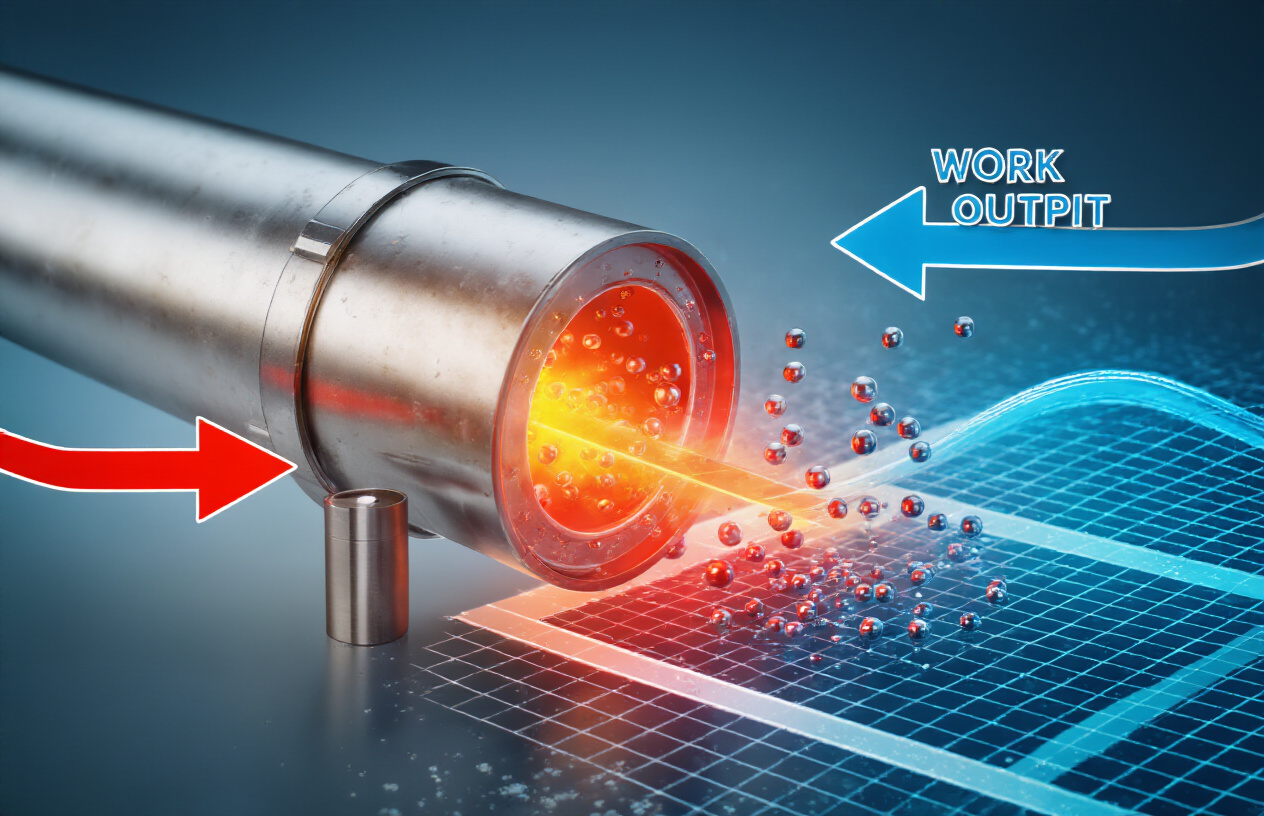
In thermodynamics physics class 11, understanding energy transfer thermodynamics requires distinguishing between heat and work as distinct modes. Heat is defined as energy transferred between two bodies due to a temperature difference, while work represents energy transfer where a force’s application point moves through displacement, independent of temperature differences. Thermodynamics primarily concerns itself with work done by a system and heat exchanged with surroundings.
Recognizing Heat and Work as Energy in Transit
Both heat and work are considered “energy in transit” during thermodynamic processes and lose their meaning once the process ceases. This fundamental concept in heat and thermodynamics class 11 emphasizes that these quantities only exist during active energy transfer. Joule’s experiment demonstrated that mechanical work required to produce specific temperature changes maintains fixed proportion to heat needed for identical changes, establishing the mechanical equivalent of heat concept where one calorie equals 4.186 Joules.
Calculating Work Done by Thermodynamic Systems: Heat And Thermodynamics Physics Class 11
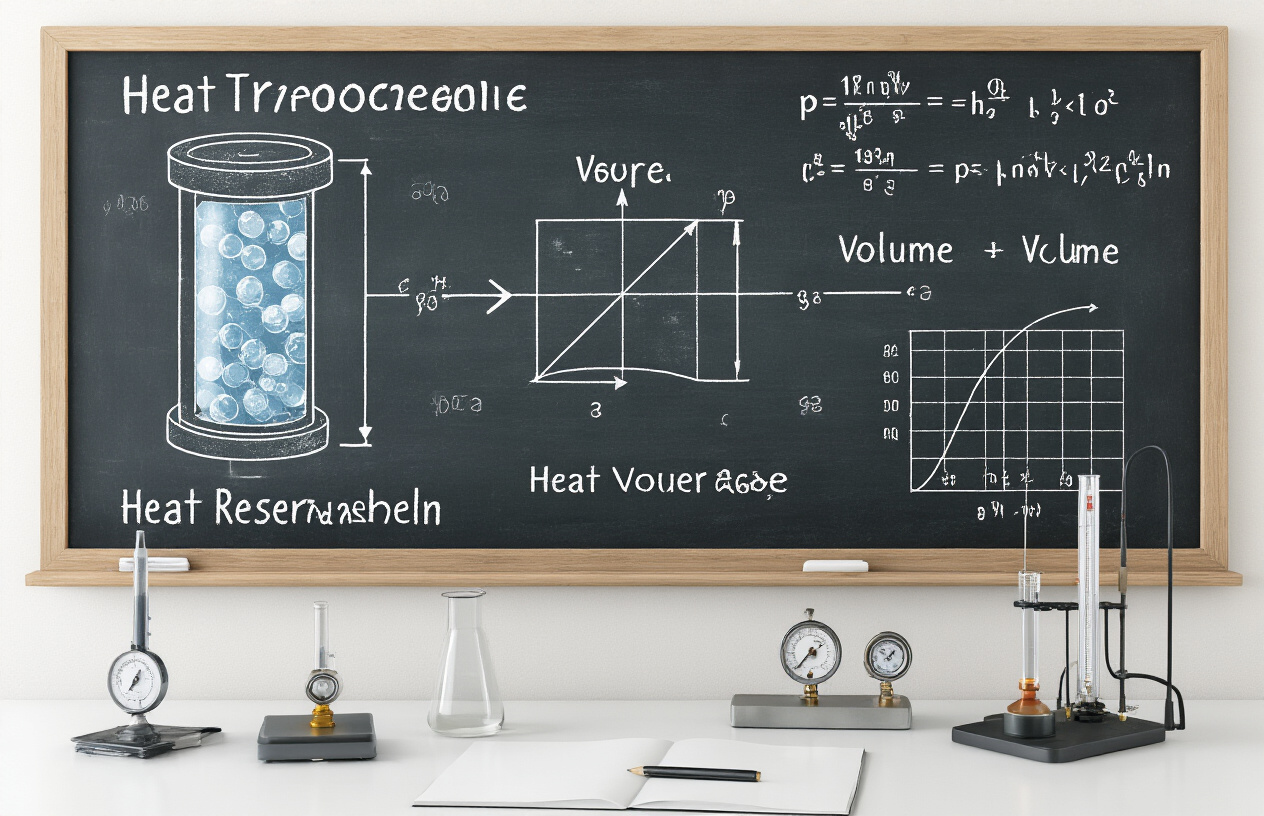
In thermodynamic systems where gas is confined in a cylinder by a movable piston, work calculations become fundamental when the piston moves upward allowing gas expansion. When this expansion occurs, the gas performs work on the piston, demonstrating the conversion of internal energy into mechanical work. For accurate work done thermodynamic systems calculations, the piston displacement must be carefully analyzed through the relationship between force, pressure, and area.
Applying Quasistatic Process Conditions for Accurate Calculations
Thermodynamics physics class 11 requires understanding quasistatic processes for precise work calculations. A quasistatic process involves thermodynamic variables (P, V, T, n) changing infinitely slowly, ensuring the system remains arbitrarily close to equilibrium with well-defined macroscopic variables. For very slow piston movement, an opposing force prevents rapid expansion and turbulence, which would make pressure undefined. When the piston rises by small displacement dx, the work dW done by the gas equals F dx = (PA) dx, where P represents pressure and A is the piston’s cross-sectional area.
Using PV Diagrams to Visualize and Calculate Work
Since the change in gas volume dV = A dx, the quasistatic work can be expressed as dW = P dV. As a quasistatic process evolves, both P and V are always uniquely defined, allowing the process to be depicted on a PV diagram. The total work energy thermodynamics calculation when taken quasistatically from initial (i) to final (f) equilibrium state is given by the integral of P dV from Vi to Vf, providing a visual and mathematical representation of work done by thermodynamic systems.

When analyzing thermodynamic processes path dependence in heat and thermodynamics class 11, understanding work signs is crucial. If the final volume (Vf) is greater than the initial volume (Vi), the work done by the gas is positive, indicating expansion. Conversely, if the volume of the gas decreases, the work done by the gas is negative, implying positive work done on the gas by its environment during compression.
Understanding Why Work Depends on Thermodynamic Path: Heat And Thermodynamics Physics Class 11
The work done by a system is not solely determined by its initial and final states but critically depends on the specific thermodynamic path taken between these states. Therefore, to calculate work in thermodynamic system work calculation, it is essential to understand how pressure varies with volume throughout the process. On a PV diagram, the work done by the system is visually represented by the area under the curve that traces the thermodynamic path.

The key insight from Joule’s mechanical equivalent of heat (1 calorie = 4.186 J) demonstrates the interconnected nature of thermal and mechanical energy. As you continue studying Class 11 physics, remember that thermodynamic processes are best understood through PV diagrams, where the area under the curve represents work done. Practice applying these concepts to different thermodynamic processes to build confidence in solving complex problems involving energy transfer and system analysis.