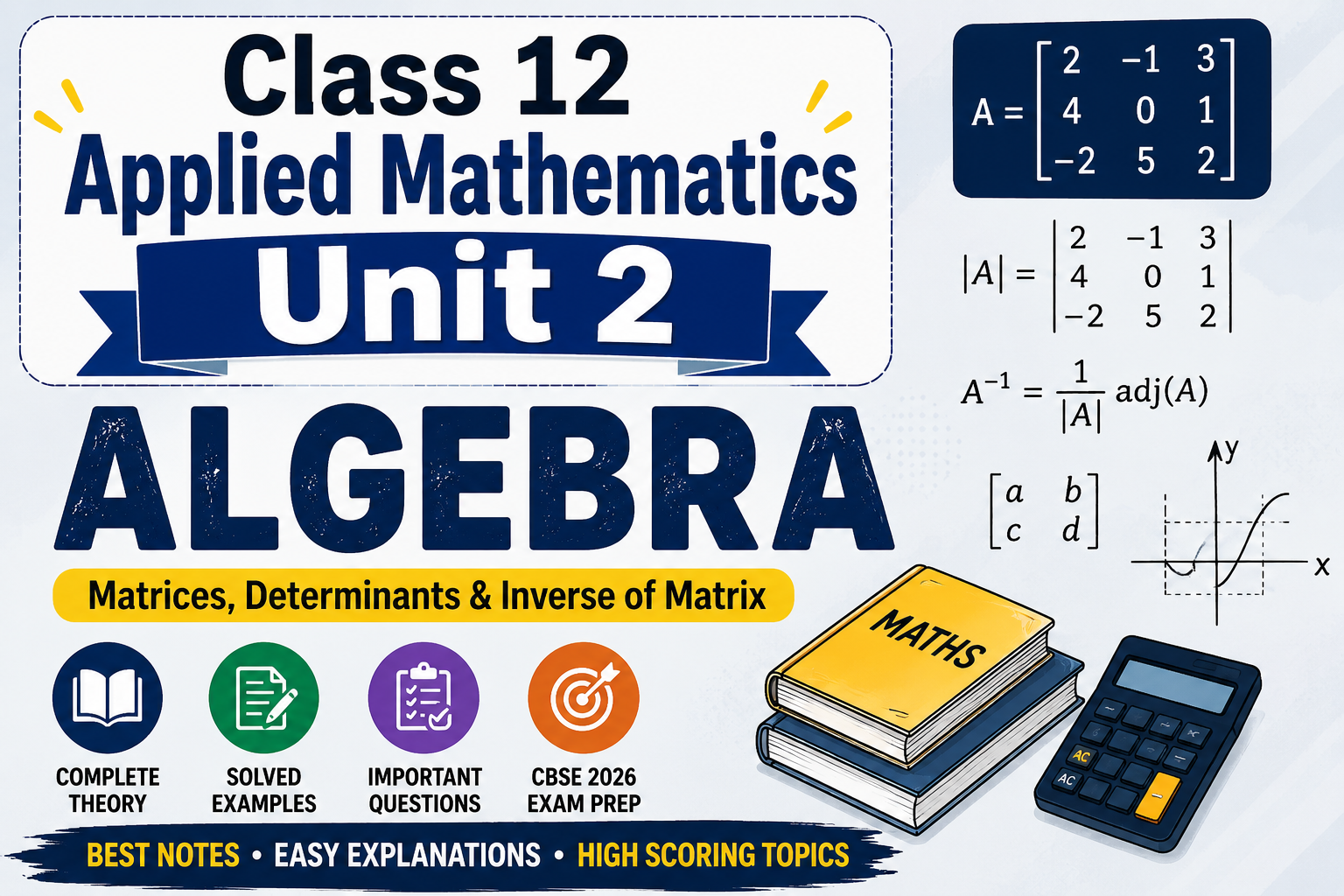
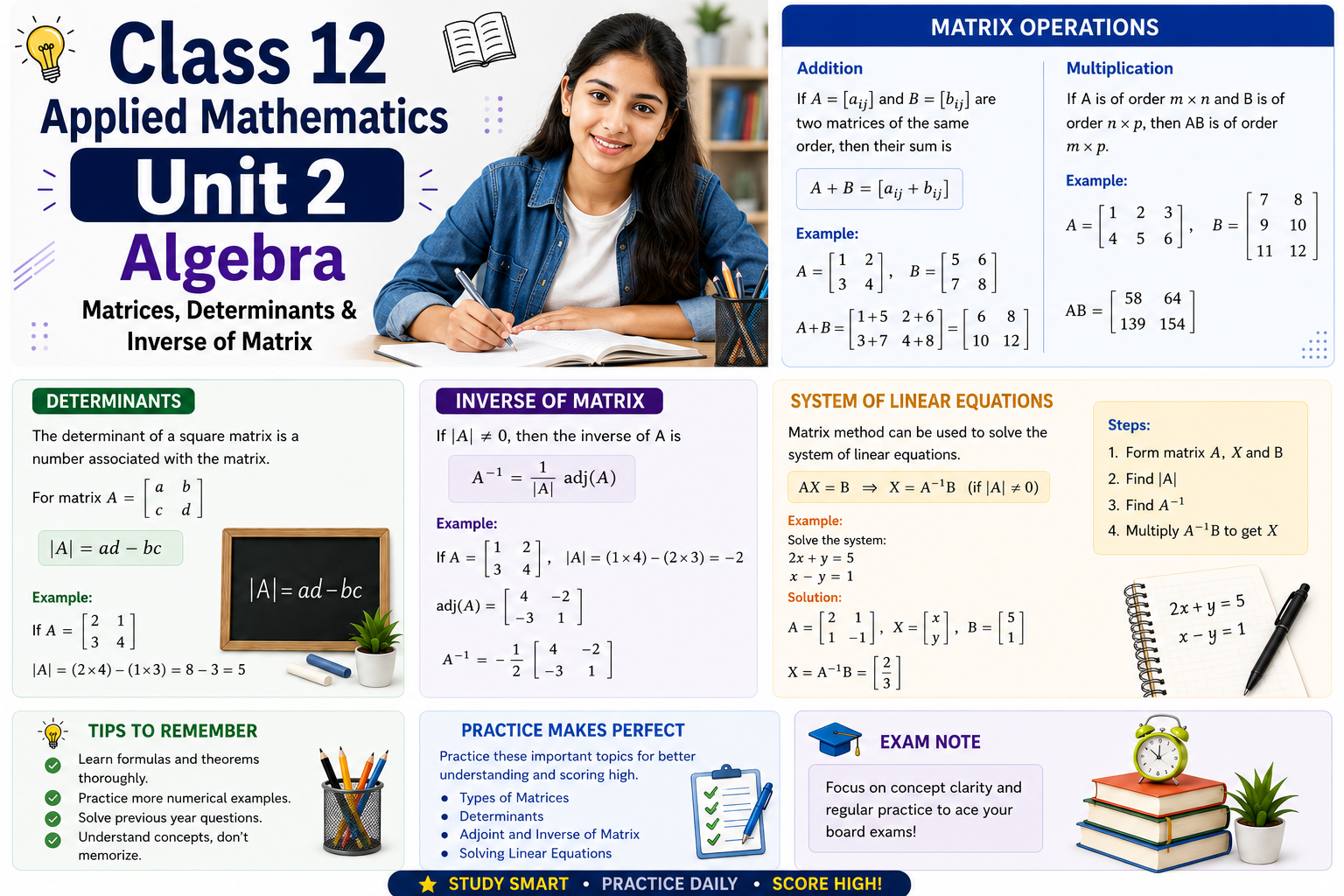
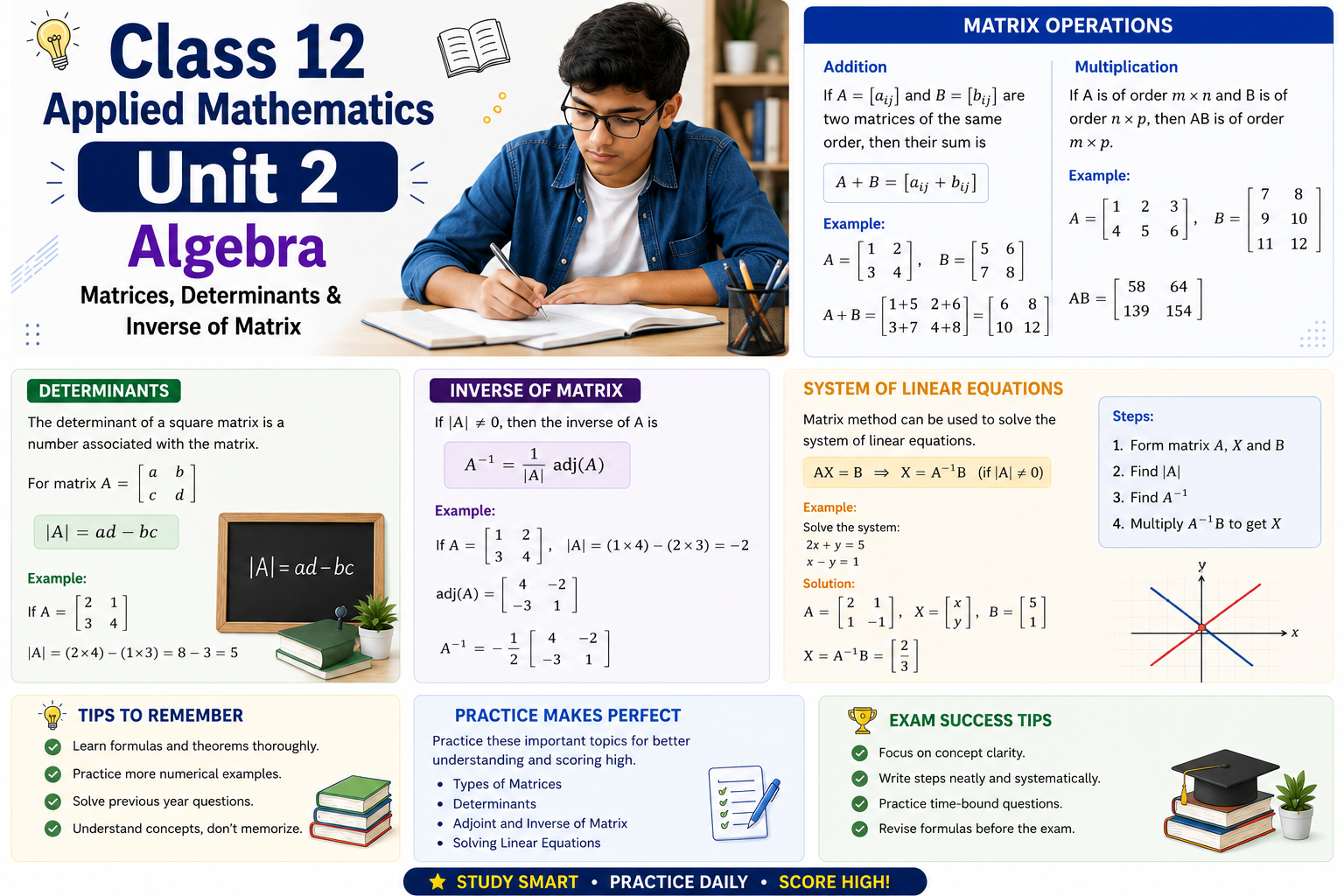
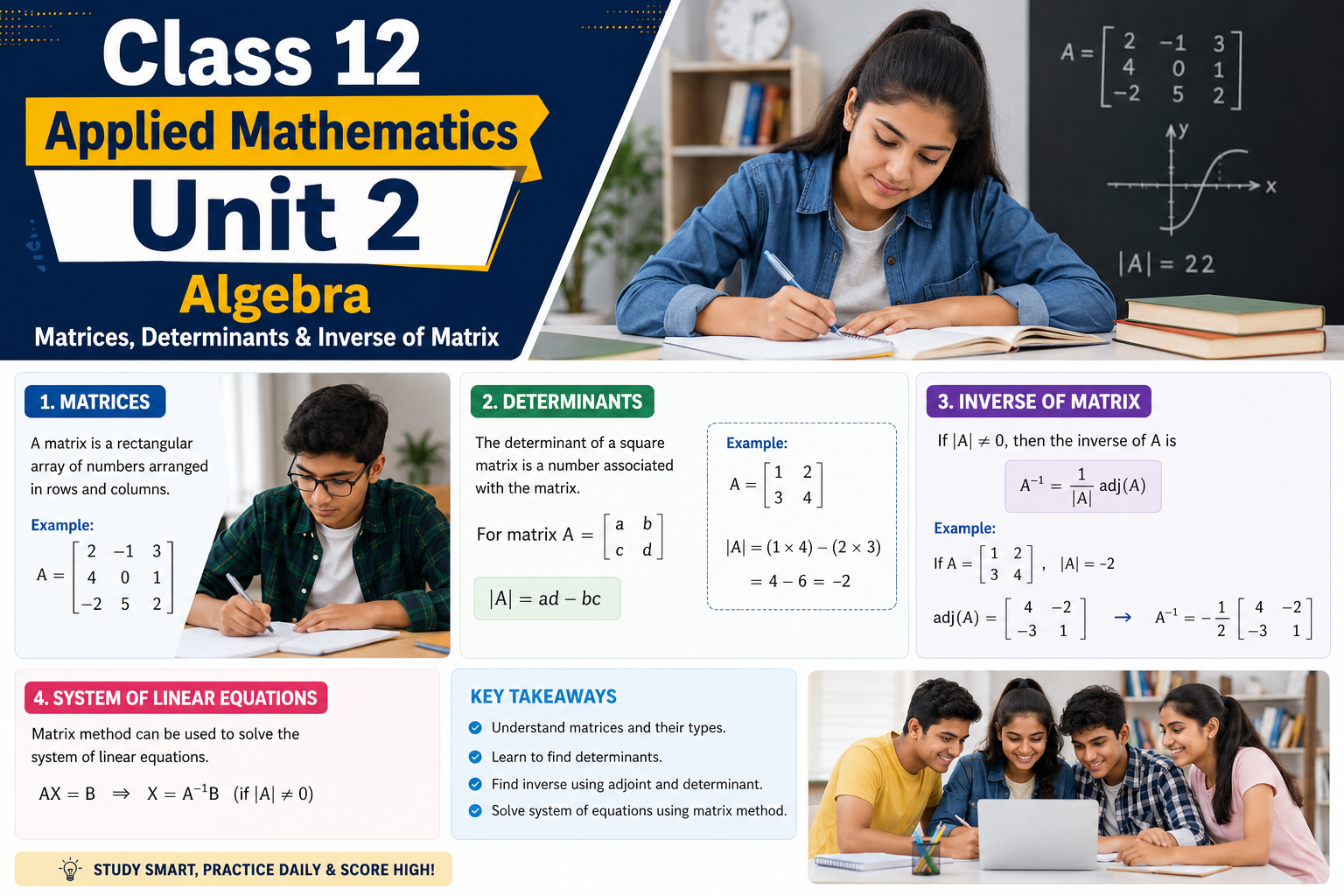
Class 12 Applied Mathematics Unit 2 is an important unit that covers matrices, determinants, inverse of matrices, and solving systems of linear equations using matrix methods. This chapter plays a crucial role in CBSE board examinations and helps students develop strong problem-solving skills.
Class 12 Applied Mathematics Unit 2 focuses on solving real-life mathematical problems using matrices, determinants, and systems of linear equations. It is one of the most important and scoring units in Applied Mathematics.
1.
What is a Matrix?
A Matrix is a rectangular arrangement of numbers into rows and columns. In mathematics, we use matrices to simplify complex data and solve linear equations.
A =
| 85 | 92 |
| 78 | 88 |
| 95 | 84 |
(3 × 2 Matrix)
Key Components:
- Rows: Horizontal lines (e.g., [85, 92]).
- Columns: Vertical lines (e.g., [85, 78, 95]).
- Element: Each individual number in the matrix.
Types of Matrices:
Common Types of Matrices: Class 12 Applied Mathematics Unit 2
1. Row Matrix: A matrix having only one row.
Example: [1, 5, 9]
2. Column Matrix: A matrix having only one column.
Example:
[2]
[4]
[6]
3. Square Matrix: A matrix where rows = columns.
A =
| 1 | 2 |
| 3 | 4 |
(2 × 2)
4. Zero Matrix: A matrix where every element is 0.
O =
| 0 | 0 |
| 0 | 0 |
(Zero Matrix)
5. Identity Matrix: A square matrix with 1s on the main diagonal and 0s elsewhere.
I =
| 1 | 0 |
| 0 | 1 |
(Identity Matrix)
Operations on Matrices:
1. Addition of matrices
2. Subtraction of matrices
3. Multiplication of matrices
4. Scalar multiplication
Important Property:
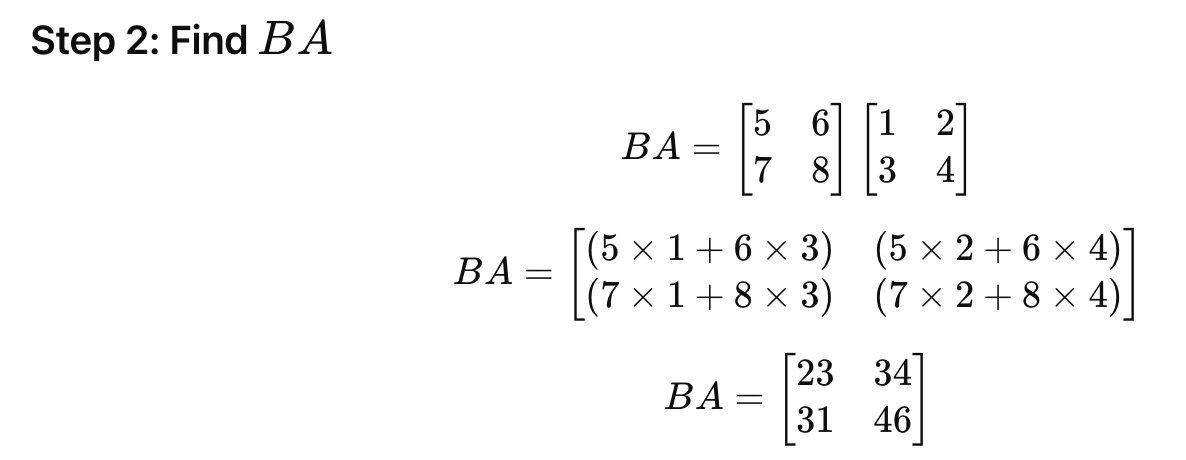
AB ≠ BA (Matrix multiplication is not commutative)
Matrices: Addition and Subtraction (Practice Questions with Solutions)
Example 1: Addition
| 2 | 4 |
| 1 | 5 |
+
| 3 | 1 |
| 0 | 2 |
=
| 5 | 5 |
| 1 | 7 |
Example 1: Subtraction
| 10 | 8 |
| 6 | 4 |
−
| 2 | 3 |
| 1 | 4 |
=
| 8 | 5 |
| 5 | 0 |
Multiplication of Matrices: Class 12 Applied Mathematics Unit 2
Definition: The multiplication of two matrices is possible only when the number of columns of the first matrix is equal to the number of rows of the second matrix.
Condition: If A is m × n and B is n × p, then AB is defined and will be of order m × p.
Multiplication of Matrices – Order Based Examples
Matrix Multiplication Example
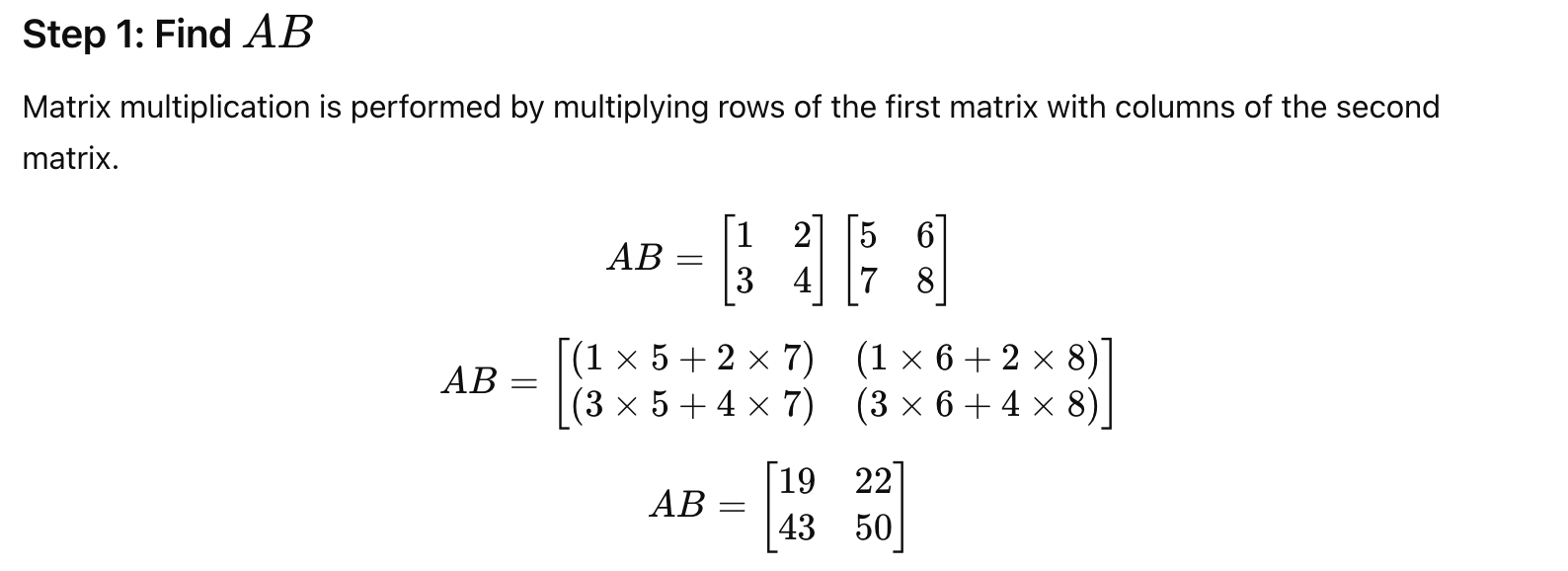
Multiplying A and B:
| 1 | 2 |
| 3 | 4 |
×
| 5 | 6 |
| 7 | 8 |
=
| 19 | 22 |
| 43 | 50 |
Top-Left: (1 × 5) + (2 × 7) = 19
Top-Right: (1 × 6) + (2 × 8) = 22
Bottom-Left: (3 × 5) + (4 × 7) = 43
Bottom-Right: (3 × 6) + (4 × 8) = 50
Multiplying (3 × 2) by (2 × 3)
| 1 | 2 |
| 3 | 4 |
| 5 | 6 |
×
| 7 | 8 | 9 |
| 1 | 0 | 2 |
=
| 9 | 8 | 13 |
| 25 | 24 | 35 |
| 41 | 40 | 57 |
Full Step-by-Step Multiplication
First Row Result:
(1 × 7) + (2 × 1) = 9
(1 × 8) + (2 × 0) = 8
(1 × 9) + (2 × 2) = 13
Second Row Result:
(3 × 7) + (4 × 1) = 25
(3 × 8) + (4 × 0) = 24
(3 × 9) + (4 × 2) = 35
Third Row Result:
(5 × 7) + (6 × 1) = 41
(5 × 8) + (6 × 0) = 40
(5 × 9) + (6 × 2) = 57
Condition for multiplication: Class 12 Applied Mathematics Unit 2
Compatibility Check
Before multiplying, check the dimensions:
m × n
n × p
Note: If the red values don’t match, you cannot multiply the matrices.
Number of columns of A = Number of rows of B
Case 1: AB is Defined ✅
| 1 2 3 |
| 4 5 6 |
×
| 7 8 |
| 9 10 |
| 11 12 |
Check: Columns in A (3) = Rows in B (3). Match!
Case 2: AB is Undefined ❌
| 1 2 |
| 3 4 |
×
| 5 6 |
| 7 8 |
| 9 10 |
Check: Columns in A (2) ≠ Rows in B (3). Error!
Important Properties:
- AB ≠ BA (Not commutative)
- A(BC) = (AB)C (Associative)
- A(B + C) = AB + AC (Distributive)
Scalar Multiplication of Matrices: Class 12 Applied Mathematics Unit 2
Definition: Scalar multiplication means multiplying every element of a matrix by a constant number.
Formula: If k is a scalar, then kA = [k × each element of A]
Example: Scalar Multiplication
To find 4A where A = [[1, -2], [3, 5]]:
×
| 1 | -2 |
| 3 | 5 |
=
| 4 | -8 |
| 12 | 20 |
Multiply each element by 4:
(4 × 1), (4 × -2), (4 × 3), and (4 × 5).
Important Properties:
- k(A + B) = kA + kB
- (k + m)A = kA + mA
- k(mA) = (km)A
Multiplication of Matrices – Mixed Practice Questions with Solutions
Q5. Check whether AB = BA
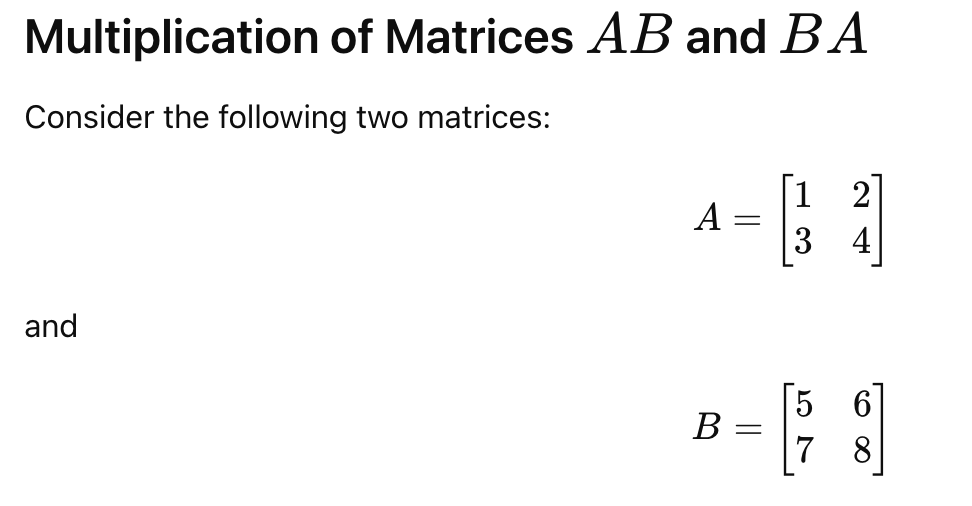
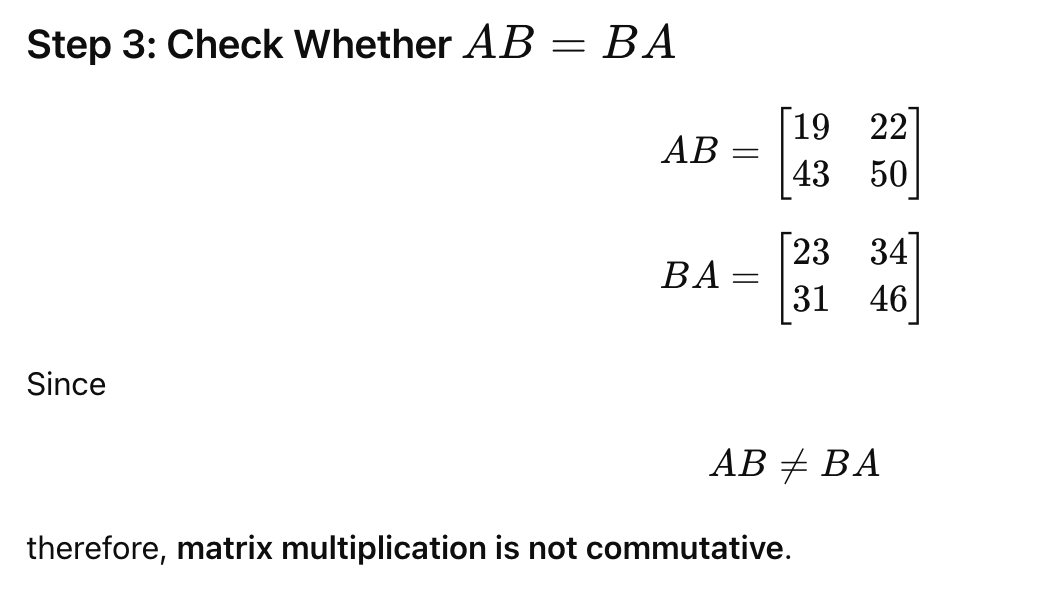 Matrix multiplication combines rows and columns to form a new matrix, while scalar multiplication simply scales each element. Both operations are essential for solving real-life problems in algebra and applied mathematics.
2. Determinants: Class 12 Applied Mathematics Unit 2
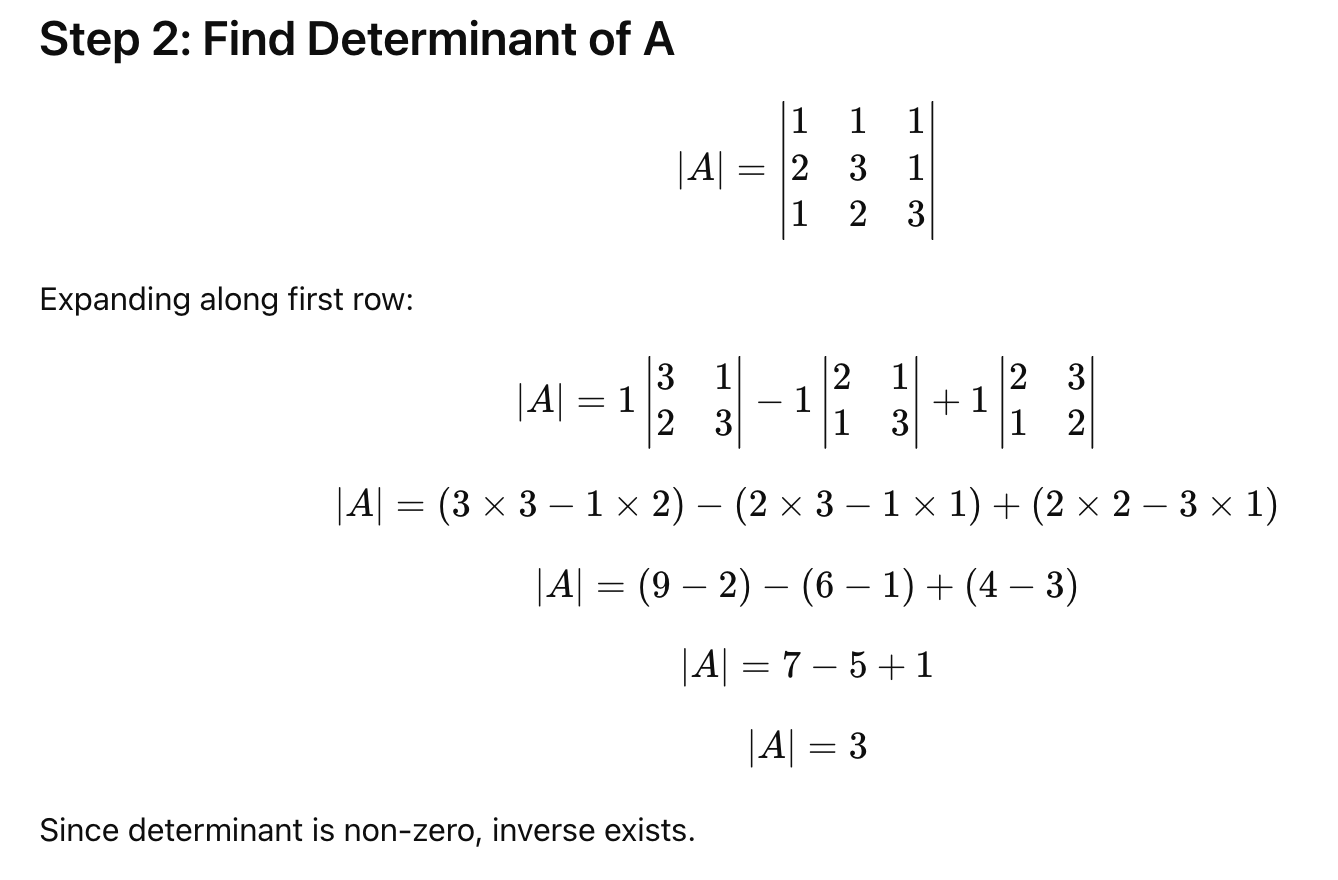
Definition: Determinant is a scalar value associated with a square matrix.
Example: Finding the Determinant
To find the determinant ,
|A| =
| 4 | 2 |
| 1 | 3 |
|A| = (4 × 3) − (2 × 1)
|A| = 12 − 2
|A| = 10
How to Calculate a 2×2 Determinant
|A| =
| a | b |
| c | d |
= (ad – bc)
So,
For 2×2 matrix:
|A| = ad − bc
Important Uses:
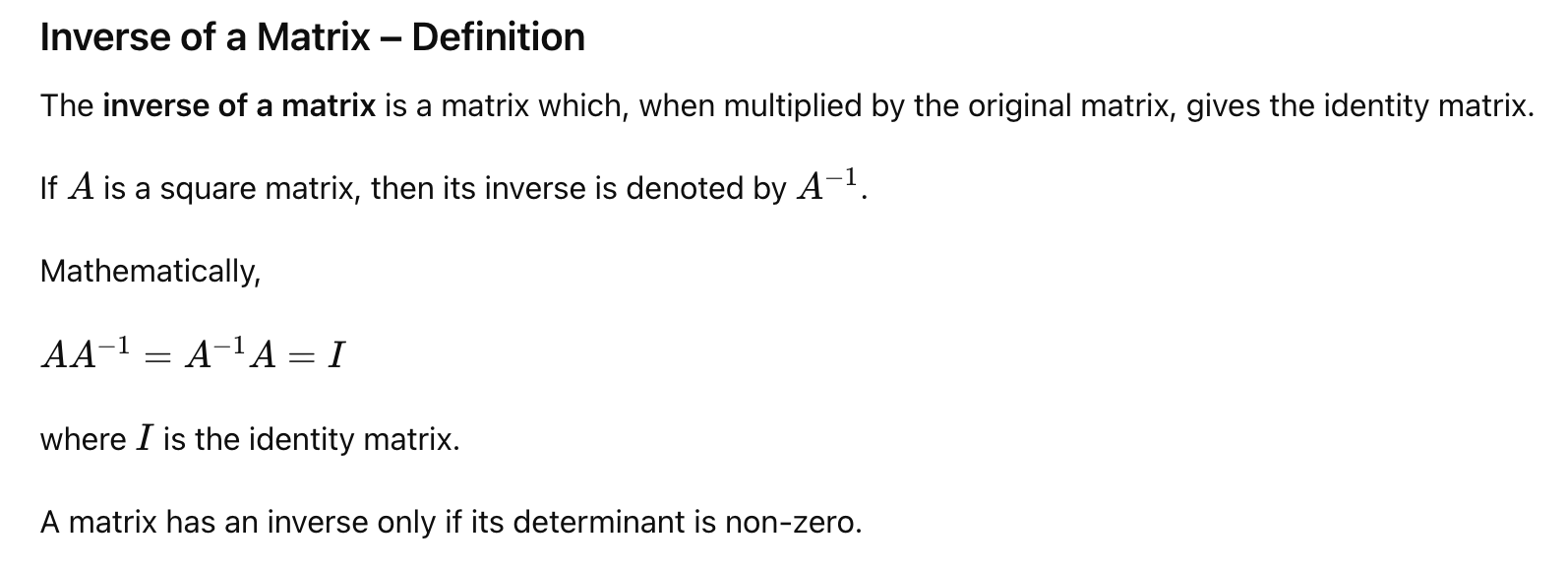
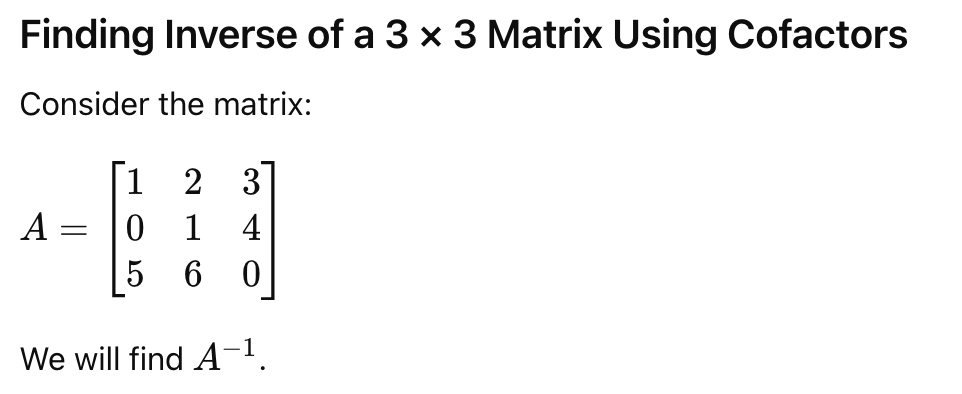
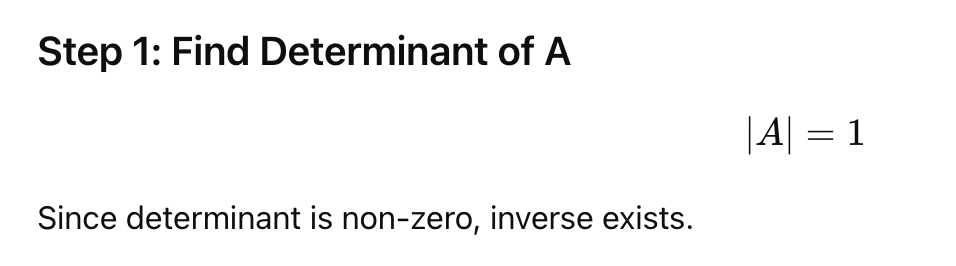
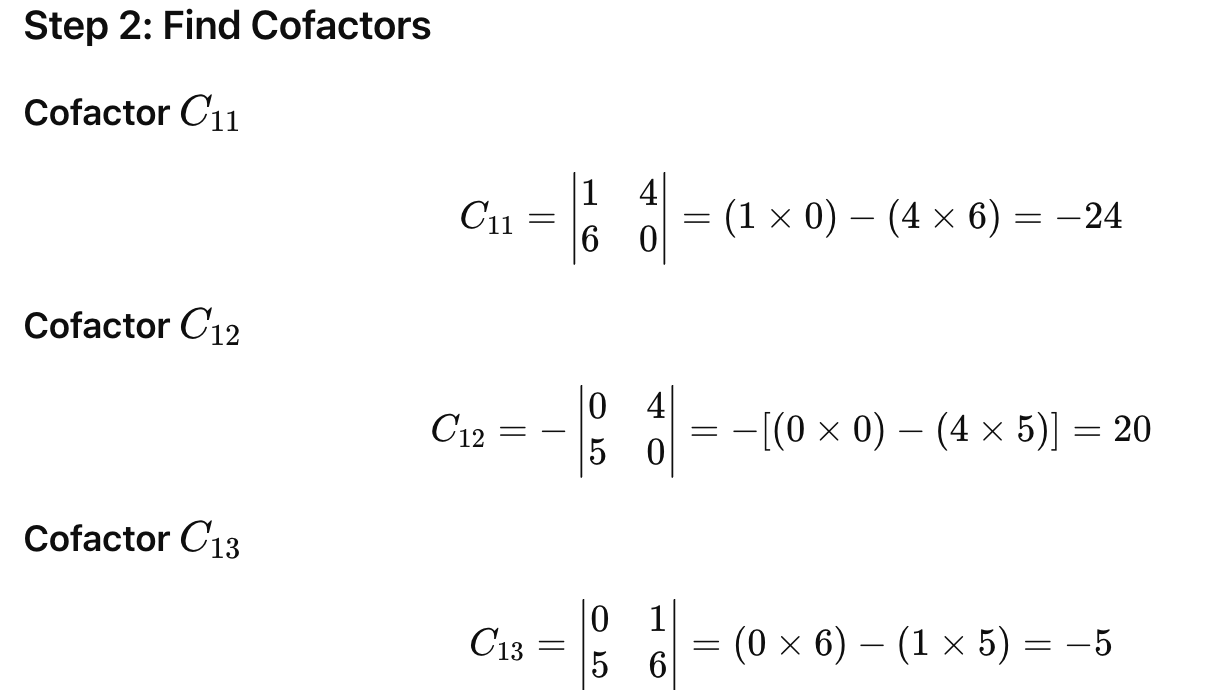
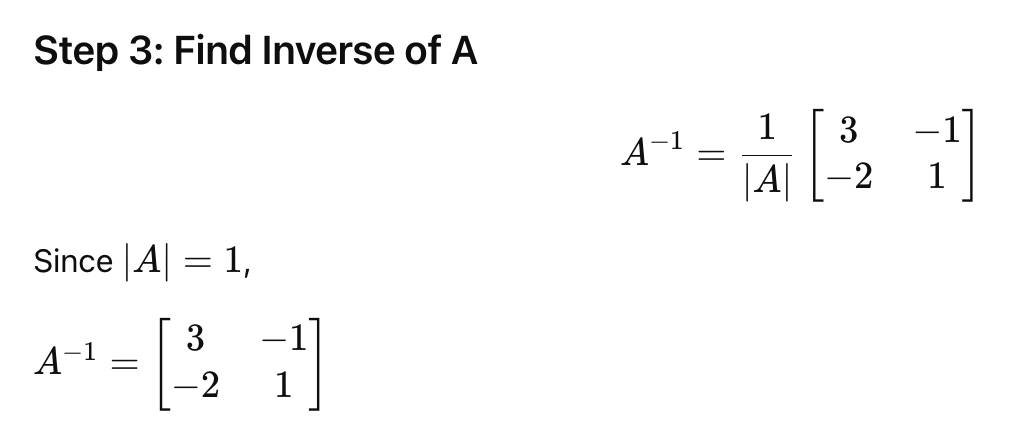
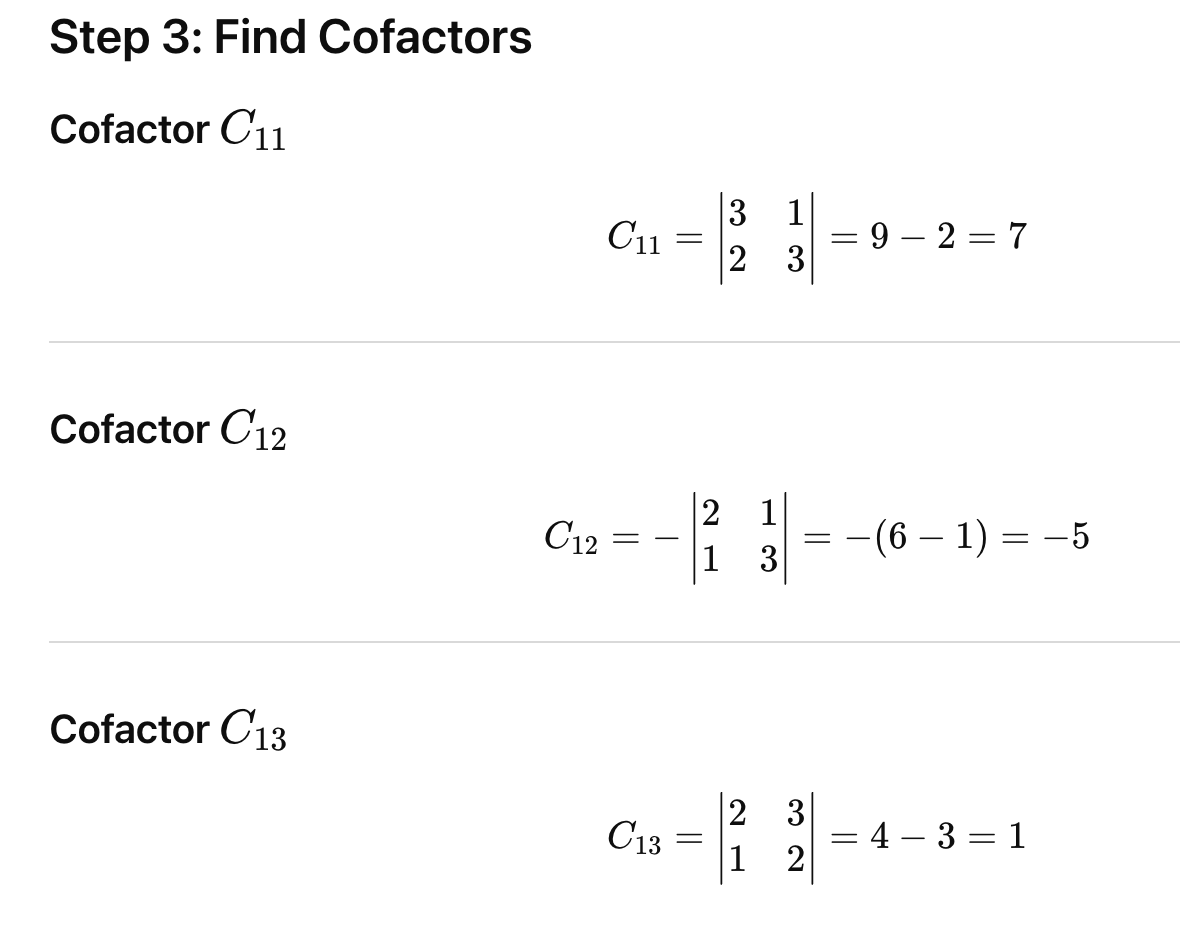
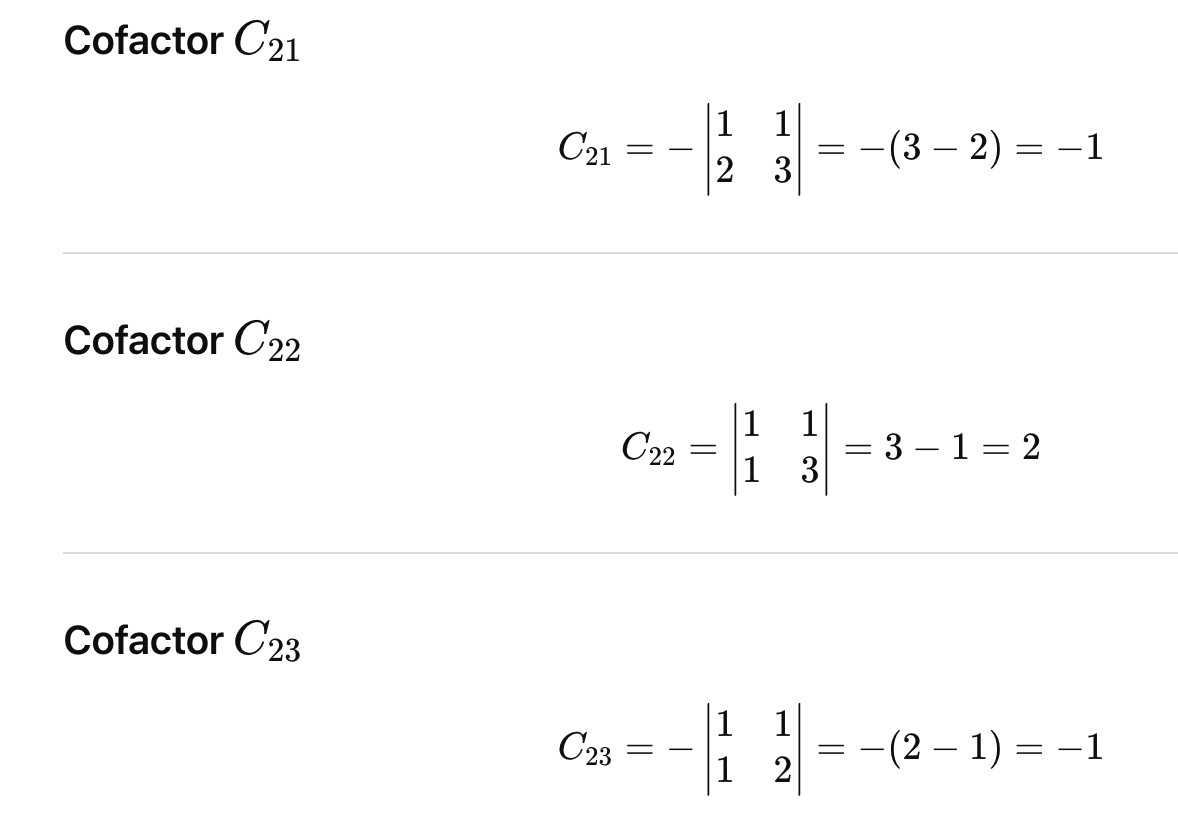
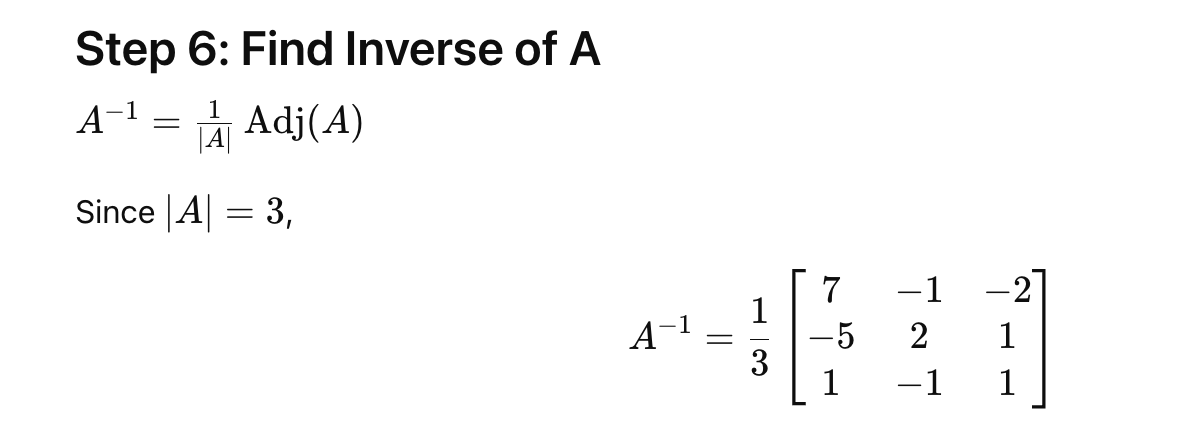
- Finding inverse of matrix
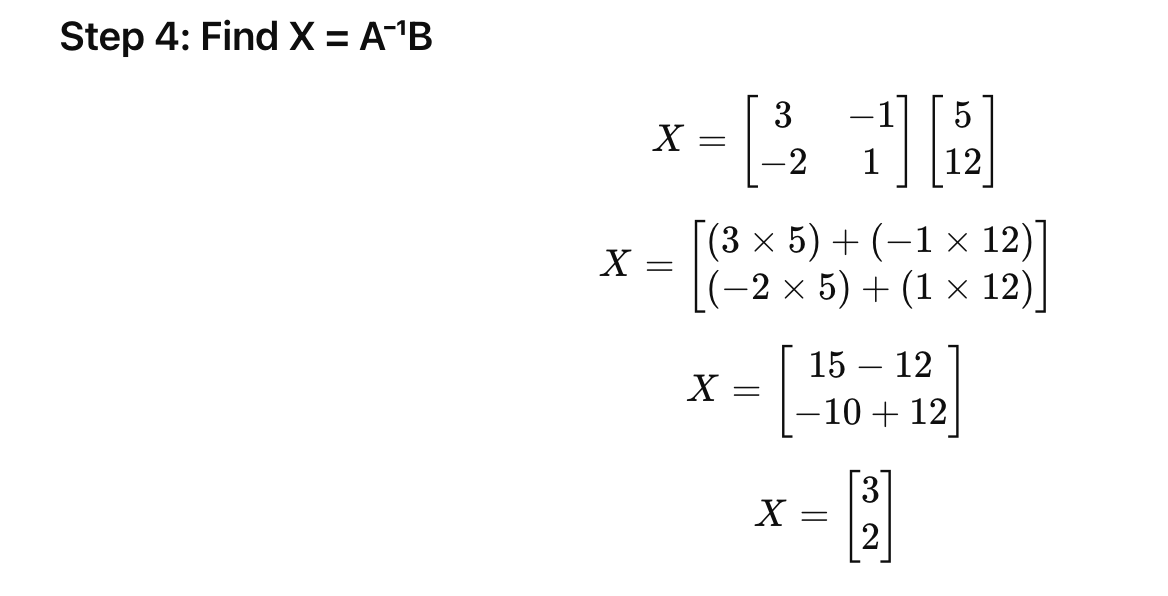
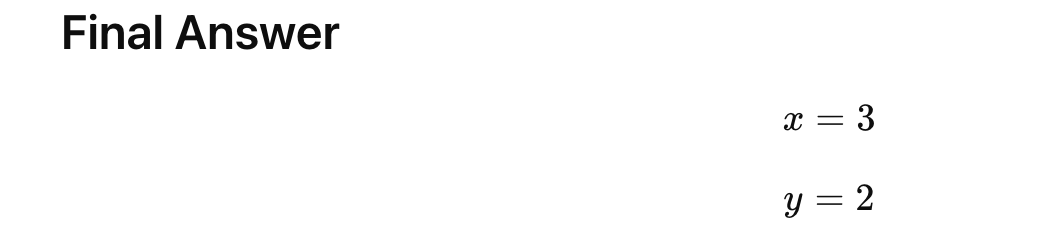
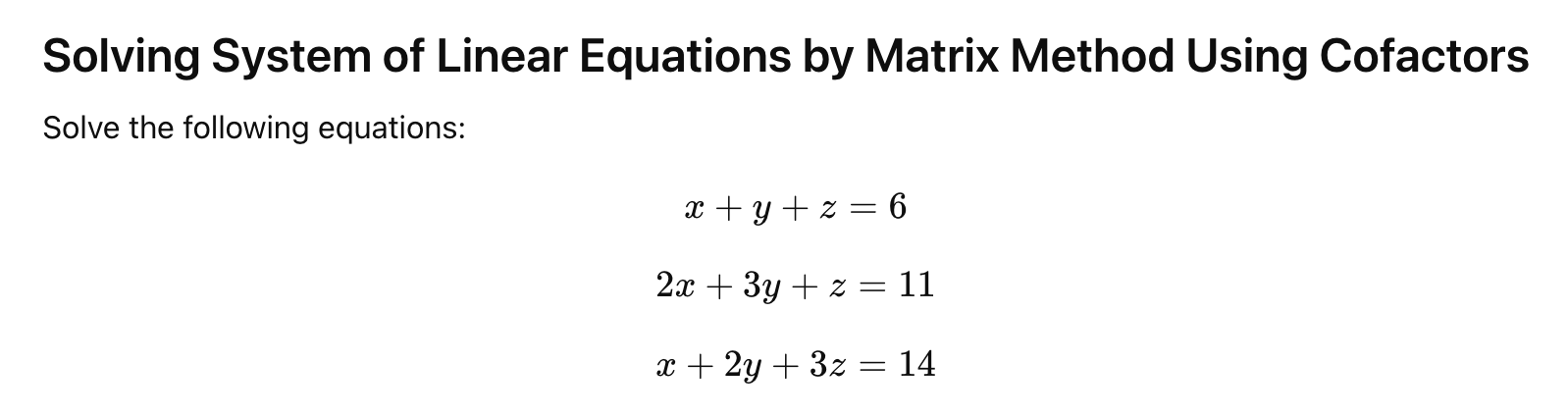
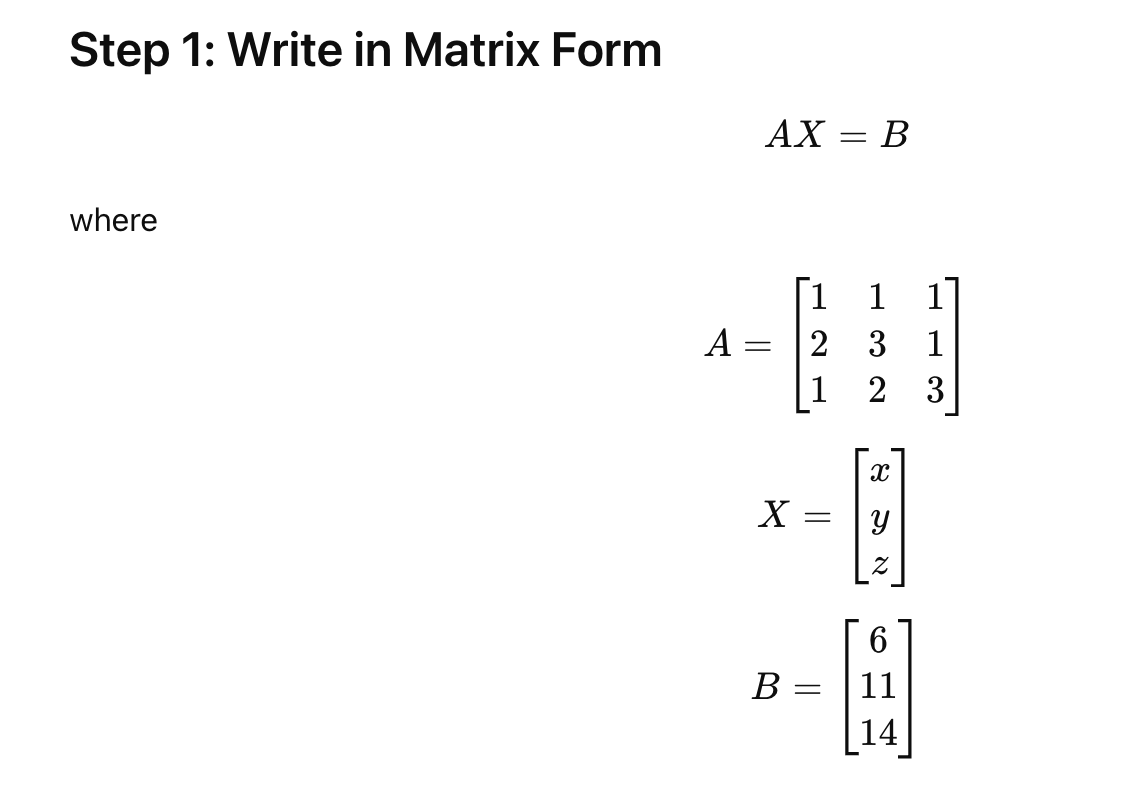
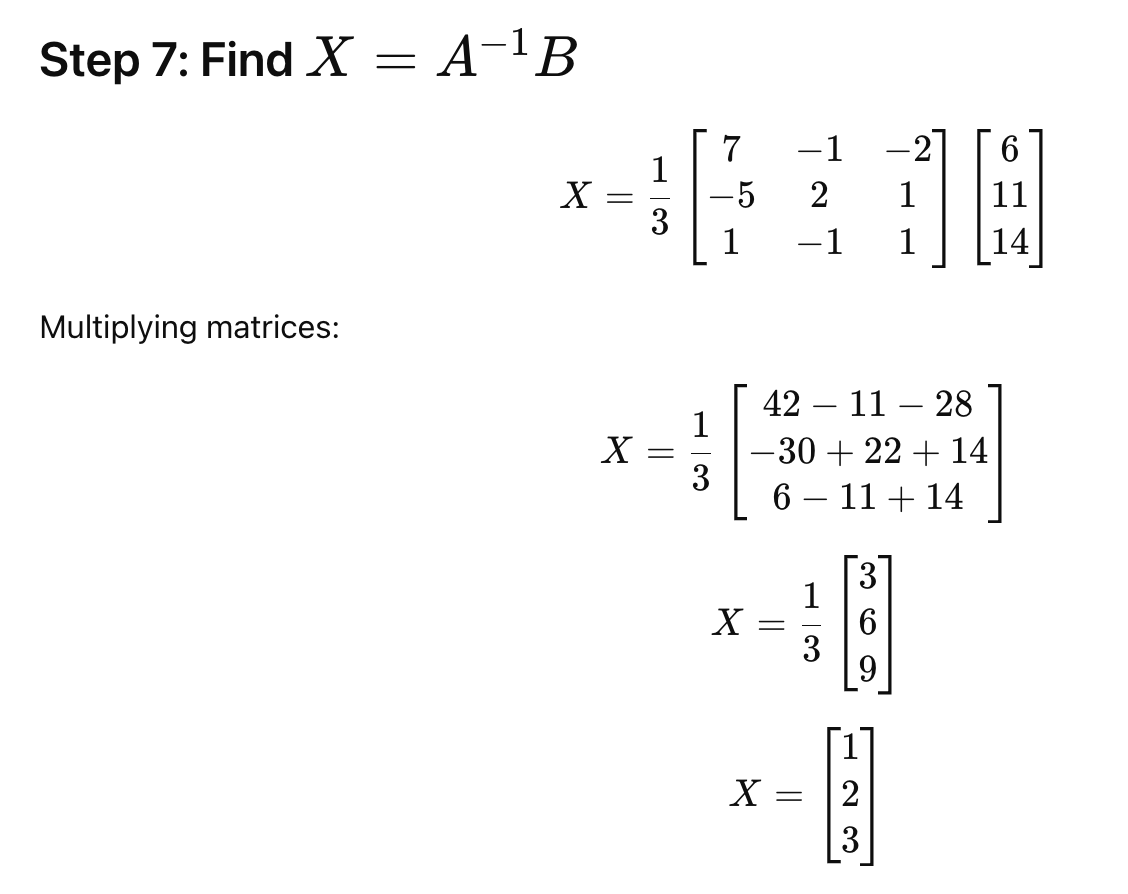
- Solving linear equations
3.
4.
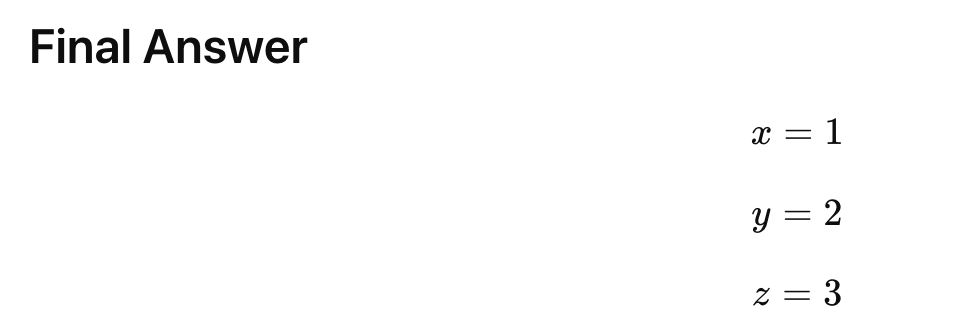
5. Types of Solutions: Class 12 Applied Mathematics Unit 2
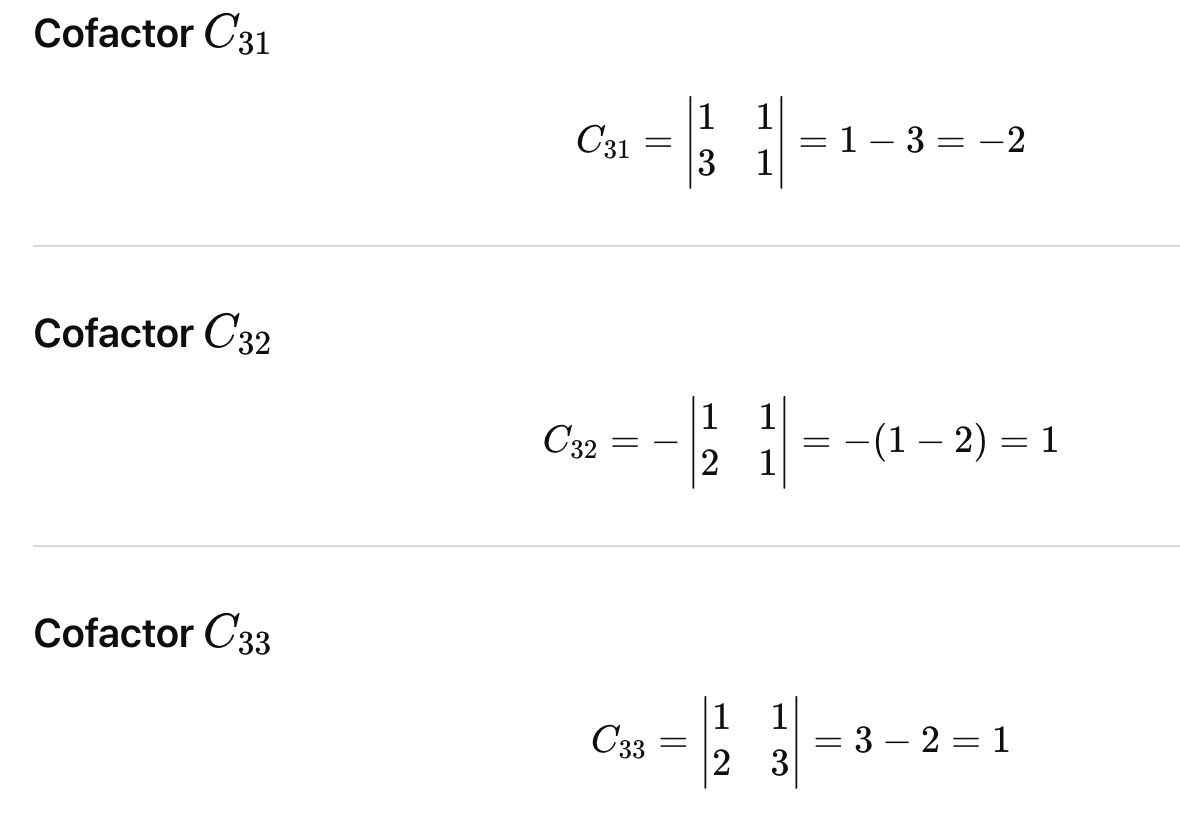
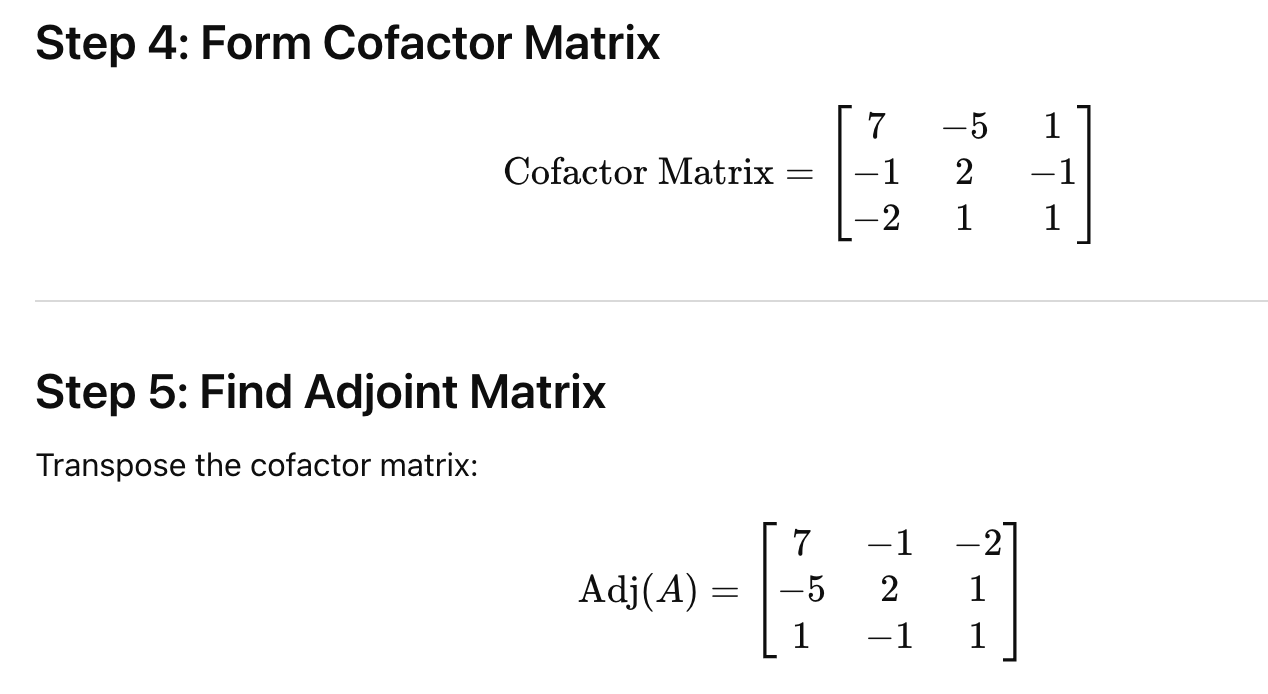
1. Unique Solution (|A| ≠ 0)
2. Infinite Solutions
3. No Solution
Exam Important Points: Class 12 Applied Mathematics Unit 2
- Matrix operations are frequently asked
- Determinant calculation is scoring
- Inverse method is important for solving equations
- Word problems based on linear equations are common
Related Post
Class 12 Applied Mathematics Unit 1 Notes
CLASS 12 Applied Mathematics Syllabus (2026): Latest Expert Analysis
Conclusion: Class 12 Applied Mathematics Unit 2
Unit 2: Algebra is a scoring unit if concepts are clear. Focus on matrices, determinants, and solving equations using matrix methods. Regular practice ensures high marks in exams.
For official CBSE syllabus and academic resources, visit CBSE Official Website
Students can also explore advanced mathematics concepts from NCERT
1 thought on “Class 12 Applied Mathematics Unit 2( CBSE 2026-27): Comprehensive Notes”