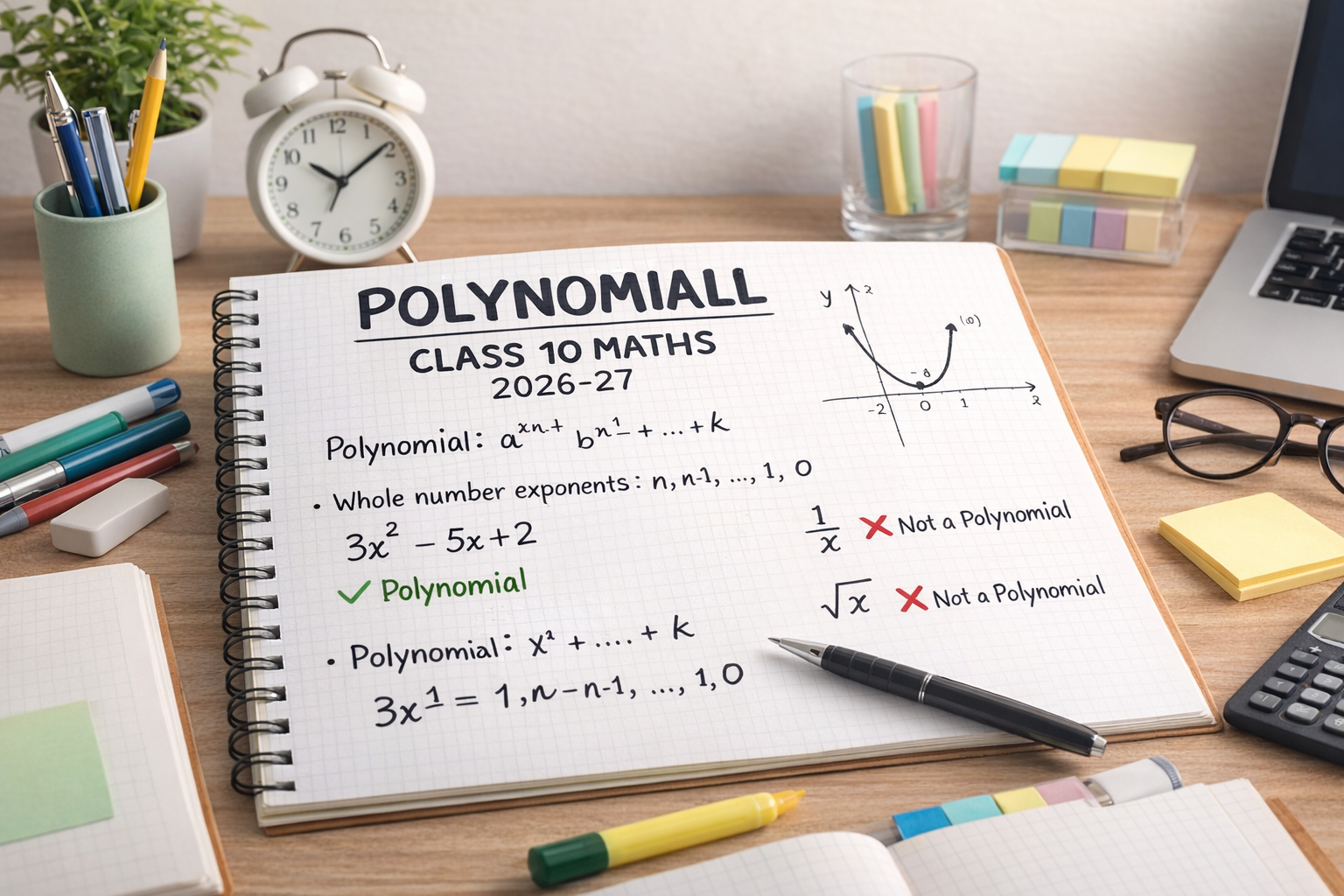
Polynomial Class 10 Maths 2026-27 is one of the most important chapters for CBSE board exams. In this article, you will get most important questions with step-by-step solutions, including α β based questions, case study questions, and competency-based questions.
Polynomial Class 10 Maths 2026-27 is an important chapter that includes concepts like zeroes of polynomial, relationship between zeroes and coefficients, and formation of quadratic polynomials. Practicing Polynomial Class 10 Maths 2026-27 questions helps students score high in CBSE board exams.

Polynomial Class 10 Maths 2026-27: Complete Guide
● Definition of Polynomial
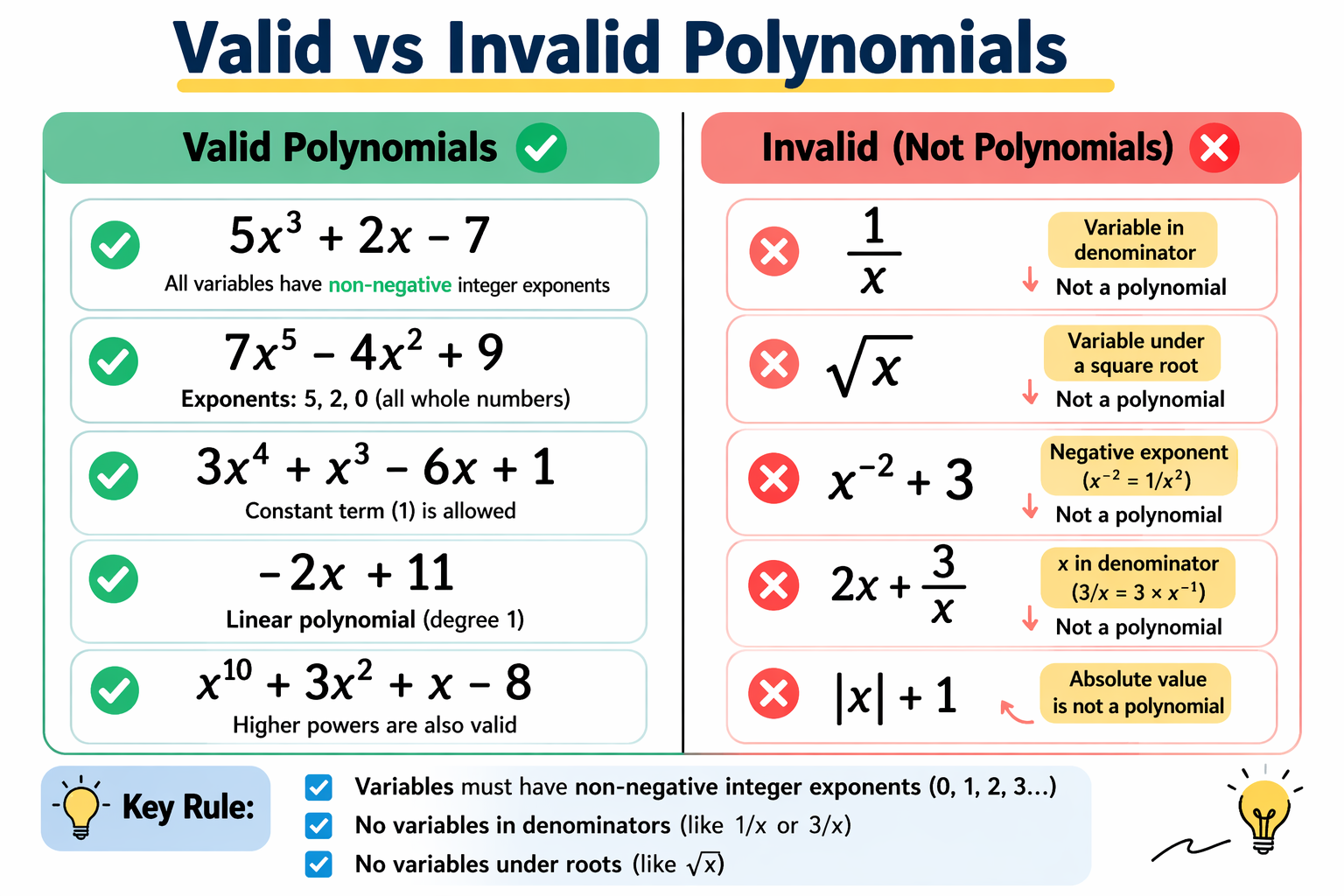
A polynomial is an algebraic expression consisting of variables, constants, and non-negative integer powers.
Examples:
x² + 3x + 2
2x³ − x + 5
7
Polynomial Class 10 Maths 2026-27 covers important concepts like linear, quadratic and cubic polynomials. Understanding Polynomial Class 10 Maths 2026-27 helps students solve board-level questions easily.
● Types of Polynomials (Based on Degree)
Linear Polynomial → ax + b
Example: 2x + 3
Quadratic Polynomial → ax² + bx + c
Example: x² − 5x + 6
Cubic Polynomial → ax³ + bx² + cx + d
Example: x³ + 2x² + x
● Zero of a Linear Polynomial
A zero of a linear polynomial ax + b is given by:
x = -b/a
Example:
2x + 4 = 0
x = -4/2 = -2

● Zeroes of a Quadratic Polynomial
A quadratic polynomial ax² + bx + c has two zeroes.
Example:
x² − 5x + 6 = 0
Zeroes = 2, 3
● Relationship Between Zeroes and Coefficients
For quadratic polynomial ax² + bx + c
α + β = -b/a
αβ = c/a
Polynomial Class 10 Maths 2026-27 Most Important Questions with Solutions
Now let us practice Polynomial Class 10 Maths 2026-27 most important questions with detailed solutions.
● Verify Relationship
Q1. Find zeroes and verify the relationship of x² – 5x + 6
Given polynomial: x² – 5x + 6
x² – 5x + 6 = (x – 2)(x – 3)
α = 2, β = 3
Verification of the relationship
α + β = 2 + 3 = 5
-b/a = -(-5)/1 = 5 → Verified
αβ = 2 × 3 = 6
c/a = 6/1 = 6 → Verified
Q2. Find zeroes and verify the relationship of x² + 7x + 10
Given polynomial: x² + 7x + 10
x² + 7x + 10 = (x + 5)(x + 2)
α = -5, β = -2
Verification of the relationship
α + β = -7
-b/a = -7 → Verified
αβ = 10
c/a = 10 → Verified
Q3. Find zeroes and verify the relationship of 2x² – 7x + 3
Given polynomial: 2x² – 7x + 3
2x² – 7x + 3 = (2x – 1)(x – 3)
α = 1/2, β = 3
Verification of the relationship
α + β = 7/2
-b/a = 7/2 → Verified
αβ = 3/2
c/a = 3/2 → Verified
Q4. Find zeroes and verify the relationship of x² – 9
Given polynomial: x² – 9
x² – 9 = (x – 3)(x + 3)
α = 3, β = -3
Verification of the relationship
α + β = 0
-b/a =0 → Verified
αβ = -9
c/a = -9 → Verified
Q5. Find zeroes and verify the relationship of 3x² + 2x – 1
Given polynomial: 3x² + 2x – 1
3x² + 2x – 1 = (3x – 1)(x + 1)
α = 1/3, β = -1
Verification of the relationship
α + β = -2/3
-b/a = -2/3 → Verified
αβ = -1/3
c/a = -1/3 → Verified
Q6. Find zeroes and verify the relationship of 4x² – 4x + 1
Given polynomial: 4x² – 4x + 1
4x² – 4x + 1 = (2x – 1)²
α = β = 1/2
Verification of the relationship
α + β = 1
-b/a = 1→ Verified
αβ = 1/4
c/a = 1/4 → Verified
Q7. Find zeroes and verify the relationship of x² – 2√5x + 5
Given polynomial: x² – 2√5x + 5
x² – 2√5x + 5 = (x – √5)²
α = β = √5
Verification of the relationship
α + β = 2√5
-b/a = 2√5 → Verified
αβ = 5
c/a = 5 → Verified

● Important Identities
α² + β² = (α + β)² − 2αβ
α² − β² = (α + β)(α − β)
(α − β)² = (α + β)² − 4αβ
α³ + β³ = (α + β)³ − 3αβ(α + β)
α³ − β³ = (α − β)(α² + β² + αβ)
1/α + 1/β = (α + β)/αβ
α²β² = (αβ)²
In Polynomial Class 10 Maths 2026-27, α and β based questions are very important for exams. Practicing Polynomial Class 10 Maths 2026-27 regularly improves problem-solving speed.
● α, β Based Questions
Polynomial Class 10 Maths 2026-27 Practice Questions
Q1. Find α² + β² for the polynomial x² − 7x + 10
Given polynomial: x² − 7x + 10
α + β = -b/a = -(-7)/1 = 7
αβ = c/a = 10/1 = 10
α² + β² = (α + β)² − 2αβ
= 7² − 2×10
= 49 − 20
= 29
Q2. Find α² − β² for the polynomial x² − 9
Given polynomial: x² − 9
α + β = -b/a = 0
αβ = c/a = -9
(α − β)² = (α + β)² − 4αβ
= 0² − 4×(-9)
= 36
α − β = 6
Now,
α² − β² = (α + β)(α − β)
= 0 × 6
= 0
Q3. Find (α − β)² for the polynomial x² − 8x + 15
Given polynomial: x² − 8x + 15
α + β = -b/a = -(-8)/1 = 8
αβ = c/a = 15/1 = 15
(α − β)² = (α + β)² − 4αβ
= 8² − 4×15
= 64 − 60
= 4
Q4. Find α³ + β³ for the polynomial x² − 4x + 3
Given polynomial: x² − 4x + 3
α + β = -b/a = -(-4)/1 = 4
αβ = c/a = 3/1 = 3
α³ + β³ = (α + β)³ − 3αβ(α + β)
= 4³ − 3×3×4
= 64 − 36
= 28
Q5. Find α³ − β³ for the polynomial x² − 5x + 6
Given polynomial: x² − 5x + 6
α + β = -b/a = -(-5)/1 = 5
αβ = c/a = 6/1 = 6
α² + β² = (α + β)² − 2αβ
= 25 − 12
= 13
(α − β)² = (α + β)² − 4αβ
= 25 − 24
= 1
α − β = 1
Now,
α³ − β³ = (α − β)(α² + β² + αβ)
= 1 × (13 + 6)
= 19
Q6. Find 1/α + 1/β for the polynomial x² − 6x + 8
Given polynomial: x² − 6x + 8
α + β = -b/a = -(-6)/1 = 6
αβ = c/a = 8/1 = 8
1/α + 1/β = (α + β)/αβ
= 6/8
= 3/4
Q7. Find α²β² for the polynomial x² − 3x + 2
Given polynomial: x² − 3x + 2
α + β = -b/a = -(-3)/1 = 3
αβ = c/a = 2/1 = 2
α²β² = (αβ)²
= 2²
= 4
Q8. Find α² + β² + αβ for the polynomial x² − 5x + 6
Given polynomial: x² − 5x + 6
α + β = -b/a = -(-5)/1 = 5
αβ = c/a = 6/1 = 6
α² + β² + αβ = (α + β)² − αβ
= 25 − 6
= 19
Q9. Find α³ + β³ for the polynomial x² − 3x − 2
Given polynomial: x² − 3x − 2
α + β = -b/a = -(-3)/1 = 3
αβ = c/a = -2/1 = -2
α³ + β³ = (α + β)³ − 3αβ(α + β)
= 27 − 3×(-2)×3
= 27 + 18
= 45
● Formation of Quadratic Polynomial
If sum of zeroes = S and product = P
Polynomial is:
k(x² − Sx + P)
Note: k is any non-zero constant.
Example:
Sum = 5, Product = 6
Polynomial = k(x² − 5x + 6)
Taking k = 1,
Final Polynomial = x² − 5x + 6
● Type 1: When Sum and Product of the zeroes are Given
Q1. Sum of the zeroes = 4, Product of the zeroes = 3
Polynomial = k(x² − Sx + P)
Polynomial = k(x² − 4x + 3)
Taking k = 1 → x² − 4x + 3
Q2. Sum of the zeroes = 7, Product of the zeroes = 10
Polynomial = k(x² − Sx + P)
Polynomial = k(x² − 7x + 10)
Taking k = 1 → x² − 7x + 10
Q3. Sum of the zeroes = 5/2, Product of the zeroes = 3/2
Polynomial = k(x² − Sx + P)
Polynomial = k(x² − (5/2)x + 3/2)
Taking k = 2 → 2x² − 5x + 3
Q4. Sum of the zeroes = 7/3, Product of the zeroes= 2/3
Polynomial = k(x² − Sx + P)
Polynomial = k(x² − (7/3)x + 2/3)
Taking k = 3 → 3x² − 7x + 2
Q5. Sum of the zeroes = 9/4, Product of the zeroes = 5/4
Polynomial = k(x² − Sx + P)
Polynomial = k(x² − (9/4)x + 5/4)
Taking k = 4 → 4x² − 9x + 5
Q6. Sum of the zeroes = 11/5, Product of the zeroes= 6/5
Polynomial = k(x² − Sx + P)
Polynomial = k(x² − (11/5)x + 6/5)
Taking k = 5 → 5x² − 11x + 6
Q7. Sum of the zeroes = 13/2, Product of the zeroes = 15/2
Polynomial = k(x² − Sx + P)
Polynomial = k(x² − (13/2)x + 15/2)
Taking k = 2 → 2x² − 13x + 15
● Type 2: When Zeroes (α and β) are Given
Q1. Zeroes: 2, 3
S=α + β = 5, P=αβ = 6
Polynomial = k(x² − Sx + P)
Polynomial = k(x² − 5x + 6)
Taking k = 1 → x² − 5x + 6
Q2. Zeroes: -1, 4
S= α + β = 3, P= αβ = -4
Polynomial = k(x² − Sx + P)
Polynomial = k(x² − 3x − 4)
Taking k = 1 → x² − 3x − 4
Q3. Zeroes: 5, -2
S= α + β = 3, P= αβ = -10
Polynomial = k(x² − Sx + P)
Polynomial = k(x² − 3x − 10)
Taking k = 2 → 2x² − 6x − 20
Q4. Zeroes: -3, -4
S= α + β = -7, P= αβ = 12
Polynomial = k(x² − Sx + P)
Polynomial = k(x² + 7x + 12)
Taking k = 3 → 3x² + 21x + 36
Q5. Zeroes: 1/2, 3
S= α + β = 7/2, P= αβ = 3/2
Polynomial = k(x² − Sx + P)
Polynomial = k(x² − (7/2)x + 3/2)
Taking k = 2 → 2x² − 7x + 3
Q6. Zeroes: 0, 5
S= α + β = 5, P= αβ = 0
Polynomial = k(x² − Sx + P)
Polynomial = k(x² − 5x)
Taking k = 4 → 4x² − 20x
Q7. Zeroes: -2, 1
S= α + β = -1, P= αβ = -2
Polynomial = k(x² − Sx + P)
Polynomial = k(x² + x − 2)
Taking k = 5 → 5x² + 5x − 10
The following Polynomial Class 10 Maths 2026-27 competency-based questions are designed as per the latest CBSE pattern to strengthen conceptual understanding.
● Competency Based Questions (Missing Value Type)
Q1. If one zero of x² − 5x + k is 2, find k
Given polynomial: x² − 5x + k
α + β = -b/a = 5
One zero = 2 ⇒ other zero = 5 − 2 = 3
αβ = c/a = k
k = 2 × 3 = 6
Q2. If α + β = 7 for x² − 7x + k, find k
α + β = -b/a = -(-7)/1 = 7
αβ = c/a = k
No additional condition ⇒ k can be any real number
Q3. If one zero of x² + kx + 6 is -2, find k
αβ = 6
Other zero = 6 ÷ (-2) = -3
α + β = -2 + (-3) = -5
α + β = -b/a = -k
-k = -5 ⇒ k = 5
Q4. If sum of zeroes of x² + 3x + k is -3, find k
α + β = -b/a = -3/1 = -3
No extra condition ⇒ k can be any real number
Q5. If αβ = 12 for x² − kx + 12, find k
αβ = c/a = 12/1= 12
No extra condition ⇒ k can be any real number
Q6. If one zero of 2x² + kx − 3 is 1, find k
Substitute x = 1:
2(1)² + k(1) − 3 = 0
2 + k − 3 = 0
k − 1 = 0 ⇒ k = 1
Q7. If α = β for x² + kx + 9, find k
Equal zeroes ⇒ D = 0
b² − 4ac = 0
k² − 36 = 0
k = ±6
Q8. If zeroes of x² − kx + 16 are equal, find k
D = 0
b² − 4ac = 0
k² − 64 = 0
k = ±8
Q9. If one zero of x² + 4x + k is -2, find k
Substitute x = -2:
(-2)² + 4(-2) + k = 0
4 − 8 + k = 0
k − 4 = 0 ⇒ k = 4
Q10. If α² + β² = 20 for x² − 6x + k, find k
α + β = 6
α² + β² = (α + β)² − 2αβ
20 = 36 − 2αβ
2αβ = 16 ⇒ αβ = 8
k = 8
The following Polynomial Class 10 Maths 2026-27 case study questions are based on the latest CBSE exam pattern.
● Case Study Questions (CBSE 2026 Pattern)
Case Study 1: x² − 7x + 10
(a) Find zeroes
x² − 7x + 10 = (x − 5)(x − 2)
Zeroes = 5, 2
(b) Verify relationship
α + β = 5 + 2 = 7
-b/a = 7 → Verified
αβ = 10 → c/a = 10 → Verified
(c) Find α² + β²
α² + β² = (α + β)² − 2αβ
= 49 − 20 = 29
(d) New zeroes = 2α, 2β
New sum = 14, product = 40
Polynomial = x² − 14x + 40
Case Study 2: x² − 5x + 6
(a) Dimensions
(x − 2)(x − 3)
Dimensions = 2, 3
(b) Area
Area = 2 × 3 = 6
(c) α² + β²
= 25 − 12 = 13
(d) Reciprocal zeroes
Sum = 5/6, Product = 1/6
Polynomial = 6x² − 5x + 1
Case Study 3: 2x² − 7x + 3
(a) Zeroes
(2x − 1)(x − 3)
Zeroes = 1/2, 3
(b) Verify
α + β = 7/2 → Verified
αβ = 3/2 → Verified
(c) α³ + β³
= (7/2)³ − 3×(3/2)×(7/2)
= 343/8 − 63/4 = 217/8
(d) α² + β² + αβ
= (7/2)² − 3/2 = 49/4 − 3/2 = 43/4
Case Study 4: x² − 4x + 4
(a) Zeroes
(x − 2)²
Zeroes = 2, 2
(b) Special
Equal zeroes
(c) α² + β²
= 16 − 8 = 8
(d) New zeroes (α+1)
New sum = 6, product = 9
Polynomial = x² − 6x + 9
Case Study 5: x² − 6x + 8
(a) Numbers
(x − 2)(x − 4)
Numbers = 2, 4
(b) αβ
= 8
(c) (α − β)²
= 36 − 32 = 4
(d) Squares of zeroes
Sum = 20, Product = 64
Polynomial = x² − 20x + 64
📘 Download official solutions from
NCERT Class 10 Maths Book
● Conclusion
This chapter is very important for exams. Practice all types of questions including zeroes, identities, and factorisation to score high marks.
Polynomial Class 10 Maths 2026-27 is one of the most scoring chapters in CBSE exams. By practicing Polynomial Class 10 Maths 2026-27 important questions, students can easily achieve high marks. Regular revision of Polynomial Class 10 Maths 2026-27 ensures better accuracy and confidence in exams.
In conclusion, Polynomial Class 10 Maths 2026-27 is a scoring chapter if practiced properly. Make sure to solve all types of questions including α β based, competency-based, and case study questions for best results.
👉 Also read:
Polynomials Class 9 Important Questions with Solutions
📢 Check latest syllabus on
CBSE Official Website